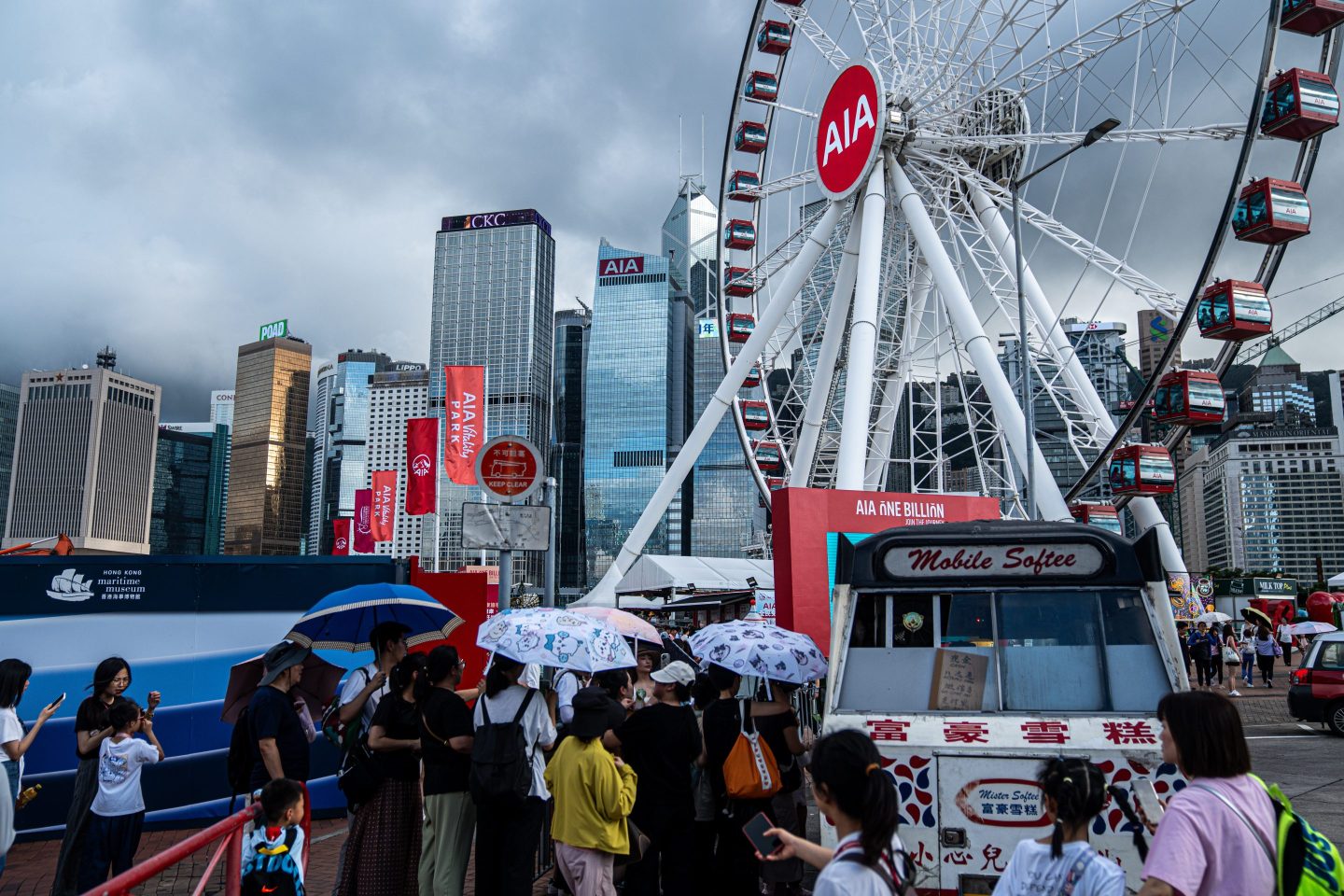
Hong Kong is seeing an influx of professionals from mainland China’s finance and tech sectors who are disillusioned with their career and salary prospects across the border. Many are trying to make a living and stay in the city by peddling insurance products, giving a boost to a once-sleepy industry.
Insurers and agents at AIA Group Ltd., Prudential Plc and other financial firms in Hong Kong are recruiting more Chinese citizens to sell insurance plans to visitors from the mainland. That business, which has drawn regulatory scrutiny in the past, is booming again after slumping during the coronavirus pandemic.
Chinese tourists have collectively poured more than HK$75 billion ($9.6 billion) into insurance policies in Hong Kong since the start of 2023, after authorities lifted strict border controls that were in place for much of the pandemic. That’s in spite of a recent crackdown by the city’s regulators on corrupt practices and unlicensed selling of the products.
Most of the policies bought by tourists are denominated in U.S. dollars or Hong Kong’s currency — which is pegged to the greenback—and have enabled Chinese citizens to move money offshore and park it in long-term investments. The products provide critical illness or term life insurance coverage, and often include savings or investment-like features that enhance their value over time. Buyers see them as a way to safeguard their assets against the weakening yuan and to capture the Asian financial hub’s higher interest rates.
It’s also been a bonanza for insurance agents, who collect large commissions from selling the policies to Chinese tourists. Top performers can earn more than HK$10 million a year—which is well over one million U.S. dollars—plus bonuses, according to several agents who are aware of such cases or seen their firm’s internal rankings of top earners, and who asked not to be named.
Insurers in Hong Kong aren’t allowed to market their products on the mainland, so many agents rely on networks of family, friends and personal contacts to get Chinese citizens to travel to the Asian financial hub to sign paperwork and buy policies. There, customers either open Hong Kong bank accounts and wire money offshore, or use their Visa or Mastercard credit cards to purchase insurance policies. China allows individuals to move up to the equivalent of $50,000 out of the mainland per year.
Talent Visas
Hong Kong loosened its work visa criteria in late 2022, after a wave of emigration threatened to undermine the city’s status as an international financial hub. It started a Top Talent Pass Scheme that would give two-year visas to job seekers from top universities and other qualified individuals, and scrapped the quota limit for its Quality Migrant Admission Scheme, another program that doesn’t require applicants to have jobs lined up beforehand.
About 200,000 people have received Hong Kong work visas since, and the vast majority of the talent pass holders are from mainland China.
At a recent AIA weekly “morning briefing” for insurance agents and others interested in becoming agents, a group of about 40 individuals discussed selling strategies in Mandarin. Many had recently gotten visas under the talent scheme and their ages ranged from the 20s to 50s. The speaker also talked about the benefits of having a Hong Kong passport, which can be gotten after seven years of living in the semi-autonomous Chinese territory. AIA did not respond to requests for comment.
On a sweat-laced afternoon in July, dozens of Chinese citizens were waiting outside a classroom at Hong Kong’s Vocational Training Council tower in Wanchai to take exams required to become an insurance agent. Many were poring over study materials bearing AIA or Prudential logos.
Xiaohui Li, a part-time insurance agent who got her Hong Kong work visa in late 2023, was there accompanying two friends. Li said she has worked for more than a decade at a Chinese internet company in Shenzhen and currently earns more than 1 million yuan ($139,600) annually, but she intends to quit her job to work full-time for Prudential.
She said she thinks it is a good time to move from the fading tech sector to the booming insurance market. “It’s hard to say how many years you can still earn the same fat paycheck from those tech companies after middle age,” said Li, who is in her late 30s, adding that she believes older workers are more likely to get laid off.
Shen, a Hong Kong work visa holder who asked that her first name not be used, had flown in from Beijing to take the exam. She said she is keeping her job in mainland China for now, but wants to work part-time as a Hong Kong insurance agent and earn enough money to renew her visa in the future. That could be an avenue for her children to come to Hong Kong for school later on, she said.
Pay Matters
People who came to Hong Kong under the Top Talent Pass Scheme can apply to extend their visas if they have a job with a remuneration package at “market level,” according to the city’s immigration department. The average base annual salary for Hong Kong insurance agents is HK$473,564 a year, and their average bonus is HK$66,256, according to data from ERI Economic Research Institute.
It hasn’t been a surefire bet for everyone. Sun, a Ph.D. holder who asked to be identified only by her last name, said she received a Hong Kong work visa last year after teaching at international schools in southern China for several years. Shortly after, the agent who helped with her visa application invited her to work for Prudential, and said the income Sun could earn as an insurance agent could help her renew her visa—and eventually become a Hong Kong permanent resident.
Sun said she was told she could get a HK$60,000 sign-on bonus from the insurer if she completed a series of online and in-person trainings, and sold policies with at least HK$90,000 in premiums over six months.
She said she bought a savings and life insurance policy for herself with a $19,300 annual premium— which covered the minimum sales requirement—and collected a HK$45,000 ($5,776) commission from it for the first year. However, she didn’t end up receiving the bonus because she was late for one of the online trainings, and Prudential terminated its agreement to hire her, according to documents reviewed by Bloomberg News.
Sun said that also means she won’t collect future commissions from the policy that she purchased. She has filed grievances against Prudential with Hong Kong’s Insurance Authority, which informed her it has referred it to the company, according to emails reviewed by Bloomberg.
A Prudential spokesperson said it does not comment on individual cases, but that it is important for its financial consultants to complete necessary trainings to comply with regulatory requirements and uphold its professional standards when serving customers.
Hong Kong regulators have become aware that some insurance agents are buying policies for themselves and reporting the commissions as income. When reviewing visa renewal requests, immigration authorities have been asking insurance agents to provide monthly commission statements, and to state how many insurance plans they sold were for individuals other than themselves, according to some agents.
Hong Kong Secretary for Labour and Welfare Chris Sun said in late June that the immigration office will be very strict in vetting applications for extensions of stay from insurance agents.
Newer Entrants
Regulatory scrutiny aside, more companies and agents expect the business of selling insurance products to mainland visitors to keep booming.
HSBC Life, the insurance arm of HSBC Holdings Plc, has also been increasing sales of policies to Chinese tourists via the bank’s branches and other platforms. Chow Tai Fook Life Insurance Co., which recently changed its name from FTLife, said half of the policies it sold last year was to mainlanders, and sales exceeded pre-pandemic levels.
“In the long run, we believe that insurance offerings in Hong Kong will continue to attract customers from Mainland China,” said Man Kit Ip, chief executive officer of CTF Life. He added that his company plans to increase the number of agents by 50% to about 3,000 in the financial year beginning July 1, 2024.
Daniel Niu worked for 17 years in a state-backed securities brokerage in Shenzhen before quitting his sales manager job with an 800,000 yuan annual salary and moving to Hong Kong this year. The 39-year-old is working as an insurance agent while pursuing a part-time master’s degree that will eventually enable him to get a two-year work visa for non-local graduates.
Niu said he wants to eventually become a permanent resident in Hong Kong, and sees the city as a better place to raise his 8-year-old child. He estimates he needs to earn at least HK$70,000 a month to cover his living expenses, which include rent, school fees and groceries. He had an opportunity to join the Hong Kong branch of his previous employer, but said it offered limited salary and growth opportunities.
As an insurance agent, Niu said there is no upper limit to his income. “I just hope that I can have deep pockets,” he said.