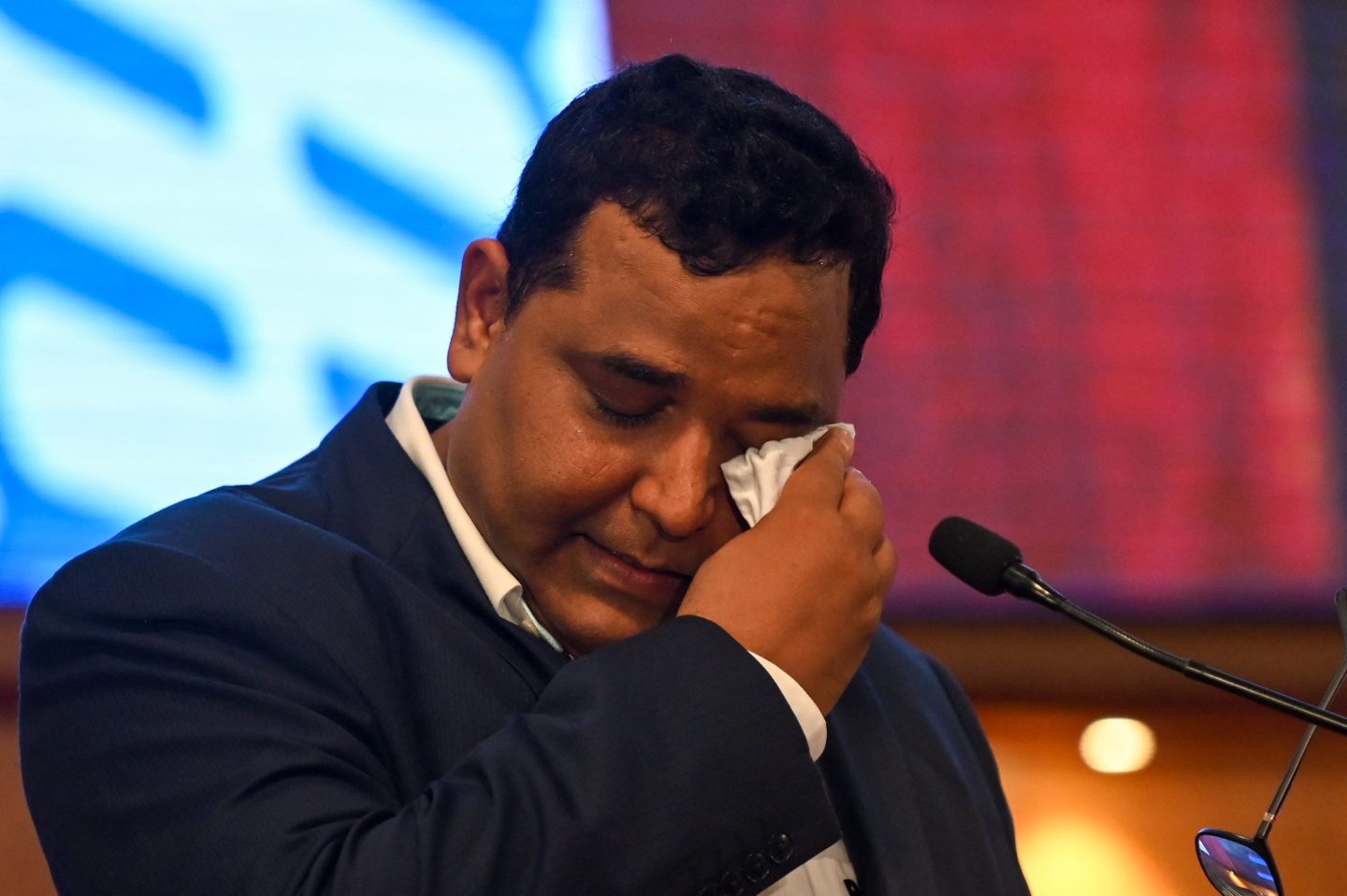
On November 18, 2021, Vijay Shekhar Sharma took to the stage at the Bombay Stock Exchange, wiping away tears as he addressed the crowd. His company, One97 Communications, had just completed India’s largest IPO ever, raising $2.4 billion and vaulting Sharma and his company to Indian tech stardom.
One97 Communications was better known as the parent company of Paytm, a payments service adopted by both Uber and the Indian Railway Service. High-profile investors like Jack Ma’s Alibaba and Ant Group, Masayoshi Son’s Softbank, and Warren Buffett’s Berkshire Hathaway backed the company.
The IPO was the last bit of good news Paytm would have.
The company has yet to make a profit. Shares in One97 are down over 70% since its debut. Softbank, Alibaba, and Berkshire have sold most, if not all, their stakes, whether due to concerns about Chinese presence or the plunge in the stock’s value. Paytm faces fierce competition in the payments space from Google and Walmart-owned Flipkart, and analysts now see the company as a classic case of hype causing an overvalued debut. (Paytm also lost its title of India’s biggest IPO, overtaken by Life Insurance Corporation’s $2.7 billion IPO in May 2022.)
Now, a regulatory crackdown threatens Paytm’s entire business model, barring it from operating its lucrative banking and mobile-wallet services.
For Rajrishi Singhal, former executive editor of the Indian newspaper The Economic Times and author of Slip, Stitch & Stumble: The Untold Story of India’s Financial Sector Reforms, Paytm’s fall comes from a growth-at-all-costs model common to startups.
“Paytm had been pushing the envelope aggressively, and that harks back to its initial formation as a startup where your top line matters more than what you’re delivering in terms of margins or profits,” he says. “Paytm was a little dismissive of the regulatory framework.”
“Compliance has been the cornerstone of our product development initiatives from the very beginning,” Paytm said in a statement to Fortune. “We cannot take products to the market without obtaining the necessary approvals while ensuring every new offering is both innovative and in full compliance with regulatory standards.”
Yet the regulatory crackdown—perhaps motivated by a wish to avoid any risk of a financial crisis before critical national elections in April—puts the future of the once high-flying startup in question, potentially eradicating most of the firm’s pre-tax profits.
What happened to Paytm?
On Jan. 31, the Reserve Bank of India accused Paytm Payments Bank—an affiliated financial institution that holds all the money in Paytm’s digital wallets—of “persistent noncompliance,” and ordered the financial institution to stop accepting new deposits.
Then, on March 1, India’s Financial Intelligence Unit slapped the bank with a $660,000 fine for routing funds towards illegal activities like online gambling.
Paytm moved quickly to cut ties with the payments bank; Sharma resigned as chair of the bank’s board last week. Paytm is now trying to build relationships with third-party banks, like Axis Bank.
The company has affirmed that its payment services will continue past March 15, the RBI’s deadline for Paytm Payments Bank to cease operations.
At a conference in Tokyo on Tuesday, Sharma suggested advisors may have been to blame for Paytm’s struggles. “The biggest thing that I’ve learned is that many times your teammate and adviser may not be getting it correct … It is important for you, yourself to be taking care of it versus just letting a teammate or a adviser suggest that what should it be,” he said, according to Bloomberg.
Without a payments bank, Paytm is restricted to just facilitating transactions—a business that provides “no revenue pathways,” Singhal says.
In a stock filing immediately after the RBI’s order, Paytm warned the order to close Paytm Payments Bank could drag down annual earnings before interest, tax, depreciation and amortization by up to 5 billion Indian rupees, or $60.4 million at current exchange rates. Paytm generated $55 million in EBITDA in the nine months ending December 31, 2023.
But Sharma may have little choice in the matter. “If he wants to keep the Paytm brand alive, he’ll have to survive only as a Unified Payments Interface [India’s nationwide system for instant payments], because he can’t stay as a wallet or as a bank,” Singhal predicts.
Paytm is the latest member of India’s startup royalty to flame out. Edtech firm Byju’s was once India’s most valuable startup, worth $22 billion in late 2022, but the startup is now dealing with accusations of inflated numbers, a toxic work culture, unethical sales practices, and missed debt payments. (The firm denies all claims.) On February 23, Byju’s shareholders voted to oust the CEO, Byju Raveendran. He’s refusing to step down.
Bad timing
Regulators had targeted Paytm and its payments bank before. The payments bank has not been able to sign on new customers since March 2022, and the RBI slapped a $650,000 fine last October for not following know-your-customer requirements. Then in November, officials barred Paytm from signing on new merchants.
The actions against Paytm are part of a broader crackdown on India’s financial industry, particularly on “shadow banks,” or financial institutions that sit outside the traditional financial system.
Indian voters will head to the polls for national elections starting in April. India’s ruling party, the Bharatiya Janata Party, and prime minister Narendra Modi are running on the country’s strong economy. Most analysts expect Modi to win a third term.
And with markets running hot—India’s equity markets recently overtook the Chinese city of Hong Kong’s in terms of total market capitalization—central bankers fear financial firms are setting themselves up for trouble.
“A financial crisis would invariably turn into a political crisis,” Singhal says. “I think [Paytm was] a risk that the political system couldn’t take.”
The situation reminds Singhal of earlier Indian financial scandals, many of which he covered during his career as an Indian business journalist and are featured in his book. For example, in the early 1990s, Harshad Mehta, a trader nicknamed “The Big Bull,” defrauded banks to fund speculative stock market bets. In the heady environment of the time, traders like Mehta “didn’t know when to say no, and withdraw,” Singhal says.
Could today’s bull market in India be sowing the seeds of another scandal?
“The financial sector is not known for its love of history,” Singhal says.