
The story of the global EV boom is really the story of China’s EV boom. The country’s consumers, attracted by government subsidies, are flocking to electric cars made by Tesla and its Chinese competitors. BYD, the EV giant backed by Warren Buffett, is close to overtaking Tesla as the world’s largest seller of battery-powered electric vehicles, almost entirely from local sales. And the flood of cheap EVs has helped China overtake Japan as the world’s largest car exporter.
Even Elon Musk accepts that China is set to dominate the EV market. “There’s a lot of people out there who think that the top 10 car companies are going to be Tesla followed by nine Chinese car companies. I think they might not be wrong,” the Tesla CEO recently said at a New York Times conference. “The Chinese car companies are extremely competitive.”
One reason for that? Speed, as Chinese EV makers pump out new models at a far greater pace than their foreign counterparts.
“For the established, the international [original equipment manufacturers], normally they have six to eight years of lifetime for the product, and three to five years for development,” Zhang Fan, head of design for state-owned carmaker Guangzhou Automobile Group (GAC), said last week at the Fortune Brainstorm Design conference in Macau.
Chinese companies do all that in half the time, he suggested. “With the same amount of time, we’ve been evolving twice while the establishment only [does] once, so that’s why we are growing so fast,” he said.
“In China, everybody’s pushing forward. Everybody’s trying to test the next big thing,” he continued.
Design changes
That speed is also giving Chinese carmakers the opportunity to radically rethink what a car might look like. “UI, UX … those are topics designers in the last generation never needed to worry about,” Zhang said.
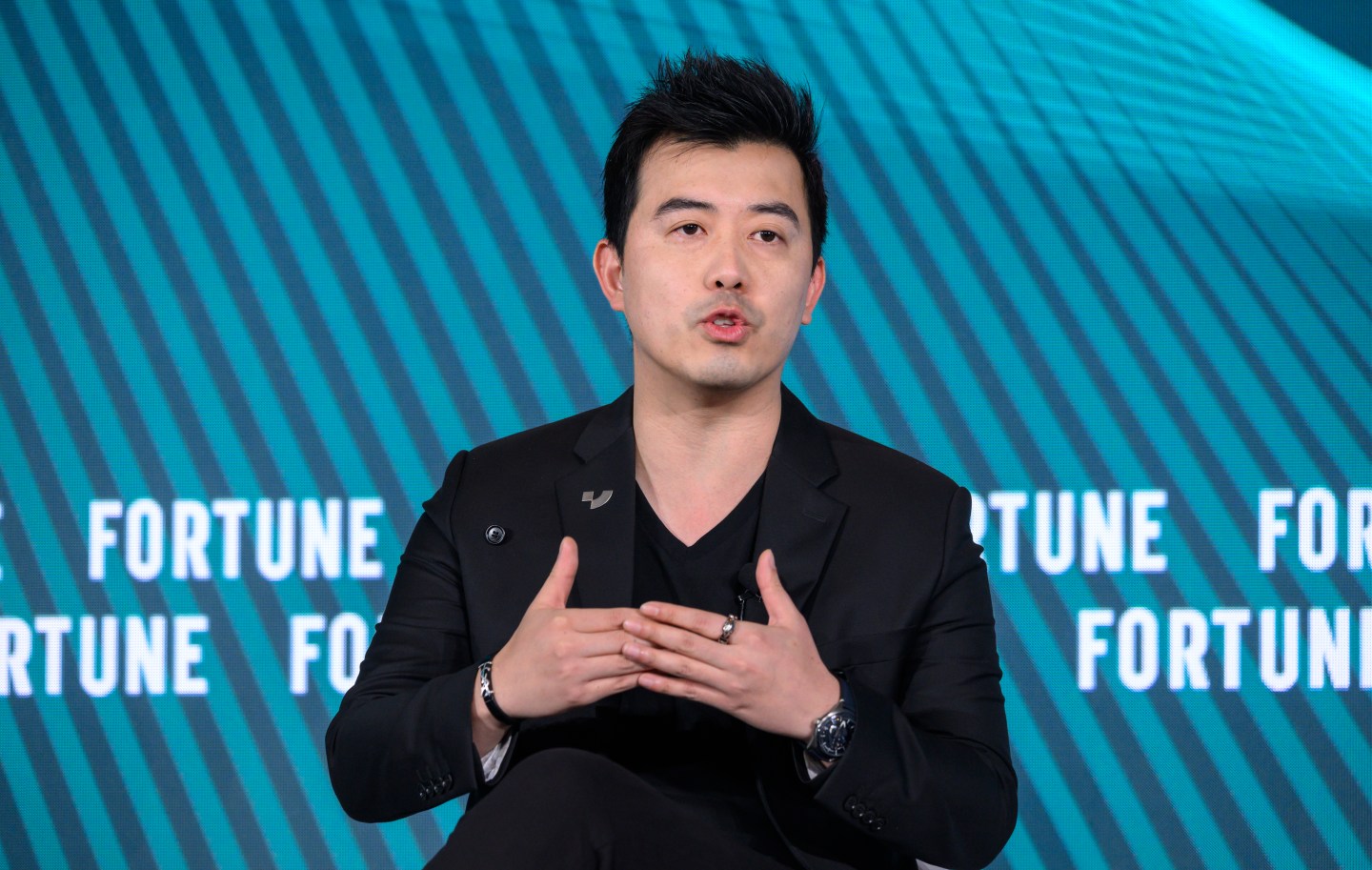
Frank Wu, head of design for automated driving brand Jiyue Auto, said that his team was “able to get rid of probably 90% of our traditional physical buttons” thanks to innovations in voice communication and artificial intelligence, deeming it similar to a “spaceship cabin sort of visual design language.” (Jiyue is an automated driving joint venture, majority-owned by Chinese carmaker Geely with tech giant Baidu as a key partner.)
Long-standing features in gas-powered cars aren’t needed in an electric vehicle. For example, EVs don’t have the same cooling requirements as cars powered by internal combustion engines. That means the front grille, a classic component of petrol cars, is entirely unnecessary.
Some companies are considering designing cars around battery-swapping, allowing EVs to “recharge” quickly by just putting in a new battery, rather than waiting first for space at a charging station, then waiting for the battery to recharge.
But Wu noted that pursuing a battery-swapping model would also force a car’s design to change. Cars that rely on battery-swapping will need thicker designs, he suggested. “That raises the hip point of your passenger seating,” he said, making “the overall package of the car look a little bit taller—or a little bit less sexy—compared to a Porsche type, where the car is very low, very wide, with a beautiful proportion.”
Other car manufacturers are starting to realize the novelty of Chinese EV designs from up-and-coming startups like Nio and Xpeng. “These startups, with no heritage, they can do things completely different,” Porsche chief designer Michael Mauer told Bloomberg in a late October interview. “That makes the decision-makers, i.e. the management board, more open-minded.”
The competition
China’s EV market is mired in fierce competition between legacy carmakers like GAC, buzzy startups like Nio and Xpeng, and EV giants like BYD and Tesla. (Who’s missing? Japanese, U.S., and German carmakers, who were slow to recognize China’s growing appetite for electric cars.) The sector has been locked in a price war as companies seek to capture market share.
Guangzhou Automobile Group is a late entrant to the Chinese EV market, only starting up a division dedicated to EV development in 2017. “We feel we were left behind,” Zhang said. Beijing has been pushing the development of electric vehicles for over a decade, offering billions of dollars in both production and consumption subsidies—which made things politically awkward for GAC.
“We are a state-owned company, and we were not doing so good. So we feel guilty, and therefore we had to do something,” he said.
Wu noted that cars are expensive, more akin to buying a house than a phone. “There’s a lot of things people are emotionally attached to when they see a car.” A car may be cheap and technologically advanced, but “if it doesn’t look good … I don’t think that’s a driving point to somebody buying that product.”
Zhang, on the other hand, observed that most of China’s EV companies were settling on similar designs—like removing the front grille—despite trying to carve a unique identity. “Everybody is trying to [have a] new look, but … this new look looks very similar to each other,” he said.
The GAC executive also admitted that he wasn’t sure that good designs were enough to win in China’s hypercompetitive EV market. “We have to be realistic. Designers don’t make the decision. We are the supporter. We are the advisor. But we are not the decider,” he said.