It is to the taste of Adam Gimbel, President of Saks Fifth Avenue, that he personally should not be one title so well-known as the great store he runs opposite Rockefeller Center. Every style-conscious woman knows about Saks Fifth Avenue. The name has all but become a national adjective standing for a gnawing anxiety of the female world: exclusiveness and that other precarious need called style. But few of the hundreds of thousands who trade there know anything at all about the man who has made Saks Fifth Avenue a sort of super-Macy’s for the well to do. Adam Gimbel is forty-four years old, and handsome in a dark, quiet way. In a business distinguished for its brashness, he is distinguished for his social graces. He plays polo, mingles with the Westchester and Long Island horse-loving sets, and affects to be disdainful of business matters. The impression is heightened by the lighthearted way he runs the store. Adam Gimbel honors merchandising axioms more often in the breach than in the observance. But underneath he is as tough and hardheaded as a steel master. And well he might be. He is feared by the upper-crust couturiers whose shibboleth is the exclusive label. He is hated by the swarming Seventh Avenue crowd, whose driving need is volume. For Mr. Gimbel has somehow joined their two worlds. He has put the luxury trade into mass production. Last year Mr. Gimbel’s fancy stores turned in $20,354,000 worth of sales and made $1,060,000.
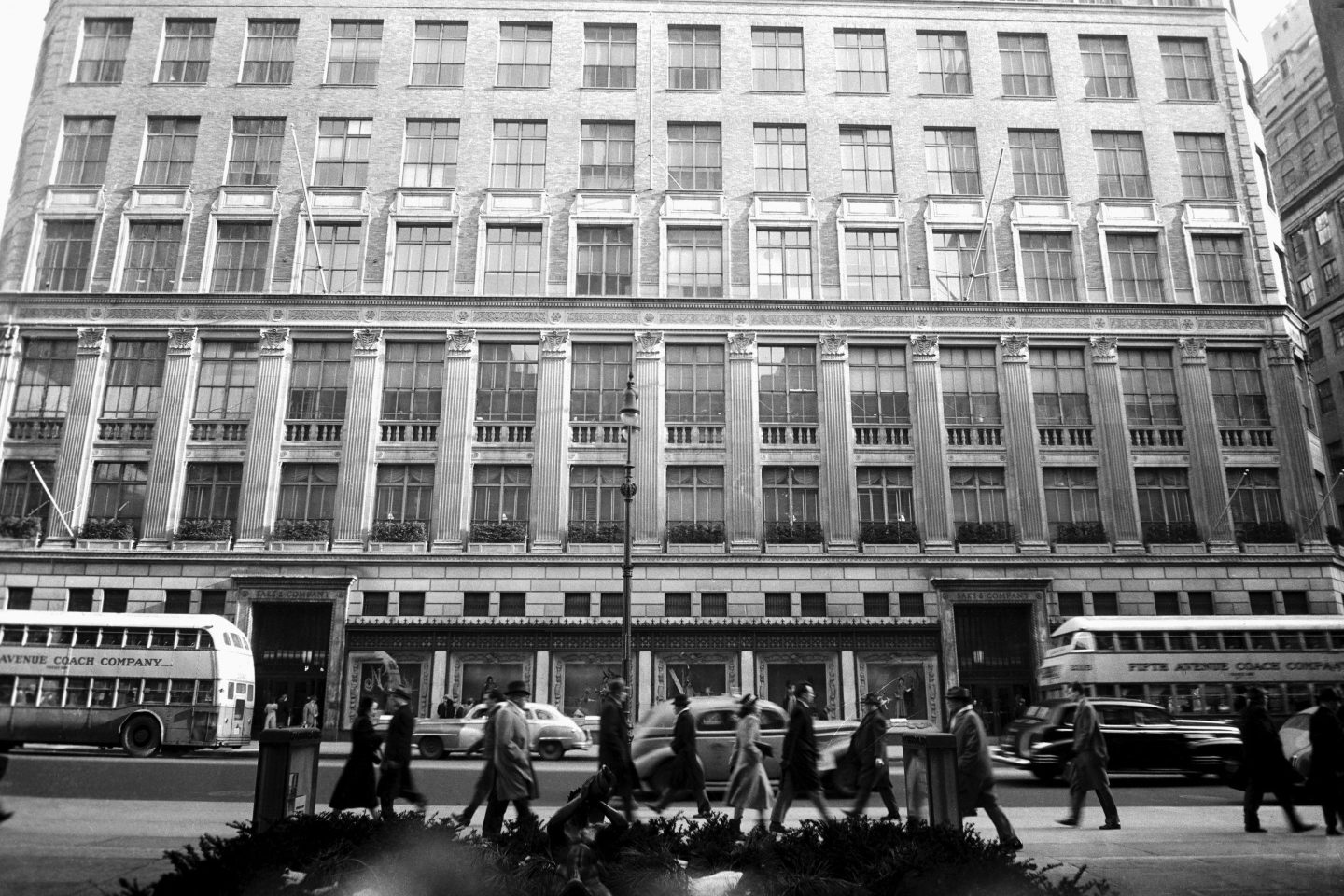
Step through one of the tall, narrow Fifth Avenue doorways into Saks, over a deep cushion of rubber matting, and you step into a pillared world of fashion surrounded by walnut paneling slightly passé. It is a spacious place—high ceilings, wide aisles, glowing cases full of soft, luxurious, mostly feminine things. There is never a clatter and fuss; here the business of buying and selling is as mannerly as it is mannered. No shrill-voiced girls cry, “Cash,” and the saleslady who finds it necessary to raise her voice to attract a floorman does so firmly—but only once. Lights are dim, so dim that if you’re matching colors you have to go to the day-light framed in the tall doors. When Saks has one of its famed accessory sales, the din is the subdued din of people who haven’t learned their manners at the anthill bargain basement tables on Herald Square. And even the alien thousands who crowd into Saks at sale time seem to be awed by it all. After all, it’s pretty hard to muster resolve for a crashing drive toward the counter when you’re confronted by a cool, well-groomed, uppity female who herself is “Very Saks Fifth Avenue” and as snooty as the label on a $395 handbag or a $29,000 sable coat.
Now this high-and-mighty air doesn’t fool or impress anybody familiar with the specialty shop business. They see it for what it is: a smoothly synchronized piece of machinery geared for volume—for volume in luxury trade, of all things. And knowing their luxury trade, they refuse to believe that it will work on such a big scale. But the customer doesn’t know, nor does she care. Whatever it is, she seems to love it. With wide-open eyes she heads for the elevators banked at the far end of the floor. On the way she will have passed a maximum of enticing counters. Meanwhile she will have been sprayed with all of the subtleties at Saks’s command. That hypnotism is not based merely upon crafty highlighting and the glossy radiance of fine merchandise on the first floor. Behind the spell-weaving is an average inventory of $7,600,000 (at retail), the biggest heap of its kind under any U.S. merchant’s roof. The customer who can escape from this seductive ambush without adding an unplanned $40 or $50 to her bill is a resolute woman.
The customer for whom Saks stocks this heap of luxuries is a composite of many women. She is the smart young woman with a lot of money, she is the matron with sophisticated tastes, she is the rising actress or movie star, she is the debutante and her eager mother, and she is occasionally that dashing, slightly overdressed young woman who is well kept. But in her most myriad aspects she is the wife of a hard-working anonymous executive in a substantial business. She lives in Kew Gardens or Salt Lake City, and her days are a calm pattern of domestic mornings, luncheons at some midtown restaurant, afternoons of bridge, matinees, shopping—especially shopping. She is neither wealthy enough nor patient nor experienced enough to patronize Saks’s Salon Moderne, whose couturier dresses, setting Saks’s high fashion, start at $145 and average $195. The department stores are apt to be too rushed and bewildering for her uncertain style sense. For her, then, Saks smooths all things, brings her dresses as near custom-made as ready-made dresses can be, and brings them at a price she can pay but in exclusive brackets she can trust. She is the woman of wealthy suburbia. She is Saks’s mass consumer.
Indeed, Saks Fifth Avenue may almost be said to have discovered her fourteen years ago, vaguely dissatisfied with the way she looked and ready to pay well for better craftsmanship and daring fashion. Since then, her image might have been shaped from the rib of the Gimbel’s Adam. To her, in an ordinary year, Saks has sold twelve dozen exclusive beaded handbags at $95 apiece, 1,500 hand-knit sweaters of a special Scotch yarn exclusive with Saks at $29.50, some 1,400 Scotch cashmere sweaters and matching tweed skirts at $41, nearly 200,000 pairs of shoes mostly in the $16.75 to $18.50 range, some 40,000 pairs of French ingrain hosiery at $2.35 to $7.50 a pair, 705 French blouses from $22.50 to $49.50, 25,000 belts ranging up to $38.50. And you could go on and on like that.
In discovering and exploiting the woman of wealthy suburbia Saks has opened a field where elegance moves over the counter in amazing volume. Almost half of the New York store’s 150,000 active accounts have addresses outside the New York area, probably the eye opener that caused Gimbel’s to launch a national string of Saks Fifth Avenue shops. Biggest of these branches is in Chicago; newest is in Beverly Hills, California. There is also a small permanent Saks shop in Greenwich, Connecticut. And there are minuscule shops at Palm Beach, Miami Beach, Sun Valley, Newport, Southampton and Westbury, Long Island, which are barely more than handy summer or winter counters for migratory Saks customers. These last are mere chicken feed in Saks’s total business and they lose money. All the branches together contribute barely 20 per cent of the parent store’s gross.
Where no love’s lost
Now it would be a mistake to assume from this that a typical Saks customer is so wedded to Saks Fifth Avenue that Saks has been obliged to move into the hinterland to meet her. Take the out-of-towner who comes to New York once or twice a year to see the town and buy some good clothes. Chances are she heads for Saks; but back home she divides her patronage among such famous stores as Martha Weathered, Blum’s, and Marshall Field in Chicago; Bullock’s-Wilshire and I. Magnin in Los Angeles. All these stores are popping mad at the Saks invasion.
As for the home grounds in New York, Saks, the vendor of what it calls “exclusivity,” has no exclusive niche to itself. It competes up and down the whole retail length of Fifth Avenue; also with the myriad smart “little shops” that rise and die and rise again on the uptown side streets; also with its sister Saks at 34th Street; also with Macy’s and many another. And this being so, it amuses Adam Gimbel when somebody accuses his store of monopolizing the luxury business; he simply waves his hands feebly to take in all New York, as much as to say: if that’s monopoly, make the most of it.
And yet it is also true that no single store in all New York is a direct competitor in the sense that it meets Saks floor for floor and line for line. Bergdorf Goodman’s exclusive departments—and they are all very exclusive—smash hard and straight against Saks costly swank in the Salon Moderne and the custom-end of all other departments, (excepting, of course, men’s wear). Bonwit Teller, which was flat on its back in 1933 with practically no business at all, is now hammering away at Saks in the lower-price ranges as well as in some of the high-priced stuff. Best & Co. does a whale of a job with the very young, both rich and not-so-rich; every time Russeks or even I. J. Fox sells a fur coat for $500 to $1,000, it is money out of Saks Fifth Avenue’s pocket. A composite of Saks might best be adduced by lumping Bergdorf and Bonwit together in more space than they now have collectively. Even that would be only an approximation. You wouldn’t have the men’s departments nor the Saks workrooms, which, as will be described presently, are at once the hidden leverage of its success and the thing that distinguishes the store from all other specialty shops.
Adam Gimbel concedes that Saks “may be unorthodox.” The trade scratches its collective head and scratches its neck and says that the whole damn show, Mr. Gimbel included, is screwy. Saks starts with that extraordinary inventory and peters out into one of the most sluggish turnovers in the business—2.85 stock turns last year against a trade average of 5 per cent.* Last year its average transaction was $12, against a trade average of $5.16; it was once an incredible $19 in 1929. Saks spends only 3 per cent of net sales for all advertising and promotion whereas the trade averages 5.9 per cent. What it all adds up to is a merchandising technique that is almost as exclusively Saks Fifth Avenue as the label on a piece of froufrou. By means of this contrariness, and by no method that can be explained in a breath, Saks snatches a handsome profit. So far as fitting Saks into the scheme of things is concerned, the best one can do is to say that it is something special in specialty shops, and pass on to an examination of how it gets that way.
On this floor…
The difference between a specialty shop and a department store, in the trade’s cynical phrase, is that the former has carpets on the floor. Saks has plenty of carpets, nondescript gray and slightly bilious green ones; they cover most of the 251,000 square feet of selling floors out of a total of 478,000 square feet in a $4,000,000 building. Almost half of what goes on at Saks goes on behind the scenes, in the uncarpeted, undecorated, private recesses where Saks works in shirt sleeves. You start at the bottom of this hidden world in a subcellar where the heating and circulatory plant is housed, and where Saks’s operating economy begins with an automatic bundler for wastepaper and bins for old electric-light bulbs, which Japan buys. And you work up to the cellar, which contains iron-caged stock rooms for individual departments, efficient package rooms, twisting chutes for sorting delivery, and an almost empty room with writhing organ-pipe pneumatic tubes for cash sales.
Above these subterranean regions is the main floor where the handbags, the piles of “junk” jewelry, the cosmetics, neckwear, hosiery, men’s furnishings, gloves, and veils draw you into the Saks whirl. Air conditioning has made no way as yet in Saks and the aged elevators crawl, but nobody seems to mind. “Second floor,” intones the elevator boy, “infants’ and children’s wear, baby carriages, nursery furniture, and toys.” The second floor is equipped to deal with you from birth (layettes) to age sixteen—the awkward age. On the third: Antoine de Paris beauty salon, run by the strictly non-French entrepreneurs—Seligman & Latz. Plus the Salon Moderne (custom dresses and French originals), expensive hats, and sportswear. And also a chiropodist. The fourth: shoes and underthings, maids’ uniforms. The fifth: blouses, women’s and misses’ dresses, suits, coats, furs, the bridal salon, and the maternity department. Sixth: men’s clothing, luggage, skis, riding habits, and automobile robes. The seventh: the Debutante Shop (“Seventh Heaven” to the copywriters), which represents one of Adam Gimbel’s rare concessions to price. The eighth floor is given over to executive offices and the employment bureau.
Beyond that you cannot go without a pass. The last two floors are occupied by the sprawling workrooms and more stock rooms, reached by service elevators. It all looks neat on the store directory, but the listing does not take into account one of the most important facts about Saks—its passion for decentralization. For example, bags and hats are stocked and sold on three floors.
On a dead man’s chest
Somewhere in almost every U.S. department store hangs a big, badly painted portrait in oils of the bewhiskered founder, reverently lighted from above. Even Saks Fifth Avenue has its oil portraits, though not quite so brashly painted or conspicuously hung. And one that is especially noteworthy confronts you outside a Vice President’s office; it shows a man with a shock of white hair, a handle-bar mustache, and a rubicund, quizzical face tilting boldly from an old-fashioned wing collar and Ascot tie.
This, testifies the brass name plate, is Andrew Saks. At the age of fourteen, Andrew quit his Lock Haven, Pennsylvania, home and went to Washington to become a newsboy. Later, taking to peddling, he put one penny against the other to such effect that he soon owned a string of small men’s clothing stores in Washington, Richmond, and Indianapolis. In 1892, Andrew bundled up his clan and came to New York. He jumped from retailing to manufacturing and back to retailing again. Two cronies from Siegel, Cooper on Sixth Avenue persuaded him to try his hand at a specialty shop. The three of them made history in 1902 by opening a store on Herald Square, an eyelash ahead of R. H. Macy, the first big merchants foolhardy enough to migrate as far “uptown” as Thirty-fourth Street.
Few Saks customers ever enter
… this world of padded dressmaking forms, bolts and heaps of fine fabrics, busy tailors, temperamental designers. Opposite are the Saks workrooms, which occupy the ninth and tenth floors. In them are created all of the Salon Moderne gowns, 25 per cent of the $750,000 worth of “Saks Original” ready-to-wear dresses, 85 per cent of the fur coats. Here too are six ice-cold fur vaults (center right) storing 20,000 coats on tiered platforms. And here, where middleman profits are eliminated and Saks inventiveness and “exclusivity” find full scope, is the basic and unique secret of the Saks technique.
Now the portrait of Andrew Saks gazes cater-cornered at another portrait in oils—a younger head, pinkly clean-shaven and nearly bald, with sharp, heavy-lidded eyes that make you think of a Byzantine merchant prince. This is Horace Andrew Saks (1882–1925), youngest of Andrew’s sons and the most famous of all the Sakses. Horace, twenty, was in his first year at Princeton when Saks & Co. opened on Herald Square. He quit school and went into the store, and when Andrew died ten years later Horace had already displayed an unmistakable genius for merchandising. Under his hand Saks & Co. grew solidly and conservatively. Plain, old-fashioned counters and tables lined the main floor, but its “apparel and specialty” line drew a steady following from the carriage trade. Horace had a flair for fancy merchandise; he made it a Saks & Co. trademark. The story goes that he bought recklessly with no thought of the price he would have to charge to make a profit. In any case, the profits took care of themselves. By 1922 Saks & Co.’s net sales had climbed from $5,192,000 in 1912 to $15,300,000, and it was making a fantastic 8 per cent net profit and doing more business in less space (approximately $75 per square foot in 200,000 square feet of floor space) than any other store in the entire U.S.
By then Macy’s, under old Isidor Straus, was hitting a terrific volume. The Gimbel clan had moved in from the Middle West by way of Philadelphia and had a big store a block to the south. The Strauses and the Gimbels growled at each other, but Horace Saks and Bernard F. Gimbel were fast friends. They toured Europe together, took summer homes near each other in Elberon, New Jersey, and played golf and commuted together.
For a long time Horace Saks had been longing to move uptown. He even had his eyes on the piece of property—a plot on Fifth Avenue, between Forty-ninth and Fiftieth streets, occupied jointly by the old Buckingham Hotel and the Democratic Club. But the Saks family had no desire to quit the security of Herald Square for the prairie north of Forty-second Street, where no big retail store had yet ventured. Then in 1922, when the Thirty-fourth Street lease still had two years to run, the landlord announced the rent would be doubled. That was enough for Horace. As head of the clan, he ruled that Saks would move anyway: he would build on Fifth Avenue and kill the Thirty-fourth Street store forever.
Now the Democratic Club was planted squarely in the center of the Fifth Avenue property, and Horace found that he couldn’t coax it out for less than $1,200,000. This was more than he felt he could afford, but in making a deal with the wealthy Kemp family, which owned the Buckingham Hotel property, he worked out a scheme for building around the Democrats. Saks & Co. floated a $3,500,000 bond issue to finance construction. Meanwhile, Bernie Gimbel watched these goings-on with friendly interest. His friend Murry Guggenheim one day asked him quizzically: “Bernie, why are you letting Horace go ahead with his plan for killing off the Thirty-fourth Street store? Its stock in trade is much too valuable to be dropped like that.”
Perceiving the sense in this, Bernie went to Horace and persuaded him to lease the store to the Gimbels. And not long afterwards, while the two of them were sitting on a coffin in the baggage car of a Jersey Central commuters’ train, he proposed a momentous deal: that Saks & Co. merge with Gimbel Bros. Among other advantages, Bernie depicted how, with the Gimbel treasure, they could buy out the Democratic Club and build a nice square building instead of the lopsided one Horace had under way. Although Horace was willing, the rest of the Gimbel family proved almost as obstinate about moving as the Saks clan had been in the beginning; eventually, however, Bernie talked them around. With that, Gimbel Bros. absorbed Saks and became the biggest single department-store organization of that time, with four big stores having combined net sales of nearly $100,000,000 a year.
Saks Fifth Avenue became the jealous charge of Horace Saks. He had made an auspicious start when he signed the 105-year ground lease with the Kemps. For its acre of land Saks stood committed to pay an annual ground rent of $300,000, which was reasonable for the period. Being mindful, however, of what his previous landlord had done. Horace managed to rivet a clause protecting the store from any further rent increases for forty-two years; thereafter any boosts were to be spaced over twenty-one-year intervals, with a top of $50,000 for each of the three such periods remaining.
The ceiling that Horace Saks thus put over future Saks Fifth Avenue rentals in 1922 must have looked wonderful to the Gimbels by 1928. Since then, however, New York real estate has sickened; and, in fact, Saks was able to dicker a temporary reduction on its ground rent during the depression. Although comparisons are difficult, it looks now as if the rent were again about right. The effect of Rockefeller Center upon the property and upon Saks’s kind of business is even more difficult to judge, and there is endless argument about it inside the store. Adam Gimbel claims that the new swarms of visitors are more apt to wear out his floors and push and shove his regular customers than buy his goods.
The store that Horace Saks had in mind was one like the Thirty-fourth Street store, but on a loftier scale. He envisaged it as an interlocking group of specialty shops, under one roof, which would let loose a broadside of competition against the small shops dotting the Avenue. That was the only business that ever interested Horace. He was already rated one of the greatest “fancy-goods” men in the trade. His scouts combed the foreign markets, and Horace himself, on his trips abroad, kept his eyes open. If he saw an unusual pin or diamond pendant, he wangled until he got the loan of it; after having a cheap copy made, he would add a fine box and sell it by the dozen in New York. He created the U.S. costume-jewelry business almost single-handed.
Saks Fifth Avenue opened its doors in 1924. And though the trade had prophesied that it would starve in the wastes north of Forty-second Street, a formidable company was already there, including Bergdorf Goodman, L. P. Hollander, and De Pinna. A year later Horace had a carbuncle on his cheek lanced and died of septic poisoning at forty-three. His son John is learning the business at Saks at 34th Street, but a Gimbel runs Saks Fifth Avenue.
The world that is Adam’s
Adam Long Gimbel has been in and out of the Gimbel tradition. The Sakses go to Princeton, the Strauses to Harvard, and the Gimbels have a preference for Yale. Unlike the other Gimbels of Yale, however. Adam went to the Architectural School. The War whisked him out of architecture, and when peace came he lapsed into the Gimbel tradition of storekeeping. He opened Gimbel’s offices in the Orient and then returned to the Philadelphia store. From there in 1924, aged thirty, he was moved to New York as assistant to Horace Saks at Saks Fifth Avenue. He fitted the new store like a custom-made glove, and after Horace died he swiftly fitted the store to himself.
Adam had ideas. He was acutely conscious of something that Horace had failed to see, and that was that Fifth Avenue was a world removed from the bargain-basement atmosphere of Herald Square. Adam made his debut in the midst of the easy-money days of the twenties. A new society was rising on Park and Fifth avenues—a society made up of women who were willing to pay well for things a cut or two above the ordinary. To attract them, Adam remade Saks. He ripped out the old-fashioned counters on the main floor. From the Paris Exposition Adam himself brought back in 1925 the concept of the new modernistic décor for windows and interior, which was to be a Saks trademark for a decade. (He is dropping it now for “cool classicism.”) Like Horace, Adam had a taste for “fancy goods,” and he bought with a lavish hand, loading his store with merchandise that was as costly as it was exciting. Much of it had formerly been available only in Europe. Adam steadily traded up, and as he did the character of Saks itself changed, and with it the clientele. All this took millions, but Adam, backed by the Gimbel’s multimillions, was able to give away his shirt—for a reputation. Saks became known as the place to go for exclusive things.
As a merchant Adam Gimbel is a queer mixture of hard sense and volatile enthusiasms; he is quick to play hunches and take long gambles. The trade calls him flighty. Even Adam admits that if Saks has one weakness, it is the tendency to become bored too easily with its own ideas. But the ideas come thick and fast. When a buyer proposed the goofy idea of starting a bar shop before repeal. Adam O.K.’d it on the spot. He induced Antoine, the perfumed Parisian coiffeur, to open a salon in Saks Fifth Avenue in 1927. When he built the new store at Beverly Hills, he installed the beauty salon on the roof—”the Hollywood touch,” according to Adam.
On account of the quick way he picks up and discards ideas, Adam also has a reputation in the trade for being a poor businessman; but that’s because the trade has never had an opportunity to judge the number of profit dollars that Adam’s flightiness adds up to. Because Saks figures have always been hidden in the Gimbel totals, it is impossible to say just how long it took Adam to shake off the losses from his early promotion. The trade has had its guesses, and a part of it remains convinced that Saks is still losing money. But the figures revealed here for the first time, which give a representative cross section of Saks & Co.’s earning record for all Saks Fifth Avenue stores, prove definitely that Saks has been making money for a long time.
After a peak of $27,415,000 in 1929, Saks rode the depression fairly smoothly, losing only $595,000 on sales of $13,788,000 in 1932. The next year Saks made $211,000 on $14,108,000 sales after whacking hell out of expenses. In 1936 its net sales swelled to $20,000,000 and its profit to $1,380,000. This was equal to 6.9 per cent of net sales—the biggest ratio in its history. Last year, squeezed by the recession and big inventories, Saks earned $1,060,000 on $20,354,000, or 5.2 per cent—a drop, to be sure, but still phenomenal against the National Retail Dry Goods Association’s average of 2.1 per cent. Saks’s expense ratio went from 35.8 per cent in 1932 to 28.8 per cent in 1937—nearly eight points under the N.R.D.G.A. typical figure. Last year, to give you an idea of how they do things at Saks, sales per employee were about $12,700, as compared to $7,591 for the trade; and sales per square foot of selling space in the big store were $65 against $46 for the trade.
In other words, Saks Fifth Avenue sells the biggest volume of high-grade specialty goods in the U.S. and cleans up doing it.
Now, the glossiness of Saks’s figures might easily be suspect. The Saks customer, walking into the store and observing an evening bag at $295, or lace handkerchiefs at $85 apiece, might wonder. For offhand it looks as if this might be a high markup racket. But whoever thinks Saks is exorbitant is right only to the extent that the bulk of Saks’s merchandise is priced higher than he can afford. In 1937 the average gross markup (before all discounts and markdowns) was 38.5 per cent, and the average after all markdowns was 31 per cent—both of which are low for the trade. Thus Saks’s profits cannot be explained by high markups, or markons, or small markdowns. To see where the profits really come from it is necessary to trace a complex hookup between the reasonable markups, administrative efficiency, and Saks’s unorthodox practices in merchandising.
All this is tied up with Adam Gimbel, whose business technique is colored somewhat by his artist’s instincts. The Saks executive staff can be reviewed in a swift glance. It is one of the simplest, most unusual arrangements in U.S. department storedom. Saks does not have a single merchandising manager—that is the first upside-down fact in its economic structure. The management divides simply into the exceedingly small executive staff and the department buyers.
Next to President Gimbel are Vice President Frederic A. Gimbel and Vice President Mary Lewis, who is new to Saks and a blonde. Tall, sleepy-looking Fred Gimbel, the bachelor brother of Bernard Gimbel and a Director of Gimbel Bros., Inc., attends to Saks & Co.’s finances and all the store services that do not impinge on merchandising. Fred is proud that Saks does an 85 per cent credit business, and prouder still that its loss on bad debts is an infinitesimal nine one-hundredths of 1 per cent of net sales. But Saks isn’t very much interested in you unless you have an established income of $3,000 or so a year, plus good banking connections.
The crucial job in the store—as in all stores of its kind—is promotion. For the past four years it has been held by the colorful and voluble Ira A. Hirschmann, music lover and friend of Mayor La Guardia. Mr. Hirschmann has recently resigned, but during his tenure of office his mind bubbled with Saks ideas, tuned to the roar of volume. It was Hirschmann who thought up the Saks ski slide; it was Hirschmann who slugged Saks ads “Very Saks Fifth Avenue,” an inspired notion that unfortunately back-fired because the salespeople turned up their noses three inches higher and made the customers mad; it was Hirschmann who discovered the Valkyrie square-fingered glove and made a sensation of it—and it was Hirschmann’s idea to pound for free publicity, because Saks spends only 3 per cent of its gross on all forms of advertising. His place is now being taken by fluffy blonde-haired Mary Lewis, formerly Vice President of Best & Co., whose mind is also tuned to volume, though in a different way. Adam Gimbel’s acquisition of Miss Lewis definitely suggests that the master of Saks is thinking more and more of the “woman’s angle.” Maybe Saks won’t go in for the Bonwit-loves-you type of promotion, which has made that store famous or infamous according to your ideas of love, but you can be sure that Mary Lewis won’t spend so much of her time batting out copy for Saks as she did for Best’s.
Saks’s new promotion manager started at Best’s nineteen years ago, after a lucky career at Macy’s, where she jumped from selling in the upholstery department to copywriting. She announces frankly that she doesn’t like criticism, and she hasn’t had much of it. In the Saks picture she’s an unknown quantity, but if she gets what she wants—volume in the moderate-priced departments—it is possible that the big Fifth Avenue specialty shop will ride back to its great 1929 gross. If it does, Mary may earn a great deal more than the $50,000 she expects on the salary-bonus arrangement she wangled from Adam. Anyhow, it now appears that Adam Gimbel is trying to ride two horses: luxury business and style in low-priced volume. Adam can probably do it if anyone can. For he’s a horseman.
Pins and needles
A venerable retailing axiom reads: “Don’t manufacture anything that you can buy, for what you buy and pay for is a known quantity in cost accounting.” The pieces of that axiom lie broken and scattered all over the floor of Adam Gimbel’s office. In 1929 when manufacturers were swamped with orders and unwilling to confine their lines to any one store, he decided that the only way he could assure Saks a steady supply of strictly exclusive merchandise was to have Saks make it. From the very beginning Adam had perceived that for Saks to be successful it must first of all be exclusive. And there was only one way to be sure of that: to create workrooms.
In the workrooms Adam Gimbel developed more than just exclusiveness, a sure-fire label, and a leverage for promotion; he also developed volume. Not volume in the sense of New York’s Seventh Avenue, but volume of a size that the luxury trade had never even dreamed of. Operating its own workrooms, Saks was able to skip part of the middleman’s profits and manufacture merchandise for retail within price ranges that would bring volume. This is the core of the Saks formula: elegance in volume at a price. It is the basis for its merchandising heresy and the source of its redemption. There is nothing like it among the big specialty shops in the nation—at least on the Saks scale.
Today the Saks workrooms ramble over the Fifth Avenue store’s ninth and tenth floors. They hum with the sound of sewing machines; they are bursting with girls stitching diligently over long tables spread with rippling, exotic fabrics, with whacky designers, grave-faced fitters, blinking tailors, and mannequins lolling about waiting for fittings. At peak periods the workrooms employ about a thousand skilled workers either in or outside of the building, and this is more than twice the number of salespeople ever seen by a Saks customer on the selling floors. The fur workroom styles 85 per cent of all Saks furs, and the big needlework rooms supply all of the Salon Moderne gowns and about 25 per cent of all Saks’s ready-to-wear dresses, suits, and sportswear.
Head of the workrooms is a Hungarian named Joseph T. Cukor. Joe is the cousin of George Cukor, the movie director. He is a ruddy-cheeked little man with a bantam walk and a waxed mustache, who calls everybody “darling.” He used to be a railroad and bridge engineer in Hungary. After drifting to the U.S., he toyed with art and fashion designing and finally migrated into the needlework trade. Joe Cukor still can’t thread a needle, but he has a feeling for dressmaking and an unholy skill for handling dressmakers. Originally in charge of the Saks alteration workroom, he branched out into dressmaking for the Salon Moderne. His department has been branching out ever since.
The domain over which Mr. Cukor presides is a jungle of dressmaker’s forms. He employs an average of 520 workers, a League of Nations in themselves. Cukor buys fabrics—silks, brocades, velvets, woolens—in exclusive patterns from such international names as Bianchini, Ducharne, Coudurier, Remond-Holland, Linton, Rodier, and Lesur. At the peak his inventories amount to $200,000, 95 per cent of it imported. Saks once tried to install a stock-control system for this temperamental dressmaking business, but it became so snarled that it was thrown out. The needlework rooms produce about 6,000 garments a year.
The basis of Saks’s style is the very expensive Salon Moderne, which has its own workroom. The basis of volume is the section turning out clothes for the ready-to-wear departments. And the brain behind both is Mrs. Adam Gimbel, who designs for Salon Moderne customers some seventy-five original gowns and sports dresses for the fall and spring seasons; these are known to the trade as “Sophie Cimbel’s.” With Emmett Joyce, a former Hattie Carnegie designer, Sophie also works up the whole line of ready-to-wear “Saks Originals,” which sell on the fifth floor from $65 up. Twice a year Mrs. Gimbel goes to Europe and returns with 100 to 110 French original gowns and dresses, bolts of fabric, special belts, flowers, and trimmings. At the end of the season the originals, which are not sold because of customs restrictions, are usually shipped to Australia because the seasons down under are exactly opposite, and the dresses bring good prices. Tall, titian-haired Sophie Gimbel is as smart as a button in her business; she turned in a whacking $583,000 last year—so good that for the trade it’s a believe-it-or-not figure.
In slack periods between the fall and spring seasons Joe Cukor fills in for the other departments and plays around with ready-to-wear originals. The result is an economical and practically continuous operation, which keeps the employees busy forty-six weeks out of the year. Thus Saks achieves at least a measure of the economics of volume production, enough to be able to sell exclusive models for not more, and often less, than the retail price of the non-exclusive Seventh Avenue brand. Consider a Saks hand-knit sports dress, for instance. Saks imports the full output of a special Scotch yarn, farms it out to be hand-knit by Italian home craftsmen, and then, in the slack periods, has its workrooms assemble and shape the dresses. The result is a dress that Saks can sell for $75. Another store, if it could get the dress, would have to price it at $110 or so to show a profit. Saks’s workrooms maintain a payroll, exclusive of designers and executives, of $700,000 a year, the biggest item in its costs. In common with a good many other stores on the Avenue, Saks is nonunion.
The clothing trade looks sourly upon the workrooms and resents Saks in the role of manufacturer. Furthermore, Seventh Avenue, quick in its anger, screams at Saks’s tough policy of dealing with a small number of manufacturers and shifting them like chessmen. Indeed, Adam Gimbel has remarked on occasion that a list of Saks manufacturers would be meaningless, because they change so often. If a manufacturer gets a Saks account, he knows that it will keep his plant humming, but he also knows that at the slightest dissatisfaction Saks will pull it away. Meanwhile the manufacturer will have lost his previous customers and may have a hard time recapturing them. To all that Saks’s answer is simple. It is running a business for Saks Fifth Avenue and not for Seventh Avenue.
The buyer is tough
Between the light Saks executive staff at the top and the workrooms that form a broad base for the whole Saks technique stands the buyer. In the conventional department store world the buyer is a harried, hard-shelled executive whose functions mesh into an intricate merchandising manager system that pounds him for turnover, and manipulates his stock with a heavy hand. But Saks has no merchandising managers. Instead, the buyer himself works closely with the workroom and the manufacturer, and this involves feeding a steady stream of ideas to both of them, choosing fabrics and primary materials, and, indeed, overseeing the whole manufacturing process. Saks is therefore a “buyer’s store” in the old-fashioned sense. And the buyer, as in all retail dress business, is the power plant in the selling machine.
From that machine Adam Gimbel demands two things: one, volume; two, ideas. A Saks buyer can earn $25,000 a year and live on Park Avenue by producing those results. But he must produce if he expects to work for Adam, who will make or break him on his style instinct. In the department buyers’ realm Saks Fifth Avenue takes its gloves off; its buyers are as tough and realistic as the type comes, which is saying a good deal.
Among them, for example, is V. J. Roy, who buys dresses for the fifth floor. Roy is a short, dapper, intense young man, who was born in Mishawaka, Indiana, and is proud of it. His real enthusiasm is for what he calls the “plain, well-to-do Mrs. ‘Kew Gardens,’ ” rather than for the cuties who order carloads of dresses on approval and are slow to pay. The dresses on which Roy usually trains his sights are those that can be worn by nine women out of ten—fashionable dresses, with a touch of glamour, but not looking as if they had burst from Vogue or Harper’s Bazaar, where dresses are naturally picked first of all for pictorial effects. Besides the Saks Originals, Roy handles dresses from such wearable houses as Maurice Rentner; Louise Barnes Gallagher, who made sports dresses smart to wear in town; and Germaine Monteil, a pert little designer who puts out one of the big “name” lines in New York. Saks carries her complete collection. The very high-style stuff Mr. Roy leaves to the Salon Moderne, though he does sometimes carry a few just as showpieces. His department does about $1,000,000 a year in dresses alone and another $500,000 in suits; 60 per cent of the dress business is in items that sell for over $50.
Like all Saks buyers, Roy works with an elastic budget. The comptroller tells him what he can spend and raises a red flag when he begins to run short. But even if he uses up his budget Roy can still get more money for a “buy” that looks like a scoop. The Gimbels are plungers and will gamble on big orders that would freeze most merchandising spines. Roy bought eighty of a recent style at a crack, and doesn’t know yet whether it will be a sensation or a dud. Not even flossy Saks can call all the styles. Last year Saks gambled on a big collection of Piguet wool-lace dresses that dropped dead on the sales floor. But the fact that Saks had spotlighted them in the windows and in a big ad aroused so much interest in the trade outside New York that orders poured in to the manufacturer, who cheerfully took all the Saks dresses back and peddled them in the hinterland.
Then there is Manuel Gerton of the shoe department, whose $3,162,000 gross last year is Saks’s biggest eye opener in volume. The price range in Buyer Gerton’s ready-made division is from $8.75 to $35. In the Padova custom shop, shoes start at $40 and have sold as high as $500 jeweled. Its chief designer is the famed André Perugia of Paris, whose designs are so exclusive to Saks that Perugia himself cannot sell them in Paris until three months after the originals have been shown in New York. Saks’s ready-to-wear shoes are made in half a dozen New York manufacturing plants whose output is about 60 per cent dominated by Saks. Briefly, this adds up to the biggest fine-shoe business in the world. The average Saks shoe salesman (and there are nearly a hundred) turns in $30,000 worth of business annually and gets a 7 per cent commission.
What Mr. Gerton in his swarthily handsome way is to shoes, redheaded Florence Gainor is to sportswear. Buyer Gainor is hot stuff in her trade. She is the one who revolutionized the world’s beaches with her dressmaker swim suits for the “modest” (amply curved) and one-piece suits for those who didn’t have to bother. Starting with play slacks for the slim-hipped, Florence worked them right around the fashion clock—slacks for breakfast, slacks for luncheon, slacks for dinner—meanwhile taking in the whole female range of structural amplitudes. In play suits she touched off the craze for faded blue denim, now so common that she is switching to “Hayseed Cotton,” the fabric used in British nurses’ blue uniforms.
Miss Gainor is currently making her play on hand-knit dresses. These have been a dead number for years, but Florence likes to pick up things like that and “give ’em a whirl.” She works fast on her ideas. She buys yarn and woolens in Scotland and has them dyed in exclusive colors; then whisks them to New York either to be made up in the workrooms, which she dearly loves, or jobbed out to Seventh Avenue. Saks does $1,125,000 a year in sportswear, and the woman who has developed this business used to be a stock girl in New York’s Franklin Simon’s. She can’t swim, golf, or play tennis.
Toward Miss Gainor’s frivolous goings-on Buyer Sol Heller of men’s clothing looks with the misgivings of a fundamentalist. Saks has a quiet, solid reputation in men’s clothing, and this is mostly because of Mr. Heller, who has white hair, a gentle manner, and speaks reverently of the past when he worked under Horace Saks in the Thirty-fourth Street store. To bring shy men safely past all the delicacies of a woman’s world, Mr. Heller has had set aside a sort of Khyber Pass on the Fiftieth Street side, where, screened by stout hedges of masculine haberdashery, a man can make his way to an express elevator that deposits him on the sixth floor in a sea of men’s clothing. And there is a faint smell of leather from the luggage department near by.
Mr. Heller rarely advertises men’s suits or coats by reproducing them in an advertisement. What he has to say is said through the elegant medium of the Major, a distinguished-looking New Yorker of the Washington Irving-Henry Brevoort era, who merely “recommends.” Mr. Heller’s simple soul still cringes every time he thinks of the big borax ski slide that used to mess up his men’s floor. It’s gone now—Macy’s put one in—but Mr. Heller never knows what may come next. His suits range from those that the Major’s grandson buys for the campus to the $150 custom-mades that the Major wears himself. The great bulk of Saks’s men’s clothes comes from Rosenthal Manufacturing Co. Mr. Heller works so closely in the tailoring and selection of fabrics that, what with his two trips to England a year and afternoons spent piously at Rosenthal’s, he is never in his department long.
Then there is also Mr. Theodore Ball, who comes as close as any buyer to the salesgirl’s idea of a romantic man. Mr. Ball is a White Russian who escaped from the Revolution on the last trip of the Czarist-run Trans-Siberian Express. In China and Japan he had a fling at the pearl business, finally popping up at Saks as a salesman for precious jewelry. He now buys handbags and jewelry, not to mention a sideline of canes and umbrellas. His departments were Horace Saks’s specialties, and Mr. Ball has given the founder no excuse for revolving in his grave. Last year his net sales in handbags were $851,000 and in “junk”—costume jewelry to the trade—they were $725,000. Here you find stock figures that are almost incredible—50,000 handbags, 1,000 charms, model bags for $395 each, and thousands of nifty knickknacks that sell from $1 up. It is a business full of hasty and inspired improvisations. For instance, Ball, who thinks nothing of paying $500 or more for a model to copy, once came across an odd, flat powder, cigarette, and vanity case all in one. Baptizing it the “Sophisticase,” he sold $100,000 worth in the first season at prices ranging from $15 to $75. Now it’s a staple.
Finally there is Mr. Wallace Bracken, buyer in luggage for eleven years. Like the rest, he is a gambler in the best Gimbel tradition. In the depression, when luggage meant next to nothing to people who weren’t going anywhere, Wallace made his throw on luxury luggage. It was a natural. Now Saks gives you a choice of 140 matching models. You can buy women’s alligator bags in seventeen different colors, or a Bracken-Saks patented “revolving disk” trunk that turns at the touch of a finger. Mr. Bracken will make to order anything you might fancy from a fitted secretary’s trunk with a built-in desk at $875 to a trunk long enough (63 ¾ inches) to hold a woman’s evening dress without folding. His department grossed $582,000 last year.
It must be clear now why warning was given at the outset of this article that Saks couldn’t be shoved into any of the conventional merchandising categories: that it was something special in specialty shops. Departures from the norm characterize the whole store. For example, the backbone of most specialty shops is the apparel departments. At Saks these are big in dollars, but they are less important than the accessories—shoes, bags, jewelry, millinery, luggage, etc. Faithful to this inconsistency, Saks also does a bigger volume and makes more profits in men’s furnishings than in men’s clothing.
Mary Lewis, a demon for volume in all departments, may change that. Adam Gimbel can provide her with the necessary tools. When it comes down to the hardboiled essentials of moving merchandise, Saks can show even the cut-rate outfits a trick or two. The atmosphere of disdainful unconcern supplied by the coolly handsome salesgirls on the first floor, the lolling mannequins, and the bowing floorwalkers really doesn’t mean a thing. Behind this disarming screening the “flatfeet” do their deadly work. They are the ones who really move the goods over the counter—big efficient ladies who are apt to chew gum, are given to slang, and have big feet from years of plowing over deeply carpeted selling floors. The Misses Fink, Burns, and Gray, for example, are the stars in better suits and dresses; their “books” average between $90,000 and $100,000 a year. They have their faithful customers, know their foibles, and can keep five temperamental women in five dressing rooms happy at one time. These ladies are the buyers’ “darlings,” and the good ones could sell the sand on the beach.
*National Retail Dry Goods Association figures for typical specialty stores doing over $500,000 annually—ex basement.