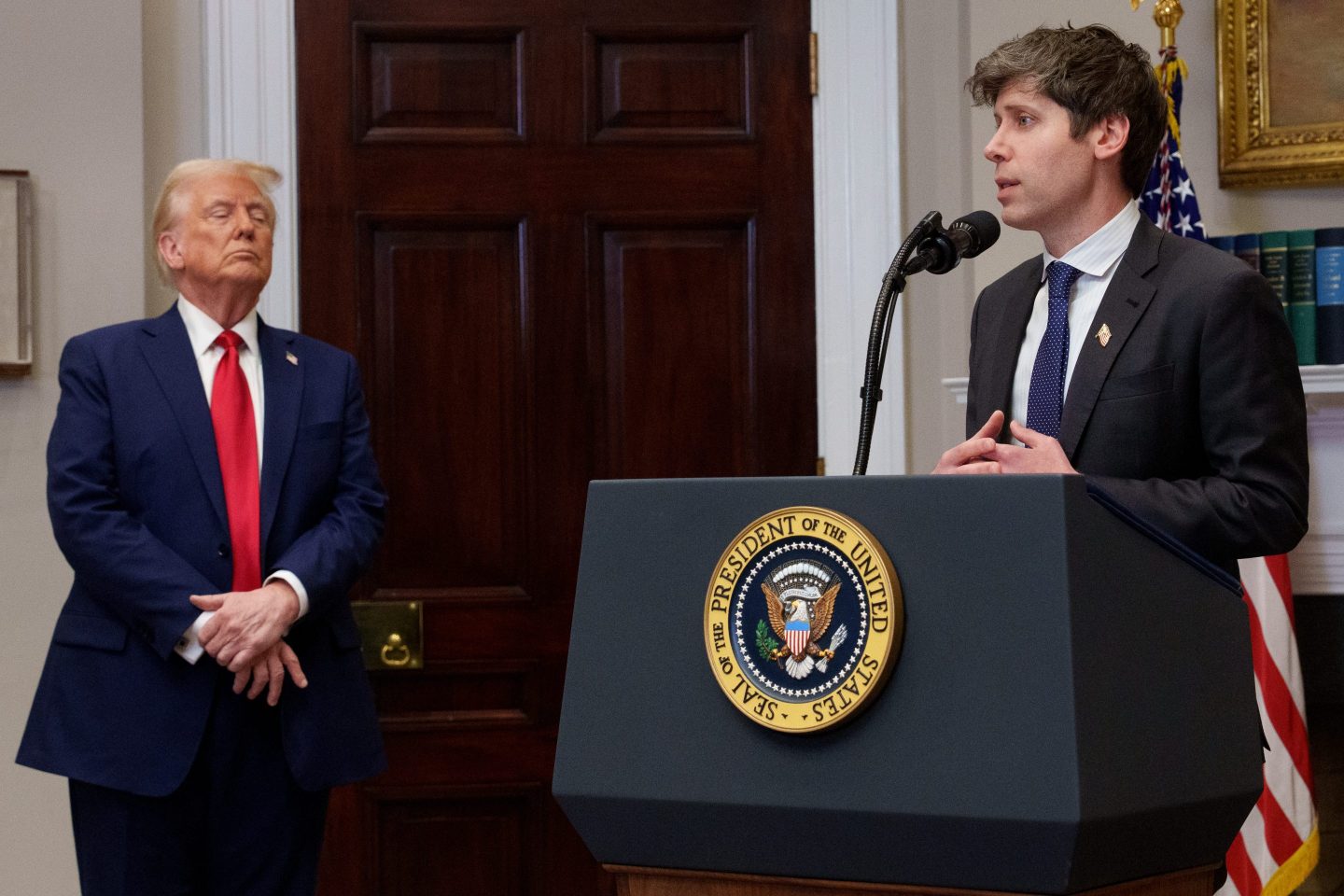
In January, OpenAI CEO Sam Altman stood next to President Trump and the leaders of Softbank and Oracle to announce a $500 million plan to build data centers in the U.S. So far, the mega project, called Stargate, has yet to complete its first planned data center in Abilene, Tex. But that didn’t stop OpenAI from touting a new global initiative today—this time aimed at developing AI infrastructure globally. While the plan, called OpenAI for Countries, is short on details, it’s long on rhetoric casting both OpenAI and the U.S. as benevolent actors in the face of authoritarian regimes like China.
The company said it wants to spread “democratic AI,” or “AI that protects and incorporates long-standing democratic principles.” That includes “the freedom for people to choose how they work with and direct AI, the prevention of government use of AI to amass control, and a free market that ensures free competition.”
The effort, OpenAI continued, would “contribute to broad distribution of the benefits of AI, discourage the concentration of power, and help advance our mission.” Partnering closely with the U.S. government, it said, is “the best way to advance democratic AI.”
More concretely, the blog post announcing the expanded Stargate said the goal is to build data centers overseas; and provide versions of OpenAI’s ChatGPT chatbots that are customized for each country’s language and culture. It also promised to strengthen security and safety of AI and launch national startup funds in individual countries with local funding and OpenAI capital.
The initiative aligns with efforts by the Trump Administration to win what it considers a fierce AI race at all costs—to protect the U.S. economy as well as prevail in the geopolitical AI chess game against China. “I think it’s a signal that we understand what is at stake,” said Daniel Newman, CEO of analyst firm The Futurum Group in an email—that is, that future world economic leadership will be decided by AI. He pointed to a recent speech by U.S. Treasury Secretary Scott Bessent, in which he said the “U.S. must win AI and quantum, nothing else matters.”
To “win” means gaining soft power through AI, he added, pointing out that Chinese companies have previously used their technology to gain soft power overseas. Over the years, Chinese tech giant Huawei, for example, “won a lot of the world trade by winning comms networks and telco,” Bessent explained.
Keegan McBride, a senior policy advisor in emerging technology and geopolitics at the Tony Blair Institute, a nonprofit advisory organization, agreed, saying American policymakers have become concerned about China’s expansive efforts to build digital infrastructure for significant parts of the world. This was particularly concerning after the January release of China’s DeepSeek R1 reasoning model that was said to perform on par with top U.S. models. It made clear that China’s AI capabilities were growing fast. Following the release of DeepSeek and other models like Alibaba’s Qwen, other Chinese models were also deployed worldwide. Since the models were openly available for developers to build on, rather than the closed models released by OpenAI, Google and Anthropic, they have gained huge momentum.
“This is the U.S. government waking up and reasserting that, when it comes to digital technology, countries should choose the United States as their key partner,” he said in an email to Fortune about OpenAI’s global initiative. He added that Michael Kratsios, director of the White House Office of Science and Technology Policy (OSTP), recently supported promoting American AI abroad. In a recent speech, he said “our industrial might, unleashed at home, and our technical achievements from AI to aerospace, successfully commercialized, can also be powerful instruments of diplomacy abroad and key components of our international alliances.”
Apparently one of the key partners in U.S. AI “diplomacy” is OpenAI, which, in the process of funding AI infrastructure overseas, would also cement its own global soft power as it seeks to expand into a massive multinational corporation. This comes just days after the company bowed to outside pressure by announcing that its nonprofit arm would retain control of its commercial operations. The decision marked a huge reversal for OpenAI, which had originally wanted to restructure itself into more of a conventional business.
The key to OpenAI gaining soft power is a multi-front strategy, according to Pierre-Carl Langlais, cofounder of the Paris-based AI lab Pleias, which focuses on developing open AI models trained on openly-licensed datasets. That includes OpenAI’s plans to release its own open source model this summer to compete with the likes of DeepSeek and China’s other AI leader, Qwen. Releasing a popular model with open “weights,” or the brains behind the model, would help OpenAI spread its technology because the model would be free to use and open to any developer to build on and work with. “I see it partly as a post-DeepSeek offensive,” Langlais said, adding that it’s similar to how Amazon’s AWS, Microsoft Azure, and Google Cloud spread their cloud computing over the past two decades by “offering a ton of credits and then you’re locked.”
So far, OpenAI has not said whether any countries have signed on to the global Stargate rollout. The ultimate goal, OpenAI said, is 10 projects with U.S. allies. While SoftBank is the financing lead for Stargate in the U.S., OpenAI’s developments abroad will be funded by a “bespoke group of partners” on each project, the Financial Times reported. It’s unclear whether those partners would be companies or countries, or both.
The big question, of course, is will this Stargate charm offensive work for OpenAI—especially when there will likely be significant strings attached to using its services? It may well be a gateway for countries to gain access to OpenAI’s most advanced AI models, in addition to Nvidia’s most sophisticated GPUs. For now, some countries, even allies like India and Israel, cannot access them due to increasingly-stringent export controls. But yesterday, Bloomberg reported that the Trump administration plans to rescind some of those restrictions, which Nvidia, in particular, had objected to.
But if Stargate is positioned as the infrastructure layer for OpenAI’s global expansion, those participating in its new initiative may be required to align with certain U.S. policies to gain access. Unlike typical corporate partnerships, this isn’t about business customers—it’s about national governments partnering with OpenAI to access cutting-edge AI technology. If OpenAI’s ecosystem becomes the only viable gateway for countries to obtain the most advanced AI capabilities, it could compromise their control over their data and technology. It also raises deeper questions about human rights including data privacy and state-level surveillance, as well as geopolitical considerations involved with using AI infrastructure controlled by U.S. interests.
“Building AI that’s attuned to the needs of ordinary people in their own languages has the potential to provide real value,” said Miranda Bogen, director of the AI Governance Lab at the Center for Democracy & Technology, a Washington, DC-based nonprofit organization that advocates for digital rights and freedom of expression. “But partnering with nation states raises serious questions about how to protect human rights against government demands. This has been a thorny challenge for tech companies over the past two decades; it’s only going to be more true with AI.”
But as the U.S. pushes for AI dominance, OpenAI may be looking beyond just creating “democratic AI.” It may also be looking to fill its own critical gaps in technical research that would help it consolidate more soft power while continuing its mission to develop its version of artificial general intelligence (AGI), or AI that matches or surpasses human capabilities in various tasks.
Langlais pointed out that while much of AI funding has been funneled into building applications for AI, foundational research remains underfunded. Extending Stargate abroad could create R&D hubs where local startups with deep technical expertise could be targeted by OpenAI for acqui-hires and strategic partnerships.
“And yes, [that would] obviously reinforce OpenAI centrality,” he said.