
• Home
  • Latest
  • Fortune 500
  • Finance
  • Tech
  • Leadership
  • Lifestyle
  • Rankings
  • Multimedia
FinanceFederal Reserve

As the Fed devises its new strategy, Powell sees an economy with ‘more volatile’ inflation

Paolo Confino
By
Paolo Confino
Paolo Confino
Reporter
Down Arrow Button Icon
Paolo Confino
By
Paolo Confino
Paolo Confino
Reporter
Down Arrow Button Icon
May 15, 2025, 3:24 PM ET
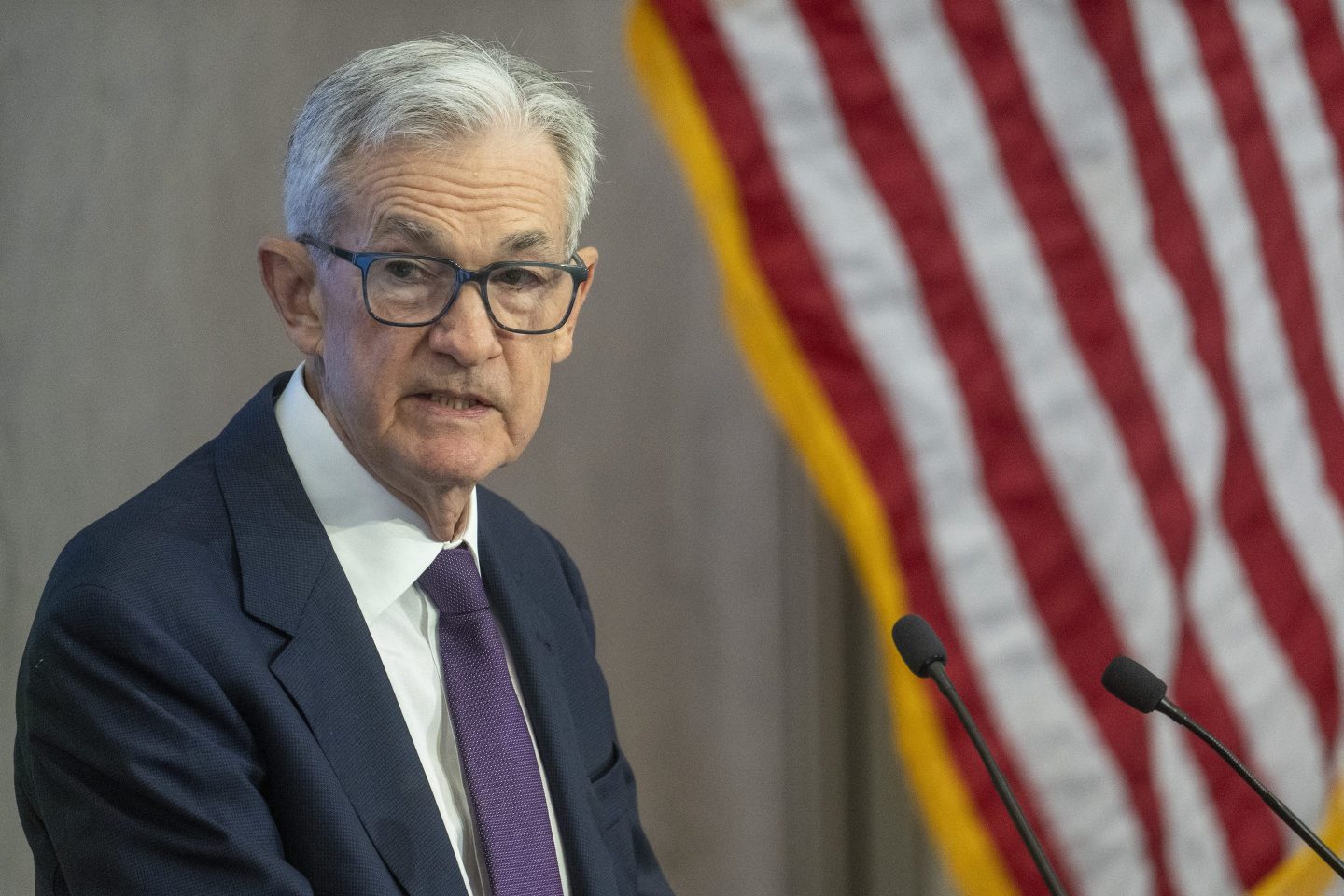
Fed chair Jerome Powell
Federal Reserve chair Jerome Powell speaking at the Thomas Laubach Research Conference in Washington D.C. on May 15. JIM WATSON/AFP
  • In discussing the outlook for the U.S. economy Federal Reserve chair Jerome Powell said he saw a future with the possibility of ups and downs in inflation. He added that he also saw an increased likelihood of “supply shocks” that could disrupt American businesses. 

Every five years the Federal Reserve reexamines the framework it uses to ensure its keeping the U.S. economy on a path of full employment and stable prices—a congressionally mandated double goal it must achieve with just a few tools, while keeping stock of evolving macroeconomic conditions, the labor market, and GDP growth. The strategy informs how exactly the Fed will achieve both its goals, which are the bedrock of a stable economy. 

Recommended Video

On Thursday, as the Fed began a conference to discuss how it would maintain maximum employment and 2% long-term inflation, the prognosis was: more turbulence.  

“We may be entering a period of more frequent and potentially more persistent supply shocks, a difficult challenge for the economy and for central banks,” Fed chair Jerome Powell said during the conference’s opening remarks. 

Powell did not discuss in detail the current state of the economy, instead focusing on its evolution from the post-Great Recession recovery to today. During the recovery period interest rates were extremely low, while the Fed’s benchmark rate now sits between 4.25% and 4.5%. Rates are higher because inflation could be more unpredictable going forward, Powell said. 

“Higher real rates may also reflect the possibility that inflation could be more volatile going forward than during the inter-crisis period of the 2010s,” he said. 

In looking back at the past five years under which the Fed’s current framework informed monetary policy, Powell discussed the COVID-19 pandemic, which hit the world shortly after the current strategy was implemented. At the time the U.S. economy had been stuck in over a decade with low growth, low inflation, and low interest rates. As a result, the plan had been for monetary policy to try and achieve an “intentional, moderate” overshoot of the 2% inflation target in periods when it was below that level, Powell said. 

Then the pandemic hit and completely disrupted those plans. 

“There was nothing intentional or moderate about the global inflation that arrived a few months after we announced our changes to the consensus statement,” Powell said, referring to the Fed’s name for its five-year plans.  

Annual inflation eventually rose as high as 9.1% in the summer of 2022. To curb the soaring price increases, the Fed started raising rates. What happened next was also unexpected. As rates rose and inflation came down, unemployment didn’t spike, as conventional economic wisdom dictated it would. Instead unemployment remained at its historically low levels of around 3.5%.  

“In a welcome and historically unusual result…this disinflation has come without the sharp increase in unemployment that has often accompanied a campaign of rate hikes to reduce inflation,” Powell said. 

Those changes will factor into the Fed’s new strategy, Powell said. “The economic environment has changed significantly since 2020 in our review, which will reflect our assessment of those changes,” he said. 

However, one thing that will remain consistent is the need to ground what the Fed refers to as “long-term inflation expectations.” 

“While the framework must evolve, some elements of it are timeless,” Powell said. “Policymakers emerged from the great inflation with a clear understanding that it was essential to anchor inflation expectations at an appropriately low level.”

Inflation expectations is a critical measure because it describes how the Fed, investors, economists, and businesses believe inflation will be in the future. Even if price increases tip up or down in a given monthly report, if businesses and consumers expect them to stay steady in the future, they generally still keep spending. Businesses are more likely to make major capital expenditures and consumers won’t hunker down in anticipation of a downturn if they believe the economy will be ok in the long run. During the rampant uncertainty and market tumult of April, Powell regularly pointed to the fact that long-term inflation expectations had remained steady. 

Keeping inflation expectations level was key to the U.S.’s post-pandemic recovery, Powell said. 

“Since the Great Inflation, the U.S. economy has had three of its four longest expansions on record,” Powell said. “Anchored expectations played a key role in facilitating these expansions. More recently, without that anchor, it would not have been possible to achieve a roughly five percentage point disinflation without a spike in unemployment.”


Join us at the Fortune Workplace Innovation Summit May 19–20, 2026, in Atlanta. The next era of workplace innovation is here—and the old playbook is being rewritten. At this exclusive, high-energy event, the world’s most innovative leaders will convene to explore how AI, humanity, and strategy converge to redefine, again, the future of work. Register now.
About the Author
Paolo Confino
By Paolo ConfinoReporter

Paolo Confino is a former reporter on Fortune’s global news desk where he covers each day’s most important stories.

See full bioRight Arrow Button Icon

Latest in Finance

Finance
Lorem ipsum dolor sit amet, consectetur adipiscing elit, sed do eiusmod tempor incididunt ut labore et dolore magna aliqua. Ut enim ad minim veniam
By Fortune Editors
October 20, 2025
Finance
Lorem ipsum dolor sit amet, consectetur adipiscing elit, sed do eiusmod tempor incididunt ut labore et dolore magna aliqua. Ut enim ad minim veniam
By Fortune Editors
October 20, 2025
Finance
Lorem ipsum dolor sit amet, consectetur adipiscing elit, sed do eiusmod tempor incididunt ut labore et dolore magna aliqua. Ut enim ad minim veniam
By Fortune Editors
October 20, 2025
Finance
Lorem ipsum dolor sit amet, consectetur adipiscing elit, sed do eiusmod tempor incididunt ut labore et dolore magna aliqua. Ut enim ad minim veniam
By Fortune Editors
October 20, 2025
Finance
Lorem ipsum dolor sit amet, consectetur adipiscing elit, sed do eiusmod tempor incididunt ut labore et dolore magna aliqua. Ut enim ad minim veniam
By Fortune Editors
October 20, 2025
Finance
Lorem ipsum dolor sit amet, consectetur adipiscing elit, sed do eiusmod tempor incididunt ut labore et dolore magna aliqua. Ut enim ad minim veniam
By Fortune Editors
October 20, 2025

Most Popular

Finance
Lorem ipsum dolor sit amet, consectetur adipiscing elit, sed do eiusmod tempor incididunt ut labore et dolore magna aliqua. Ut enim ad minim veniam
By Fortune Editors
October 20, 2025
Finance
Lorem ipsum dolor sit amet, consectetur adipiscing elit, sed do eiusmod tempor incididunt ut labore et dolore magna aliqua. Ut enim ad minim veniam
By Fortune Editors
October 20, 2025
Finance
Lorem ipsum dolor sit amet, consectetur adipiscing elit, sed do eiusmod tempor incididunt ut labore et dolore magna aliqua. Ut enim ad minim veniam
By Fortune Editors
October 20, 2025
Finance
Lorem ipsum dolor sit amet, consectetur adipiscing elit, sed do eiusmod tempor incididunt ut labore et dolore magna aliqua. Ut enim ad minim veniam
By Fortune Editors
October 20, 2025
Finance
Lorem ipsum dolor sit amet, consectetur adipiscing elit, sed do eiusmod tempor incididunt ut labore et dolore magna aliqua. Ut enim ad minim veniam
By Fortune Editors
October 20, 2025
Finance
Lorem ipsum dolor sit amet, consectetur adipiscing elit, sed do eiusmod tempor incididunt ut labore et dolore magna aliqua. Ut enim ad minim veniam
By Fortune Editors
October 20, 2025
Fortune Secondary Logo
Rankings
  • 100 Best Companies
  • Fortune 500
  • Global 500
  • Fortune 500 Europe
  • Most Powerful Women
  • Future 50
  • World’s Most Admired Companies
  • See All Rankings
Sections
  • Finance
  • Fortune Crypto
  • Features
  • Leadership
  • Health
  • Commentary
  • Success
  • Retail
  • Mpw
  • Tech
  • Lifestyle
  • CEO Initiative
  • Asia
  • Politics
  • Conferences
  • Europe
  • Newsletters
  • Personal Finance
  • Environment
  • Magazine
  • Education
Customer Support
  • Frequently Asked Questions
  • Customer Service Portal
  • Privacy Policy
  • Terms Of Use
  • Single Issues For Purchase
  • International Print
Commercial Services
  • Advertising
  • Fortune Brand Studio
  • Fortune Analytics
  • Fortune Conferences
  • Business Development
About Us
  • About Us
  • Editorial Calendar
  • Press Center
  • Work At Fortune
  • Diversity And Inclusion
  • Terms And Conditions
  • Site Map
Fortune Secondary Logo
  • About Us
  • Editorial Calendar
  • Press Center
  • Work At Fortune
  • Diversity And Inclusion
  • Terms And Conditions
  • Site Map
  • Facebook icon
  • Twitter icon
  • LinkedIn icon
  • Instagram icon
  • Pinterest icon

Most Popular

placeholder alt text
Success
Japanese companies are paying older workers to sit by a window and do nothing—while Western CEOs demand super-AI productivity just to keep your job
By Orianna Rosa RoyleFebruary 27, 2026
1 day ago
placeholder alt text
Success
Walmart exec says U.S. workforces needs to take inspiration from China where ‘5 year-olds are learning DeepSeek’
By Preston ForeFebruary 27, 2026
1 day ago
placeholder alt text
Law
China's government intervenes to show Michigan scientists were carrying worms, not biological materials
By Ed White and The Associated PressFebruary 26, 2026
2 days ago
placeholder alt text
Commentary
'The Pitt': a masterclass display of DEI in action 
By Robert RabenFebruary 26, 2026
2 days ago
placeholder alt text
Economy
Come 2030, the U.S. deficit will be worth 5.9% of GDP—more than spending on Social Security, and equal to major health programs
By Eleanor PringleFebruary 26, 2026
2 days ago
placeholder alt text
Personal Finance
Current price of gold as of February 27, 2026
By Danny BakstFebruary 27, 2026
1 day ago

© 2026 Fortune Media IP Limited. All Rights Reserved. Use of this site constitutes acceptance of our Terms of Use and Privacy Policy | CA Notice at Collection and Privacy Notice | Do Not Sell/Share My Personal Information
FORTUNE is a trademark of Fortune Media IP Limited, registered in the U.S. and other countries. FORTUNE may receive compensation for some links to products and services on this website. Offers may be subject to change without notice.


Latest in Finance

trump
LawTariffs
‘Why shouldn’t we get our money back too?’ Normal people are starting to demand Trump tariff refunds
By Mae Anderson and The Associated PressFebruary 28, 2026
18 minutes ago
warren
InvestingBerkshire Hathaway
Berkshire Hathaway shareholders just woke up to a letter by someone other than Warren Buffett
By Josh Funk and The Associated PressFebruary 28, 2026
27 minutes ago
trump
PoliticsWhite House
Trump says Cuba has ‘no money’ and ‘maybe we’ll have a friendly takeover’
By Will Weissert and The Associated PressFebruary 28, 2026
28 minutes ago
paramount
LawHollywood
Warner/Paramount sets up Hollywood to shrink from Big 5 to Big 4, a decade after Disney took out number 6
By Lindsey Bahr and The Associated PressFebruary 28, 2026
37 minutes ago
iran
Middle EastMiddle East
‘This will be probably your only chance for generations’: Trump tells Iranians to first take cover, then rise up
By Brian Melley and The Associated PressFebruary 28, 2026
40 minutes ago
sarandos
InvestingMedia
3 things we will never know after Netflix pulled out of the Warner Bros. bidding, handing it to Paramount
By Nick LichtenbergFebruary 28, 2026
44 minutes ago