
The average interest rate for a 30-year, fixed-rate conforming mortgage loan in the U.S. is 6.014%, according to data available from mortgage data company Optimal Blue. That’s down roughly a basis point from the prior report, and down about 13 basis points from a week ago. Read on to compare average rates for a variety of conventional and government-backed mortgage types and see whether rates have increased or decreased.
Check Out Our Daily Rates Reports
- Discover the highest high-yield savings rates, up to 5% for February 27, 2026.
- Discover the highest CD rates, up to 4.15% for February 27, 2026.
- Discover the top CD rates from major banks on February 27, 2026.
- Discover the current mortgage rates for February 27, 2026.
- Discover current refi mortgage rates report for February 27, 2026.
- Discover current ARM mortgage rates report for February 27, 2026.
- Discover the current price of gold for February 27, 2026.
- Discover the current price of silver for February 27, 2026.
- Discover the current price of platinum for February 27, 2026.
Current mortgage rates data:
Note that Fortune reviewed Optimal Blue’s latest available data on Jan. 16, with the numbers reflecting home loans locked in as of Jan. 15.
What’s happening with mortgage rates in the market?
If it feels like 30-year mortgage rates have been stuck near 7% forever, that’s not far from the truth. Many observers were hoping that rates would soften when the Federal Reserve started cutting the federal funds rate in September 2024, but that didn’t happen. There was a brief dip preceding that meeting, but rates shot back up afterward.
In fact, by January 2025 the average rate on a 30-year, fixed-rate mortgage topped 7% for the first time since last May, according to Freddie Mac data. That’s a far cry from the historic average low of 2.65% we saw in January 2021, when the government was still trying to stimulate the economy and stave off a pandemic-induced recession.
Barring another massive catastrophe, experts agree we won’t see rates in the 2% to 3% range in our lifetimes. And right now, with President Donald Trump pursuing policies such as tariffs and deportations, some observers have feared the labor market could tighten and inflation could reignite. Against that backdrop, U.S. homebuyers have been stuck with high mortgage rates—though some found ways to make their purchase more affordable, such as negotiating rate buydowns with a builder when purchasing newly constructed housing.
But, homebuyers (and homeowners considering refinancing) finally got some relief starting in late August and early September of 2025. Leading up to the Fed’s Sept. 16-17 meeting, mortgage rates started trending noticeably downward in anticipation that the central bank would reduce the federal funds rate.
The Fed did indeed deliver the expected cut, reducing its benchmark rate by a quarter percentage point—the first cut of 2025. Then, it made a second cut of the same amount at the end of October and a third in early December.
How to get the best mortgage rate possible
While economic conditions are out of your control, your financial profile as an applicant has a major impact on the mortgage rate you get. With that in mind, strive to do the following:
- Ensure your credit is in excellent shape. The minimum credit score to get a conventional mortgage is generally 620 (for FHA loans, you may be able to qualify with a score of 580 or a score as low as 500 and a 10% down payment). But, if you’re hoping to get a low rate that could potentially save you five or even six figures in interest over the life of your loan, you’ll want a score quite a bit higher. For example, lender Blue Water Mortgage notes that a score of 740 or higher is considered top tier.
- Keep your debt-to-income (DTI) ratio low. You can calculate your DTI by dividing your monthly debt payments by your gross monthly income, then multiplying by 100. For example, someone with a $3,000 monthly income and $750 in monthly debt payments has a 25% DTI. It’s typically best when applying for a mortgage to have a DTI of 36% or below, though you may get approved with a DTI as high as 43%.
- Get prequalified with multiple lenders. You may wish to try a mix of large banks, local credit unions, and online lenders and compare offers. Plus, getting connected with loan officers at several different institutions can help you evaluate what you’re looking for in a lender and which one will be best able to meet your needs. Just make sure when you’re comparing rates that you’re doing it in a way that’s apples to apples—if one estimate relies on you purchasing mortgage discount points and another does not, it’s important to realize there’s an upfront cost for buying down your rate with points.
Mortgage interest rates historical chart
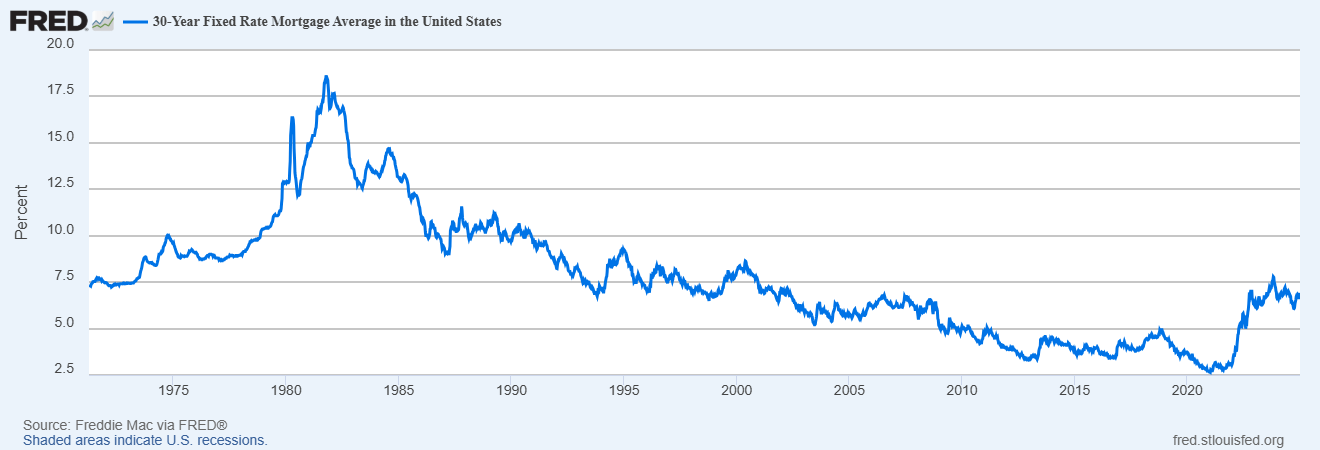
Rates feel high because practically everyone recalls the ultra-low rates that prevailed over the last 15 years or so. A unique set of historical circumstances drove that market: The long period when the Fed held its key rate at zero to recover from the Great Recession, followed by the unprecedented policies put in place as the country battled the global Covid-19 pandemic.
Now that more normal economic conditions prevail, experts agree we’re unlikely to see such dramatically low interest rates again. Taking the long view, rates around 7% are not abnormally high.
Consider this St. Louis Fed chart tracking Freddie Mac data on the 30-year, fixed-rate mortgage average. In the 1990s, 7% rates were more or less the norm. Compared to rates in the 1970s and 80s, 7% rates look like a deal. In fact, September, October, and November of 1981 all saw mortgage interest rates above 18%.
Historical context is scant comfort for homeowners who want to move but feel locked in with a once-in-a-lifetime low interest rate. Such situations are common enough in the current market that low pandemic-era rates keeping homeowners put when they’d otherwise move have become known as the “golden handcuffs.”
Factors that impact mortgage interest rates
The current state of the U.S. economy is the biggest factor impacting mortgage interest rates. If lenders fear inflation, they raise mortgage rates to protect their long-term profits.
Another big-picture factor is the national debt. When the federal government runs large deficits and has to borrow to make up the difference, that can put upward pressure on interest rates.
Demand for home loans plays a key role. If demand for loans is low, lenders may lower rates to attract more borrowers. On the other hand, high demand means lenders might decide to raise rates as a way of covering costs for handling a higher volume of loans.
And of course, we must consider the Federal Reserve’s actions. The Fed can influence interest rates on financial products such as mortgages both through deciding to hike or cut the federal funds rate and through what actions it decides to take regarding its balance sheet.
The federal funds rate gets significant media attention, as increases or decreases to this benchmark rate (which is the rate banks charge each other for borrowing money overnight) often coincide with increases or decreases to the interest rates for home loans and other forms of credit. That said, the Fed does not set rates for mortgages or other credit products directly, and such interest rates do not always track perfectly with the fed funds rate.
Another way the Fed influences mortgage rates is via its balance sheet. In times of economic distress, the central bank buys financial assets and holds them on their balance sheet, injecting liquidity into the economy. Mortgage-backed securities (MBS) are a key type of asset for the Fed in such situations.
However, until fairly recently the Fed was been slimming down its balance sheet, allowing assets to mature without buying new ones to replace those that have aged off it. That puts an upward pressure on mortgage interest rates. This policy, known as quantitative tightening, ended as of December 2025.
Why it’s important to compare mortgage rates
Comparing rates on different types of loans and shopping around with different lenders are both important steps in getting the best mortgage for your situation.
If your credit is in stellar shape, opting for a conventional mortgage might be the best choice for you. But, if your score is sub-600, an FHA loan may give you a chance a conventional loan would not.
When it comes to shopping around with different banks, credit unions, and online lenders, it can make a tangible difference in how much you pay. Freddie Mac research shows that in a market with high interest rates, homebuyers may be able to save $600 to $1,200 annually if they apply with multiple mortgage lenders.