
The Federal Aviation Administration has stopped installing the new routers tied to last week’s nationwide ground stop and switched off the ones already running. That puts the U.S. air traffic system back on Cisco routers that have been in place for about 25 years. The agency still isn’t saying what broke it.
An FAA spokesperson confirmed the halt on the Juniper Networks routers to ABC News on Tuesday, adding the agency “has not yet determined the root cause of Friday’s issue.” The FAA had also turned off the Juniper units already installed, the Associated Press reported, and is leaning on the older Cisco gear to keep the network up while it investigates.
The retreat comes a day after the Trump administration offered a very different theory of last week’s failures. Homeland Security Secretary Markwayne Mullin went on Fox News Monday night and told Sean Hannity: “I believe that it’s the SI.” He meant superintelligence.
Mullin was relaying a theory from an unnamed tech-industry contact: that self-coding, self-fixing programs could overwhelm systems that can’t keep pace, explaining the five-day run of breakdowns that hit Microsoft, the FAA, and JPMorgan Chase. In the same interview, Mullin said he could tell Americans “with 98% certainty, we’re not seeing a cyber attack.”
The FAA’s own move on Tuesday points at hardware.
Friday’s ground stop ran more than four hours, the longest nationwide ground stop since the Sept. 11 attacks. More than 14,000 flights were canceled Friday and Saturday, according to ABC News. Radar feeds and aircraft communications were disrupted at 17 of the FAA’s 22 Air Route Traffic Control Centers. The agency says “excessive data” flooded its telecommunications network at a rate of 1,000 connection attempts every 4-to-5 seconds, overwhelming legacy equipment, according to the AP. Its initial investigation pointed to a radar site in Amarillo, Texas, and a radio communications site in El Dorado, Ark., Newsweek and Reuters reported.
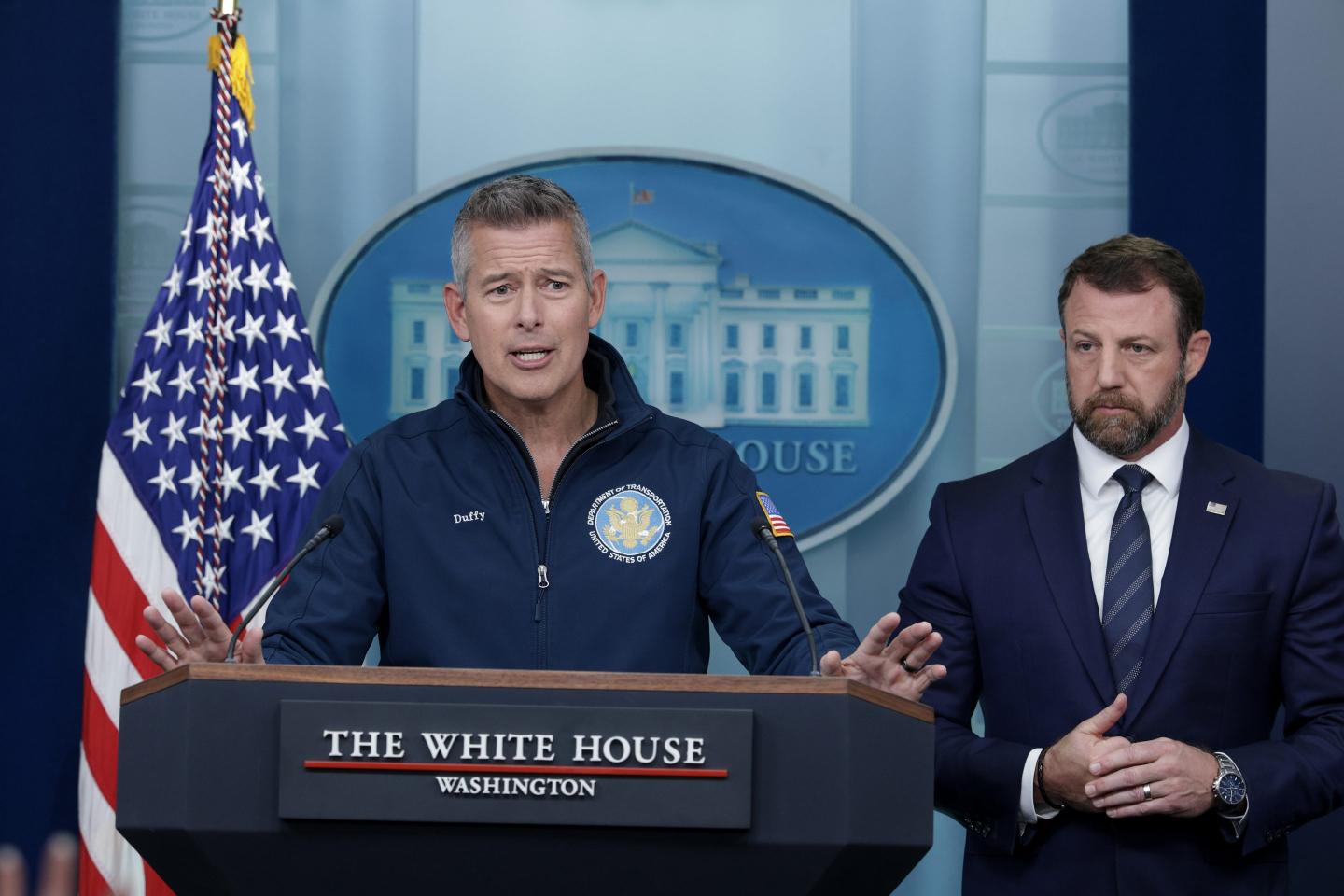
The work at those sites was the modernization. L3Harris, whose predecessor Harris Corp. won the FAA’s telecommunications infrastructure contract in 2002, has been swapping old copper wires for fiber-optic lines and old routers for Juniper devices. Transportation Secretary Sean Duffy said on Friday the cause was either “contractor error or a faulty piece of equipment.” At a press conference Saturday, FAA Administrator Bryan Bedford said: “We see zero evidence of anything nefarious, and zero evidence of anything AI-related.”
Duffy has also said the FAA’s new AI air-traffic tool, SMART, played no role. The $875 million system was expanded to the airspace of all 22 centers on Nov. 10, three days before the outage, the AP reported.
Delta CEO Ed Bastian, at the Fortune 500 Innovation Forum in Detroit on Monday, told Fortune the ground stop came from “a combination of faulty equipment, coupled with human error.”
“There’s no evidence that there’s [an] AI trigger. There’s no evidence that there’s cyber at play,” he said.
Pulling the plug on the routers doesn’t close the case, though. Thirteen Democrats on the Senate Commerce Committee, including ranking member Maria Cantwell (D-Wash.) and Sen. Ben Ray Luján (D-N.M.), asked Duffy in a letter released Tuesday to keep the pause in place until the root cause is found.
“Identifying the device that failed does not establish why it failed,” they wrote. Citing L3Harris, the letter says 3,648 routers are slated for conversion to Juniper devices; about 400 have been installed and 69 are operational. The FBI said Tuesday it is working with the Transportation Department, the FAA, and L3Harris, but hasn’t taken possession of any equipment, Reuters reported.
So nobody has said publicly what generated those 1,000 connection attempts every few seconds. That gap is where the superintelligence theory lives. Gary Marcus, the NYU professor emeritus and AI critic, told Fortune on Monday that he had “the same intuition as Mullin’s contact.” Asked what actually caused last week’s failures, he said: “We don’t really know yet.”
There’s an older explanation that doesn’t need AI at all. In his 1984 book Normal Accidents, the Yale sociologist Charles Perrow argued that tightly coupled, complex systems will fail in ways nobody designed for, and that fixes often add the complexity that causes the next failure. Honeywell Technologies CEO Vimal Kapur made a version of the point at the same Detroit forum on Monday, saying automation in plants and hospitals has grown too complex for the humans overseeing it, and that “what happened in the last two weeks is an example of complexity.”
Mullin, for his part, put it in homier terms: “When you change one thing in a house, everything else starts changing.”
The money question is still on the table. The administration this week updated its request to Congress to $50.1 billion to overhaul air traffic control infrastructure, on top of the $12.5 billion lawmakers approved last year. That money was meant, in part, to replace copper wire, floppy disks, and 1980s-era radar, though much of it is also going to runways and other construction, according to the AP.
“We can’t even get $50 billion to fix our skies,” Bastian said Monday, noting “hundreds of billions, if not trillions of dollars” are flowing into AI and data centers.
For now, the fix for a failed upgrade is the 25-year-old equipment it was supposed to replace. The next test is the root-cause report. Until it lands, the FAA isn’t putting any more new routers in.
Generative AI was used for research assistance and/or transcription of this article. The reporter independently reported and verified the factual claims in this article, and a human editor reviewed it before publication.