
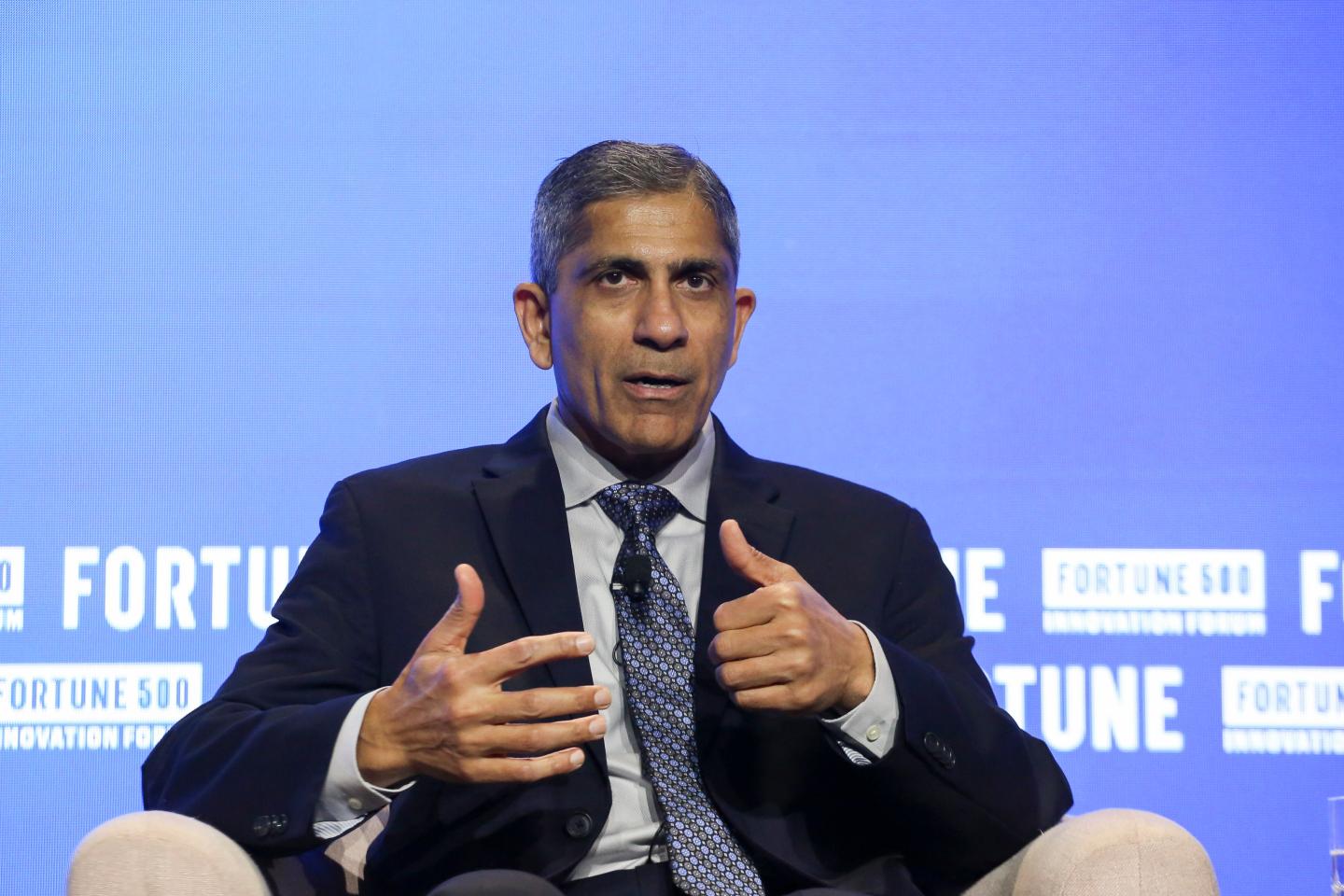
The automation that runs hospitals, data centers, and refineries got its start in the 1970s. Honeywell Technologies chairman and CEO Vimal Kapur says it has since grown too complex for the people still watching over it.
Speaking at the Fortune 500 Innovation Forum in Detroit on Monday, Kapur said those facilities run themselves for the most part, “maybe 95%,” with a person left in the loop to handle the exceptions. “Over the last 50 years since this got created, the systems have become highly complex because we kept adding more and more software and physical infrastructure to it,” he said. “So human cannot keep up with that at this point of time.”
He pointed to recent news as an example. “What happened in the last two weeks is an example of complexity,” Kapur said, where “humans are not able to keep up with it,” producing an “undesired incident.” He didn’t say which one, but the options are almost too numerous to count.
On Nov. 13, the FAA ordered a nationwide ground stop. Transportation Secretary Sean Duffy said the agency was focused on a copper-to-fiber upgrade by contractor L3Harris in El Dorado, Ark., that flooded routers with connection attempts and disrupted some radar feeds, while adding, “we don’t actually have the root cause.” On Nov. 12, Microsoft 365 began an outage that lasted more than a day. As of press time, many Americans were unable to access their bank accounts.
Physical AI, minus the robots
Kapur’s answer is what the industry calls “physical AI,” of which he said humanoid robots are a “very small portion.” His version goes into “every large asset which exists: hospital, data center, life sciences facilities, refineries.” It adds “a layer of learning system, the human knowledge” on top of the existing automation “so that you are able to make human more productive.”
The obstacle is data: “We assume that data is available abundantly on [the] internet,” Kapur said. “But when you look at a physical system, the data is in some system which is in this building or in this hospital. Those data [are] not in public domain.” Turning it into something useful takes people “who have deep domain knowledge,” he said. He called data access “the first friction” in an April talk at Goldman Sachs.
Honeywell sells automation to building, industrial, and process customers, and now sells the AI layer that goes on top. When it spun off its aerospace business on June 29, completing its three-way split, the company said it was positioned to lead “the industrial sector’s transition from automation to autonomy.” In October it launched Forge Cognition, an AI platform built with Nvidia and Dell that can run buildings in an autonomous mode, which haven’t been fully switched on, its CTO told Fortune at the time. On stage, Kapur put it more modestly: “Physical AI is not about job replacement; it’s about making humans more productive.” At Goldman in April, he said, “we’ll likely build systems which are more augmented and less autonomous.”
The back-office version
Dave Bozeman, CEO of freight broker C.H. Robinson, who shared the stage with Kapur, described the same problem from the paperwork side. “Variability is now structural,” he said, and supply chains “continue to be super complex.” His company’s answer is what it calls “Lean AI”: AI agents built to do “bespoke, very specific tasks,” with “orchestrating type of agents” on top. The first target is order-to-cash, which he called “a very manual process. Millions of transactions.”
Bozeman also pitched it as help for workers, who he said don’t want to do “those mundane tasks every day” and would rather “go up that value stack.” He cited “over 60% productivity gains since the end of 2022.” The company’s Oct. 28 earnings release measures that as shipments per person, per day in its North American Surface Transportation unit, up more than 65% over the same stretch. The other half of that ratio is people. C.H. Robinson had about 17,400 employees at the end of 2022 and about 11,900 at the end of 2025, according to its filings, a drop of nearly a third that FreightWaves tied to automation and AI.
“That doesn’t mean that it won’t be hard from a change perspective,” Bozeman said.
The 1983 warning
The problem Kapur describes was laid out more than 40 years ago. In 1983, Lisanne Bainbridge, a psychologist at University College London, published “Ironies of Automation” in the journal Automatica. She argued that designers automate what they can and leave the operator “to do the tasks which the designer cannot think how to automate.” Those leftover tasks include taking over when conditions turn abnormal. Her central irony was that “the more advanced a control system is, so the more crucial may be the contribution of the human operator.”
She also warned about what watching does to people. Operators’ “physical skills deteriorate when they are not used,” she wrote, and of the person reduced to monitoring a system: “The human monitor has been given an impossible task.” Her paper argued that automation “may expand rather than eliminate problems with the human operator.” That’s the test for an AI layer added to the stack.
Fewer hands to go around
Kapur said the shortage of skilled workers is what makes this urgent. “The skill shortage is the biggest problem we all face,” he said. “Anywhere there’s a touch labor where the humans need to work with hand, those workforce is becoming less and less available.” In the Goldman talk, he blamed retirement in part.
A 2024 study puts numbers on it for manufacturing. Deloitte and the Manufacturing Institute found U.S. manufacturers could need as many as 3.8 million additional workers between 2024 and 2033, and that 1.9 million of those jobs could go unfilled if workforce problems aren’t addressed. Sixty-five percent of manufacturers surveyed called attracting and keeping talent their primary business challenge.
Kapur gave his own company a much shorter clock than 50 years. Honeywell Technologies has more than 50,000 employees, and he said he personally took training on Copilot. “Next 18 to 24 months, we all have to reskill ourselves,” he said.
Generative AI was used for research assistance and/or transcription of this article. The reporter independently reported and verified the factual claims in this article, and a human editor reviewed it before publication.