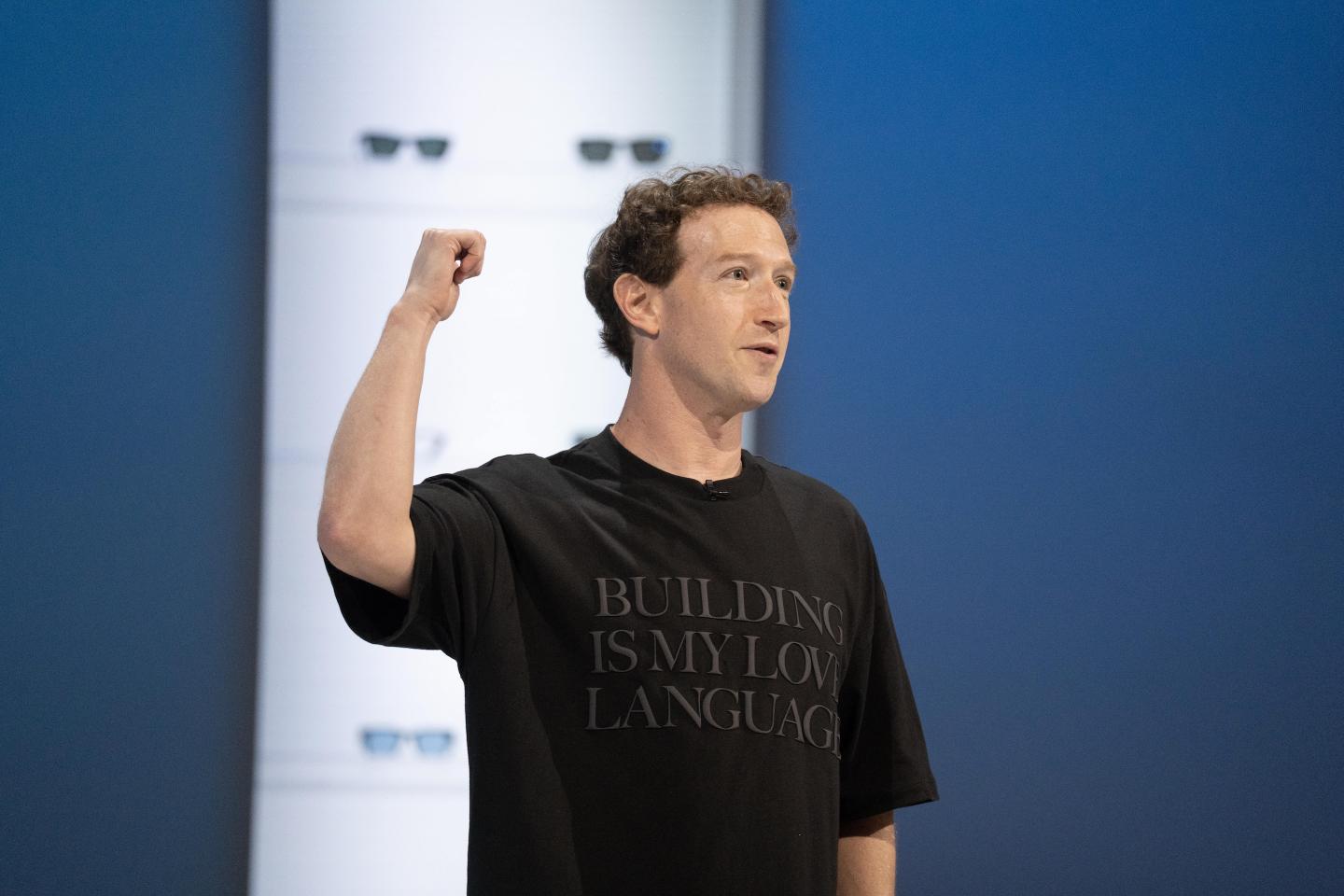
Mark Zuckerberg says he knew he was taking an enormous risk when he greenlit Meta’s AI buildout—a commitment he pegged at as much as $200 billion—before there was any proof it would work.
“We’re going to write this check for, like, I don’t know, like $100 billion, $200 billion,” Zuckerberg said on a recent episode of Cheeky Pint, the podcast hosted by Stripe cofounder John Collison. “I’m like, ‘Alex, are you sure this is going to work?’”
Alexandr Wang, Meta’s chief AI officer, appeared alongside Zuckerberg and said decisions of that size get made “long before there’s proof points around whether or not even the thing is working.” He added: “It’s like the opposite of Lean Startup.”
The episode was released Oct. 12, the same day Meta launched Muse Wonder, the first frontier-class model from the superintelligence lab Wang leads. Meta has guided for as much as $145 billion in capital expenditures this year, much of it on AI infrastructure.
Much of that money is going toward what Zuckerberg describes as a “full-stack” operation.
“Meta is a full-stack tech company,” he said. “We build our own data centers, we build our own chips, we build our own low-level infrastructure.”
Lessons from the smartphone wars
Zuckerberg’s push to own the full stack may stem from his nearly two-decade rivalry with Apple and Google, which control the world’s dominant smartphone platforms. Facebook’s iPhone app launched in July 2008, followed by an Android app in September 2009. Its mobile years that followed were marked by friction with the platform owners, some of it self-inflicted.
Zuckerberg repeatedly sought workarounds to the limits those platforms imposed. In 2013, Facebook pushed updates to its Android app outside the Google Play store, prompting Google to ban the practice. In 2019, Apple shut down a Facebook “Research” app that paid users, including teens, up to $20 a month for sweeping access to their phone data. The biggest blow came in 2021, when Apple began letting iPhone users block apps from tracking them—a change Meta later said would cost it about $10 billion in 2022 alone.
Zuckerberg has said that experience shapes his approach to AI. “One of my formative experiences has been building our services constrained by what Apple will let us build on their platforms,” he wrote in a 2024 post on Meta’s website.
Speaking with Collison, Zuckerberg said owning the stack is “less about wanting to own a platform for its own sake. It’s about being able to build the best things.”
The cost of going it alone
Unlike Amazon, Microsoft, and Google, Meta doesn’t run a cloud business that rents its data centers to outside customers, so it shoulders those costs itself. Zuckerberg said a one-gigawatt AI data center costs $50 billion to $60 billion to build and roughly $15 billion a year to operate. Meta’s Hyperion campus in Louisiana is designed to scale to five gigawatts.
That could change. In July, Bloomberg reported that Meta is building a cloud business to sell AI computing power and is also weighing selling raw computing capacity. Weeks later, Zuckerberg confirmed the cloud plans on Meta’s earnings call. On Cheeky Pint, he framed all that compute as a hedge.
“…If like the cost is whatever, $15 billion a gigawatt, we could get like a lot more for that,” Zuckerberg said. “So I think that you, in order for it not to work out, it’s not just that we have to fail, AI overall has to fail.”
The bet on agentic commerce
Meta’s full-stack ambitions don’t stop at data centers. Zuckerberg and Wang want Muse Wonder and the more powerful Muse Wonder Full to drive Muse, Meta’s personal AI agent, which can act on people’s behalf.
“The best personal agent should feel like a team of experts in your corner,” Wang said. “Your legal team, and your finance team, and your medical team.”
Wang said he uses Muse to “source increasingly obscure teas from increasingly obscure vendors of tea.” Zuckerberg said he set up an Instacart account specifically for Muse, which orders ingredients for weekend baking projects with his 3-year-old daughter. He went from using Instacart maybe twice a year to “once or twice a week.”
That vision of full-fledged agentic commerce could, paradoxically, disrupt Meta’s main profit engine. Advertising made up about 98% of Meta’s revenue last quarter, and eMarketer projects the company’s worldwide ad revenue will reach $243.46 billion this year, surpassing Google’s for the first time.
Meta’s future business model
But if AI agents compare prices, check delivery dates, read reviews, and ultimately make purchase decisions, who are the ads for?
Collison raised a version of that question on the podcast, suggesting that a business that “only succeeds by overcharging consumers” would rationally want to keep agents out. Zuckerberg countered that few businesses have tried to block agents and that those that do are likely to lose out. “We have way more businesses that are calling us asking to integrate deeply,” he said. He argued agents could grow commerce overall: “Is the total addressable market for all of commerce just increasing dramatically?”
Zuckerberg also sketched how Meta could make money beyond ads. “Subscriptions is going to be a big one,” he said. Muse is free to use, with paid plans at $20 and $100 a month for heavier users. On commerce, he floated taking “a small cut of what you are saving or making for people.” And on Meta’s July earnings call, he pitched business agents as working “just like the ad system”: “We will get paid when we deliver results for those businesses.”
What Zuckerberg hasn’t addressed directly, on the podcast or the earnings call, is whether agents will eat into the ad impressions that generate nearly all of Meta’s revenue today. For now, Wall Street isn’t pressing the point. Bank of America analyst Justin Post wrote last week that Meta is “back on offense with AI,” naming rising AI spending—not agents—as the top risk.