

Have you talked to a Gen Zer or even a Gen Alpha kid about AI lately? On playgrounds, kids point at each other and say “that’s AI” about behavior they find fake or unconvincing. In high school and college, AI is a cheating tool that turns in easily spotted slop if you’re not careful. In the workforce, it’s a tool for rendering an email inbox almost entirely useless.
In short, the AI natives most exposed to this technology have the most intense love/hate feelings about it. It’s not a technological revolution to them; it’s a giant pain.
Managers at large U.S. companies are using AI more than ever and increasingly feeling the way their kids and younger colleagues do, according to a new survey from Wharton Human-AI Research and research firm GBK Collective. Among managers and above, 62% reported using AI daily, up from 46% last year. Meanwhile, the share describing themselves as excited fell eight percentage points to 51%. A quarter described themselves as skeptical, and 44% as cautious. The researchers called it the first wave in their four-year study in which usage and excitement moved in opposite directions.
“The amazement is kind of wearing off a little bit,” Prasanna “Sonny” Tambe, a professor of operations, information and decisions and co-director of the Wharton Human-AI Research, told Fortune. In its place, he said, is greater caution: “This technology is moving so fast and our organization is not ready to keep up.”
This cooling isn’t a backlash. Optimism among managers and above held steady at 59%, and 80% reported positive financial returns from AI, though only 28% called those returns strongly positive. The annual waves are separate samples rather than a panel tracking the same people, so the data describe a shift in mood across the management ranks; the findings suggest that the people responsible for putting AI to work are encountering a distinction younger users have already been expressing. A technology can be useful, even game-changing, without inspiring confidence about everything that comes with it.
A Gallup survey conducted with the Walton Family Foundation and GSV, published in April, found that 51% of Americans ages 14 to 29 used generative AI at least weekly, even as excitement fell 14 percentage points from the previous year. Among employed Gen Z respondents, 48% said AI’s workplace risks outweighed its benefits, even as 56% acknowledged that AI tools can help them do their work faster.
For Jeremy Korst, a Wharton lecturer, GBK partner and founder of AI consultancy Mindspan Labs, the cooling reflects the move from experimenting with a technology to making it work inside an organization.
He said it’s like going from an “Oh, wow” level of excitement to how to make that transition actually work.
The work after the output
One of the most consequential changes may be what happens after AI produces an answer.
Seventy-two percent of managers and above said their focus had shifted from creating outputs to managing AI-generated outputs. Among managers and directors, the figure was 63%; among vice presidents and above, it reached 82%.
That shift puts verification at the center of the job. An agent’s ability to carry out a task is not the same as an organization’s ability to determine whether it carried out that task correctly.
“I think we have been overindexing a little bit on what agents can do, as opposed to … what is it that we can verify that agents can do,” said Tambe, who is also working on economic research from within OpenAI while he’s on sabbatical. (“It is very interesting,” he said. “This economy, as you know, is evolving so quickly that each of us … are seeing a different piece of this and trying to figure out from all the signals we can get what’s going on here.”) Verification, Tambe said, gets more complicated when an agent’s work crosses organizational functions.
Korst pointed to research by Wharton’s Gideon Nave and Steven Shaw on what they call “cognitive surrender”: the question of whether reviewers are truly checking AI’s work, or at what point they simply sign off.
Organizations haven’t settled who answers for the mistakes that slip through. Tambe offered that as a deceptively simple example of the work ahead: “It’s a simple question, but from an organizational perspective, it’s pretty hard because it involves job roles and complicated things like that that actually take time to resolve.”
Asked who is held most responsible when an autonomous AI makes a consequential error, 28% of managers and above named a governance or risk team, 26% named the deploying employee’s manager, and 25% named the employee. Among managers and directors specifically, one in five said nobody was clearly accountable or they did not know. Among VPs and above, 3% said the same.
For now, most departments keep a person in the loop. Among managers and above who identified their department’s highest permitted level of AI autonomy, 48% said AI performed the work but a human approved it before execution. Another 35% said AI provided suggestions or drafts while a person made every final call. Only 17% reported autonomous operation with either after-the-fact sampling or real-time monitoring and guardrails.
Strain in the middle
All of that checking, approving and deciding lands on a layer of the company that was already busy.
Korst said it’s “putting a bunch of strain in the middle of the organization,” describing “middle managers and teams who are tasked to lead this transformation and do it right.” That layer, he added, “doesn’t have a lot of capacity.”
The technology’s expanding capabilities can make the problem worse, Korst said. Being able to do more does not tell a manager what is worth doing.
“How do I prioritize what I should be doing?” he asked rhetorically. “Or else I can very quickly find myself running a new treadmill because of the technology.”
The strain runs downhill, too. A third of managers and above reported that their departments had already slowed or frozen hiring because of AI, and 24% expected AI to result in fewer entry-level hires over the next two to five years, compared with 14% who expected fewer executive hires.
Bosses and their employees also disagree about how well prepared the workforce is. While 78% of managers and above said employees received adequate AI training, only 56% of entry- and mid-level employees agreed. Those junior employees were added to the survey for the first time this year, and the results do not compare managers and employees matched within the same companies.
Who’s getting it right
The survey’s answer to Korst’s “how” question is that the companies seeing real returns are the ones redesigning the work around it.
Departments that judge AI by at least one growth measure, such as net-new revenue or sales conversion, were far more likely to report strongly positive returns: 35%, against 13% for those that measured efficiency alone. Departments with strong returns were more likely to have changed their management structure (64% vs. 47%) and to have significantly changed their workflows (84% vs. 69%). They did not report more staff reductions or hiring freezes than other departments.
Korst said that matches what he sees with clients. The firms reporting material returns are asking, “How can I transform what I’m doing or do new things in this age?” he said. Those firms are still in the minority.
Agent authority tracks with transformation, too. Among departments that let agents take actions touching customers, 25% have transformed their workflows, compared with 12% of those that don’t. Where agents may take irreversible financial or legal actions, the figure is 29% against 13%.
Korst, a former executive at Microsoft and T-Mobile, compared the moment to factory electrification. Factories first swapped the central steam plant that drove every machine through a system of rotating shafts for an electric motor. It was cleaner and more efficient, but the gains were small.
“It took someone like Ford to come along to say, ‘Well, let’s rethink this,’” Korst said. Individually powered machines could be placed anywhere on the floor, and the whole production process could be rebuilt around them.
That rebuild took decades. Tambe said electricity took roughly a century to spread through the economy. He said it took about 50 years for 40% of U.S. households to get electricity, and air conditioning, a direct byproduct, didn’t take off until the 1950s, when it opened up the South economically.
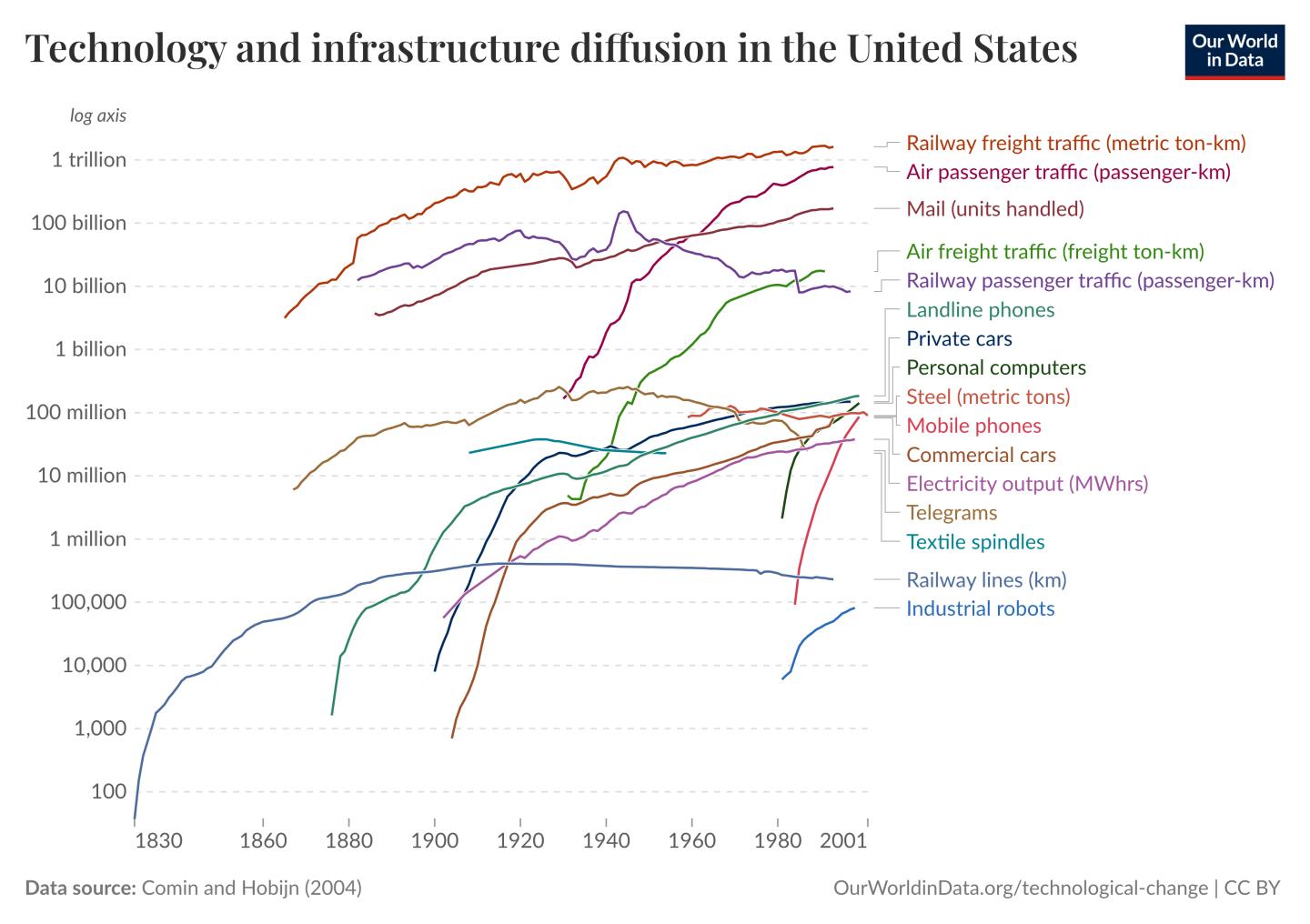
“It’s a great comparison in terms of the scope and the scale, but the speed of what’s happening … is really something quite different,” Tambe said. By comparison, he noted, ChatGPT accounts were everywhere within a year or two.
“We’re starting to do it in multi-month and multi-year transformations,” Korst said.
Tambe noted another difference. Much of the factory reorganization came with a new generation of managers, “when the old ones retired and left and the new ones came in and fixed it,” he said. “So we don’t have that kind of timescale.”
Waiting for a recession
Stanford economist Robert Hall shared the Nobel Prize in economics with Michael Woodford on the morning of Fortune‘s interview with Tambe and Korst. Tambe cited Hall’s work showing that these big economic shifts tend to really lock in when the economy is in recession. “It’s a very interesting parallel,” Tambe said.
Goldman Sachs economists have made a similar argument about AI. Last October, David Mericle and Pierfrancesco Mei argued that the U.S. had entered a period of “jobless growth”—robust GDP alongside modest hiring—that was likely to persist, as Fortune reported. They also offered support for Hall’s thesis: “History also suggests that the full consequences of AI for the labor market might not become apparent until a recession hits.”
“I’m not going to predict recessions,” Tambe said, backing away from a near-term forecast. What he sees in the survey data and in the economy is that “the workflow transformation process has kicked off,” he said. “It doesn’t sound like people are waiting because this technology I think is viewed as so consequential.”
The survey backs him up: 52% of managers and above said their department had changed its management structure because of AI, and 73% said workflows had changed significantly.
Whether managers are really catching up to Gen Z depends on whom you ask.
Tambe said he’s seen the gap firsthand, as he gave back-to-back talks to high school students and senior executives over the summer and asked each group for words describing how they saw AI. The students were far less enthusiastic, he said, and the executives were ready to go.
“Maybe the executives [are] starting to turn the corner on that and start to see for practical implementation reasons what some of the challenges are here,” he said.
He said he wasn’t sure the two groups were pulling back for the same reasons. Executives confronting deployment problems aren’t necessarily responding to the same pressures as students thinking about their futures. And he thinks the movement runs both ways: his younger students, he said, seem to be becoming less concerned than they were a year or two ago.
“There’s a bit of convergence happening here,” Tambe said.
AI can make outputs arrive instantly, but Tambe and Korst both agreed that the harder skill is judging which ones are any good. Tambe said he’s still working through whether that judgment belongs to the person running the workflow.
“It might be the case that you have generalists that run the workflow and experts who run the verification, or you might have one person who does it all,” he said. “That’s an interesting question.”