
• Home
  • Latest
  • Fortune 500
  • Finance
  • Tech
  • Leadership
  • Lifestyle
  • Rankings
  • Multimedia
Economy

Goldman economists on the Gen Z hiring nightmare: ‘Jobless growth’ is probably the new normal

Nick Lichtenberg
By
Nick Lichtenberg
Nick Lichtenberg
Business Editor
Down Arrow Button Icon
Nick Lichtenberg
By
Nick Lichtenberg
Nick Lichtenberg
Business Editor
Down Arrow Button Icon
October 14, 2025, 10:38 AM ET
Jerome Powell
Federal Reserve Chair Jerome Powell sees a “low-hire, low-fire” labor market.Chip Somodevilla—Getty Images

The challenging U.S. labor market is entering a new normal, according to Goldman Sachs economists David Mericle and Pierfrancesco Mei, who tackled the phenomenon of “jobless growth” in an Oct. 13 note. It resonates with what Federal Reserve Chair Jerome Powell memorably described in September as a “low-hire, low-fire” labor market, in which, for some reason, “kids coming out of college and younger people, minorities, are having a hard time finding jobs.”

Recommended Video

Some analysts blame the downturn in entry-level hiring on the impact of AI on the economy, others on macroeconomic uncertainty, especially the seesawing tariffs regime from the Trump administration. The takeaway is clear, though, that getting hired is really hard in the mid-2020s.

“The modest job growth alongside robust GDP growth seen recently is likely to be normal to some degree in the years ahead,” Mei and Mericle wrote, adding that they expect the great majority of growth to come from solid productivity growth boosted by advances in artificial intelligence, “with only a modest contribution from labor supply growth due to population aging and lower immigration.”

The key question is whether the trend of jobless growth will continue, with an era of “job hugging” likely to persist. In an ominous note, the economists cite the track record of how big labor shifts tend to play out: “History also suggests that the full consequences of AI for the labor market might not become apparent until a recession hits.”

Productivity outpacing job creation

America’s economy continues to expand, with real GDP growth projected to remain steady and respectable, even as monthly payroll growth lags well behind historical recovery averages. Goldman Sachs researchers say most of the nation’s output gains will come from productivity improvements—largely powered by rapid AI adoption—while demographic trends like population aging and lower immigration hold down labor supply growth. The result: Hiring activity outside of health care has turned negative on net in recent months, while management teams in many sectors are focused on using AI to streamline operations and cut labor costs.​

This shift is clear in data collated by the investment bank. Payroll growth by industry shows almost all sectors outside health care posting weak, zero, or even negative net job creation, despite otherwise solid macroeconomic indicators. Meanwhile, the share of executives who mention both AI and employment in the same context on earnings calls has reached historic highs.​

Goldman finds the labor market to be “somewhat weaker” than just before the pandemic, with job growth turning net negative in recent months outside of health care, and company management teams increasingly focused on using AI to reduce labor costs, “a potentially long-lasting headwind to labor demand.”

Federal Reserve governor Chris Waller told CNBC’s Steve Liesman the previous week that, notwithstanding the government shutdown and lack of government jobs data, the alternative data are all telling a similar story. “Job growth has probably been negative the last few months,” he said, prompting an exclamation from his interviewer. “If you have negative job growth, that’s not maximum employment, where you’re shrinking your hiring,” Waller said, arguing that the central bank is not fulfilling the employment half of its dual mandate.

The ‘low-hire, low-fire’ labor market

Goldman’s analysis is measured, as Mei and Mericle write they are “skeptical of the boldest claims that rapid technological progress could lead to very high unemployment,” citing their global economics colleagues who argue that innovation and greater spending power will create new opportunities. Relatedly, the Nobel Committee awarded the economics prize earlier this week to economists who specialize in studying “creative destruction,” the same dynamic Goldman is describing here. That being said, Mei and Mericle add dryly, “Some transitional friction has been normal historically and is certainly possible in the future.”

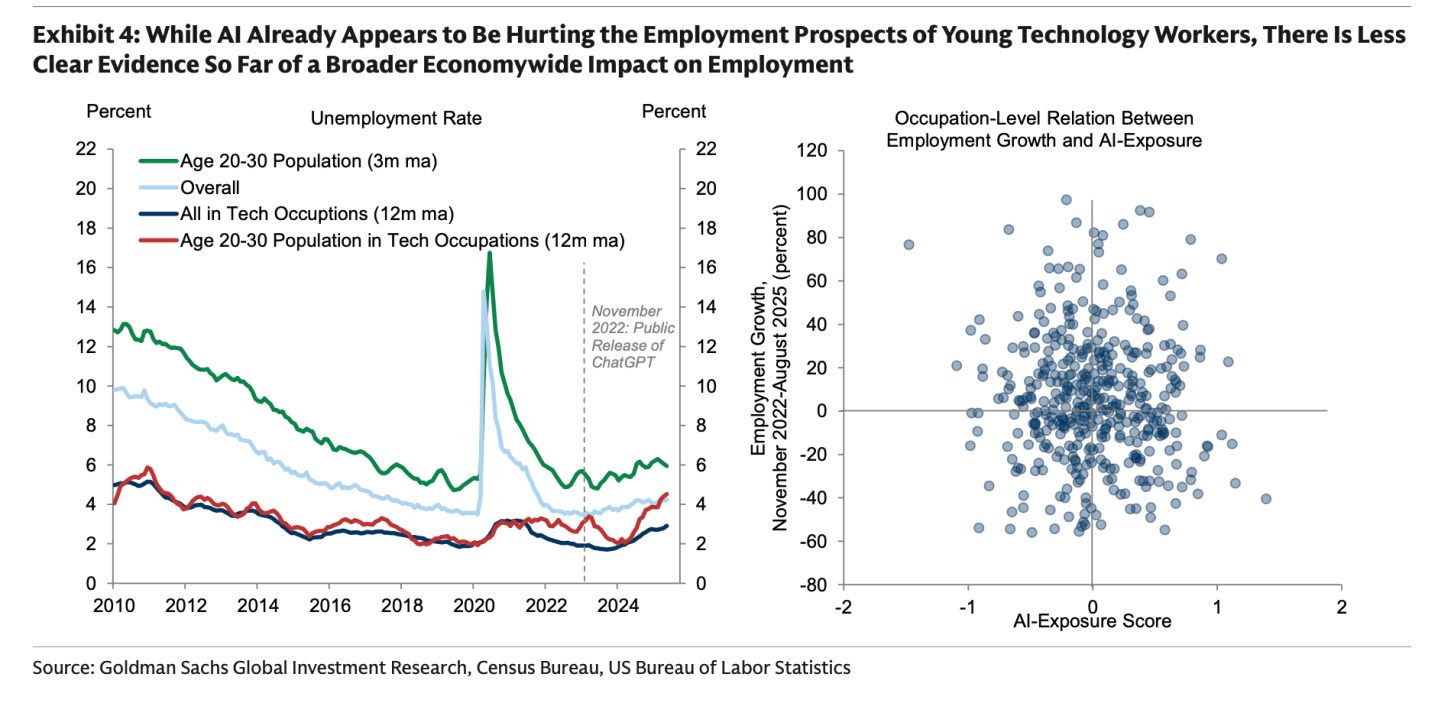
Mei and Mericle do find that AI appears to be hurting the employment prospects of young technology workers, especially those in areas exposed to automation, while the overall macro impact is limited, citing similar research by economist Erik Brynjolfsson and the Yale Budget Lab.
Risks and opportunities in the ‘jobless’ future

The Goldman report also examines the risks and broader implications. History suggests that the full consequences of AI for the labor market may not appear until the next recession hits, citing a leading explanation that “companies use recessions to restructure and streamline their workforce by laying off workers in less productive areas.” This is especially true when recessions follow productivity booms, when overhiring may have occurred, they argue. Several top CEOs and economists have argued that the hiring binge known as the “Great Resignation” resulted in many overpaid workers with inflated job titles who have stopped churning out as the labor market slowed.

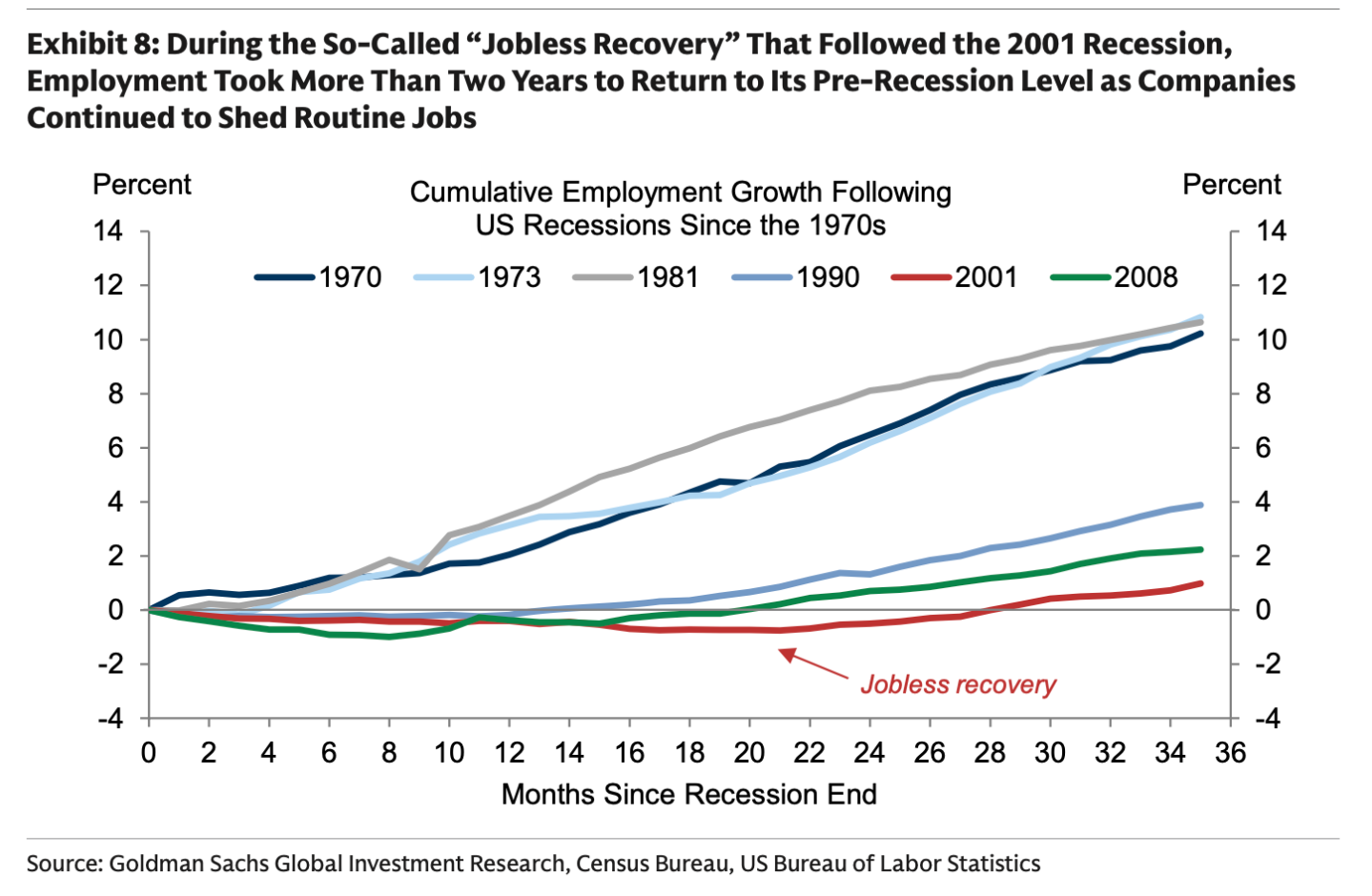
Goldman cites the “jobless recovery” of 2001 after the dotcom bubble burst. “During that recovery, despite a soft labor market, productivity growth remained elevated, and GDP growth rebounded earlier than employment growth.” Economists Alex Bryson and David Blanchflower previously told Fortune that their research on labor markets and young worker “despair” suggests that jobless recoveries could be the culprit, although they acknowledge that the wages and unemployment picture is much more positive. In some sense, then, the low-hire, low-fire labor market may be an acceleration of a condition familiar throughout the 21st century so far: improving productivity that doesn’t feel all that great to workers on very lean teams.
As “jobless growth” becomes entrenched, Goldman Sachs expects policymakers to face tough new choices. Central banks could be forced to keep interest rates lower in response to subpar job creation and modestly higher unemployment, while markets may see mixed effects. Asset prices could be supported by healthy output and low rates, but only if unemployment remains contained and new kinds of jobs emerge to offset losses caused by AI.​

For now, Mericle’s “low-hire, low-fire” diagnosis serves as both warning and guide: Jobless growth may not mean mass layoffs, but it does mean fewer opportunities for job seekers and slower rebounds from economic shocks in the years to come.​

Join us at the Fortune Workplace Innovation Summit May 19–20, 2026, in Atlanta. The next era of workplace innovation is here—and the old playbook is being rewritten. At this exclusive, high-energy event, the world’s most innovative leaders will convene to explore how AI, humanity, and strategy converge to redefine, again, the future of work. Register now.
About the Author
Nick Lichtenberg
By Nick LichtenbergBusiness Editor
LinkedIn icon

Nick Lichtenberg is business editor and was formerly Fortune's executive editor of global news.

See full bioRight Arrow Button Icon

Latest in Economy

Finance
Lorem ipsum dolor sit amet, consectetur adipiscing elit, sed do eiusmod tempor incididunt ut labore et dolore magna aliqua. Ut enim ad minim veniam
By Fortune Editors
October 20, 2025
Finance
Lorem ipsum dolor sit amet, consectetur adipiscing elit, sed do eiusmod tempor incididunt ut labore et dolore magna aliqua. Ut enim ad minim veniam
By Fortune Editors
October 20, 2025
Finance
Lorem ipsum dolor sit amet, consectetur adipiscing elit, sed do eiusmod tempor incididunt ut labore et dolore magna aliqua. Ut enim ad minim veniam
By Fortune Editors
October 20, 2025
Finance
Lorem ipsum dolor sit amet, consectetur adipiscing elit, sed do eiusmod tempor incididunt ut labore et dolore magna aliqua. Ut enim ad minim veniam
By Fortune Editors
October 20, 2025
Finance
Lorem ipsum dolor sit amet, consectetur adipiscing elit, sed do eiusmod tempor incididunt ut labore et dolore magna aliqua. Ut enim ad minim veniam
By Fortune Editors
October 20, 2025
Finance
Lorem ipsum dolor sit amet, consectetur adipiscing elit, sed do eiusmod tempor incididunt ut labore et dolore magna aliqua. Ut enim ad minim veniam
By Fortune Editors
October 20, 2025

Most Popular

Finance
Lorem ipsum dolor sit amet, consectetur adipiscing elit, sed do eiusmod tempor incididunt ut labore et dolore magna aliqua. Ut enim ad minim veniam
By Fortune Editors
October 20, 2025
Finance
Lorem ipsum dolor sit amet, consectetur adipiscing elit, sed do eiusmod tempor incididunt ut labore et dolore magna aliqua. Ut enim ad minim veniam
By Fortune Editors
October 20, 2025
Finance
Lorem ipsum dolor sit amet, consectetur adipiscing elit, sed do eiusmod tempor incididunt ut labore et dolore magna aliqua. Ut enim ad minim veniam
By Fortune Editors
October 20, 2025
Finance
Lorem ipsum dolor sit amet, consectetur adipiscing elit, sed do eiusmod tempor incididunt ut labore et dolore magna aliqua. Ut enim ad minim veniam
By Fortune Editors
October 20, 2025
Finance
Lorem ipsum dolor sit amet, consectetur adipiscing elit, sed do eiusmod tempor incididunt ut labore et dolore magna aliqua. Ut enim ad minim veniam
By Fortune Editors
October 20, 2025
Finance
Lorem ipsum dolor sit amet, consectetur adipiscing elit, sed do eiusmod tempor incididunt ut labore et dolore magna aliqua. Ut enim ad minim veniam
By Fortune Editors
October 20, 2025
Fortune Secondary Logo
Rankings
  • 100 Best Companies
  • Fortune 500
  • Global 500
  • Fortune 500 Europe
  • Most Powerful Women
  • Future 50
  • World’s Most Admired Companies
  • See All Rankings
Sections
  • Finance
  • Fortune Crypto
  • Features
  • Leadership
  • Health
  • Commentary
  • Success
  • Retail
  • Mpw
  • Tech
  • Lifestyle
  • CEO Initiative
  • Asia
  • Politics
  • Conferences
  • Europe
  • Newsletters
  • Personal Finance
  • Environment
  • Magazine
  • Education
Customer Support
  • Frequently Asked Questions
  • Customer Service Portal
  • Privacy Policy
  • Terms Of Use
  • Single Issues For Purchase
  • International Print
Commercial Services
  • Advertising
  • Fortune Brand Studio
  • Fortune Analytics
  • Fortune Conferences
  • Business Development
About Us
  • About Us
  • Editorial Calendar
  • Press Center
  • Work At Fortune
  • Diversity And Inclusion
  • Terms And Conditions
  • Site Map
Fortune Secondary Logo
  • About Us
  • Editorial Calendar
  • Press Center
  • Work At Fortune
  • Diversity And Inclusion
  • Terms And Conditions
  • Site Map
  • Facebook icon
  • Twitter icon
  • LinkedIn icon
  • Instagram icon
  • Pinterest icon

Latest in Economy

President Donald Trump (C) oversees "Operation Epic Fury"
Economynational debt
Trump’s action against Iran is yet another wobble for government debt, warns UBS
By Eleanor PringleMarch 2, 2026
26 minutes ago
EuropeLetter from London
European markets slide as Iran ‘war trade’ joins the global AI ‘scare trade’ 
By Kamal AhmedMarch 2, 2026
38 minutes ago
An intercepted projectile falls into the sea near Dubai's Palm Jumeirah archipelago on March 1, 2026. The United States and Israel launched strikes against Iran on February 28, killing Iran's supreme leader and top military leaders, prompting authorities to retaliate with strikes on Israel and US bases across the Gulf. (Photo by FADEL SENNA / AFP)
EnergyMarkets
Stocks enter global selloff but some on Wall Street are looking for assets that respond well to war
By Jim EdwardsMarch 2, 2026
2 hours ago
Electrician apprentices at work.
Future of WorkCareers
A dire electrician shortage is a ‘life-or-death’ threat to the AI data center boom—and an opportunity for Gen Z
By Preston ForeMarch 2, 2026
4 hours ago
EnergyOil
Dow futures fall 350 points on U.S.-Iran conflict, but oil prices pare gains as Trump hints at sanctions relief for new leadership
By Jason Ma and Amanda GerutMarch 1, 2026
7 hours ago
Middle EastDubai
This American tourist stranded in Dubai due to Iran’s bombardment doesn’t think she’ll be back — ‘the universe was trying to tell us something’
By Brian Melley and The Associated PressMarch 1, 2026
12 hours ago

Most Popular

placeholder alt text
Economy
Your grandparents are the reason the U.S. isn't in a recession right now. That won't last forever
By Eleanor PringleMarch 1, 2026
1 day ago
placeholder alt text
Success
MacKenzie Scott's close relationship with Toni Morrison long before Amazon put her on the path give more than $1 billion to HBCUs
By Sasha RogelbergMarch 1, 2026
19 hours ago
placeholder alt text
Middle East
As Iran attacks Dubai, the tax-free haven for the global elite could see 'catastrophic' fallout — 'this can also send shockwaves globally'
By Jason MaMarch 1, 2026
18 hours ago
placeholder alt text
Personal Finance
Trump's universal 401(k) architect on why lower-income people distrust retirement accounts: 'they want to know what the catch is'
By Jacqueline MunisFebruary 28, 2026
2 days ago
placeholder alt text
Middle East
U.S. military gives Iran a taste of its own medicine with cheap copycat Shahed drones, while concern shifts to munitions supply in extended conflict
By Jason MaMarch 1, 2026
16 hours ago
placeholder alt text
Health
Gen Z men are eating ‘boy kibble,’ the human equivalent to dog food, to load up on protein cheaply
By Jake AngeloMarch 1, 2026
23 hours ago

© 2026 Fortune Media IP Limited. All Rights Reserved. Use of this site constitutes acceptance of our Terms of Use and Privacy Policy | CA Notice at Collection and Privacy Notice | Do Not Sell/Share My Personal Information
FORTUNE is a trademark of Fortune Media IP Limited, registered in the U.S. and other countries. FORTUNE may receive compensation for some links to products and services on this website. Offers may be subject to change without notice.