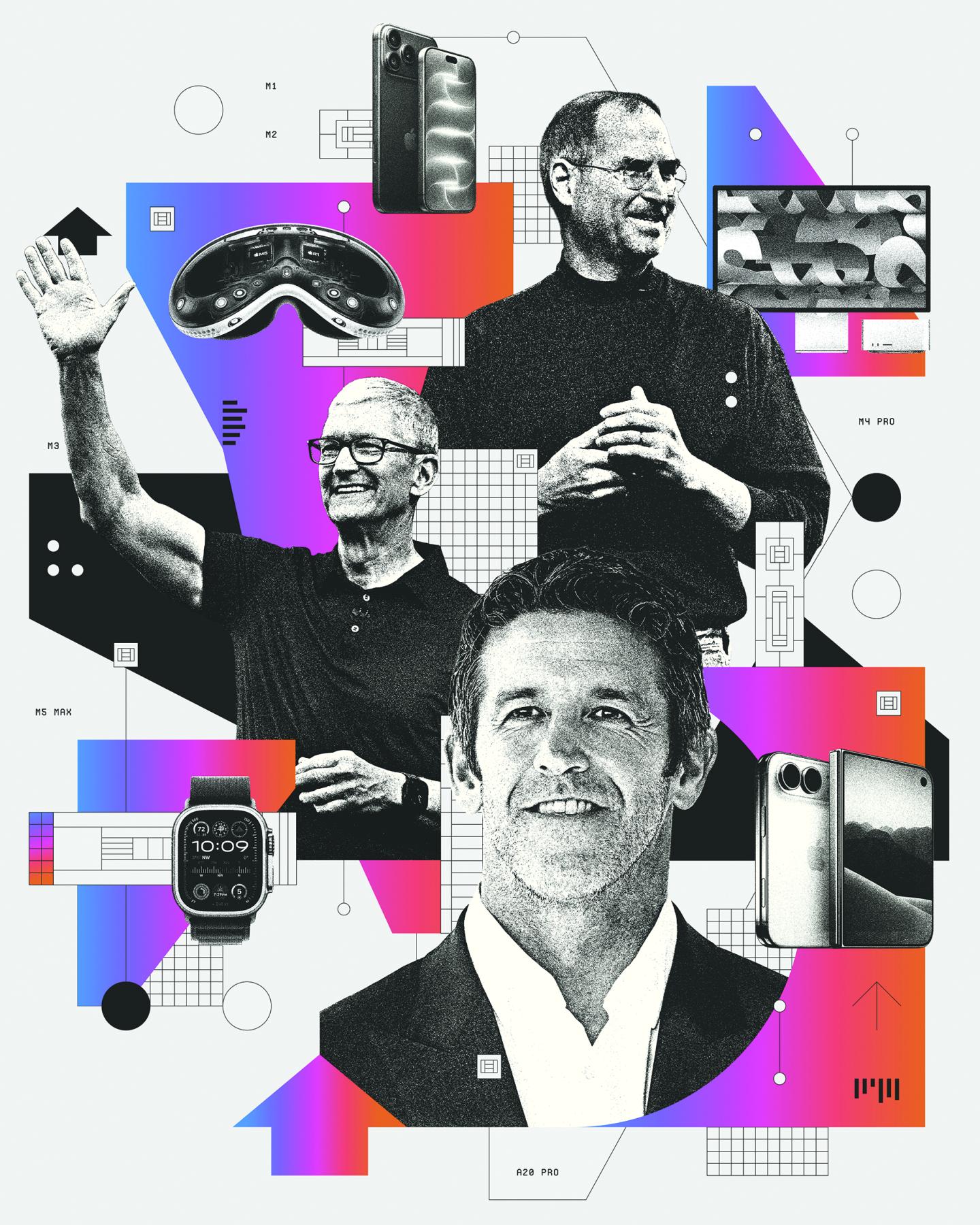

In late July, current and former Apple product developers gathered for a reunion at the company’s Cupertino, Calif., headquarters. As evening fell and guests sipped drinks and ate hors d’oeuvres, John Ternus slipped into the Observatory building, an event space embedded in a landscaped hillside with a large oval window that looks out toward Apple’s main building.
Some guests were surprised to see Ternus at the gathering, held to celebrate a design team executive’s 30th anniversary at the company. Ternus, who was anointed Apple’s next CEO in April, had just finished a long day of reporting the company’s quarterly earnings. But he hung around and worked the crowd, flashing his signature warm smile and reminiscing.
Ternus gave no formal speech, but he projected calm confidence, and in individual conversations, he spoke with genuine excitement about Apple’s product road map over the next several years. “It was super reassuring,” one event attendee told Fortune, asking to remain anonymous to discuss a private Apple gathering. “He holds a tremendous amount of optimism and belief that hard things can be worked out.”
Ternus will certainly have plenty of hard things to work out at the $4.6 trillion company that he’ll lead as of Tuesday, when Tim Cook ends his tenure as CEO and becomes executive chairman of Apple’s board of directors. While the consumer giant’s reach has never been wider, it’s also confronting some of the biggest trials of its 50-year history.
Cook has made Apple a cash-flow king and one of the world’s supply-chain titans, but as Ternus inherits the iPhone-maker from the legendary CEO, Apple is grappling with questions about its strategy on artificial intelligence, where it is facing competition from rivals such as OpenAI. Meanwhile, a memory chip shortage threatens to squeeze its margins, its revenue growth is slowing, and even longtime Apple fans admit the maker of aspirational tech has lost some of its product design mojo.
Though Apple accounts for roughly one in five smartphones shipped worldwide, it’s been a while since the company truly surprised consumers. Recent launch events have mostly settled into a predictable cadence of incremental camera upgrades and routine spec bumps. There have been notable misfires, too, including the Vision Pro headset and updates to its Siri voice-activated assistant. Major software overhauls, like the polarizing Liquid Glass iOS redesign, faced sharp criticism over legibility and performance. Meanwhile, Apple’s long-rumored foldable phone will arrive years after competitors like Samsung defined the category.
The stakes are even higher now in many ways, because every tech company that matters in Silicon Valley is racing to build out new form factors specifically designed for the AI era. That poses a massive risk for Apple, which has been behind the curve in popular products like AI-enabled glasses.
There’s little question that Ternus is an able, trusted, product-literate leader, by all accounts well-liked and respected within the company whose hardware he has helped shape for more than two decades. But it remains to be seen whether an insider, however accomplished, is the right choice to lead the company through an era when it may well need a more disruptive leader—someone who can move faster in AI, make bigger bets, and perhaps reawaken the bold product instincts that made Apple one of Silicon Valley’s most consequential companies.
The Ternus era begins
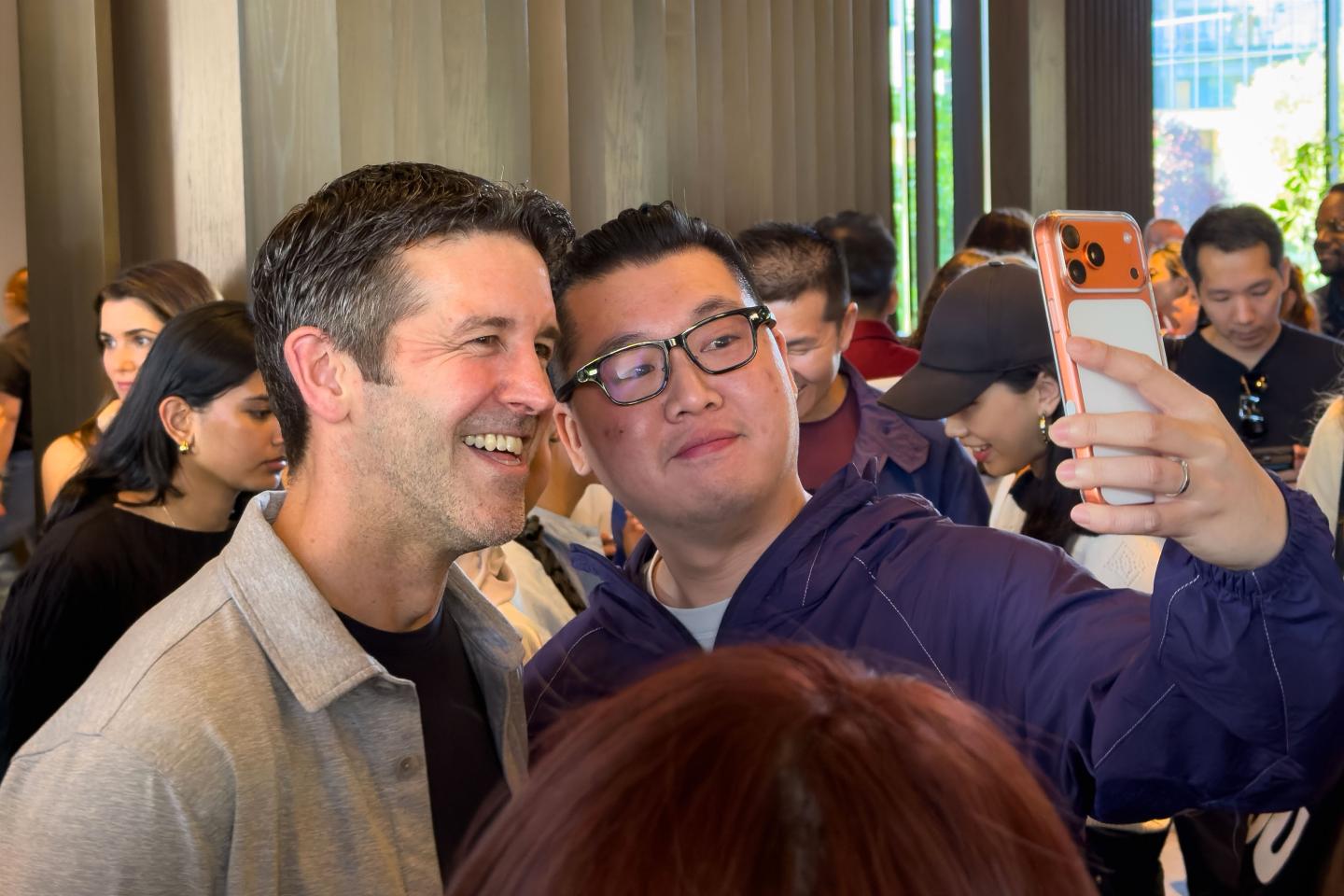
Jean-Louis Gassée, a former Apple executive, told Fortune that based on his interactions with Ternus and those in the Apple orbit, he doesn’t expect to see the new CEO make major changes to start. “I don’t think he’s intent on rushing to make a name for himself,” he said. “He doesn’t want to roil the waters. It’s going to be small touches here and there until they have something really new.”
That focus on continuity is perhaps unsurprising given that Ternus, at 51, has spent 25 years climbing Apple’s corporate ladder. Originally hired by Apple’s product design team, Ternus became vice president of hardware engineering in 2013, overseeing Macs and iPads. In 2021, he became a member of Apple’s senior executive team and has also taken on the development of iPhones, AirPods, and other devices. As his role expanded, Ternus became a more visible presenter at Apple product events, particularly around Mac hardware, Apple silicon, and iPad announcements.
To those who have worked with him or have known him throughout his life, a few things are clear: Ternus is widely admired as a confident, steadfast person with a reputation for being a man of the people, a product-engineer savant with an encyclopedic memory of Apple product minutiae, and an all-around nice guy who has played a significant part in building many of Apple’s most successful hardware products. (Like almost any product leader, he has also worked on products that haven’t been as successful, like the Vision Pro.)
Ternus is not the irascible, never-satisfied tech savant that Apple cofounder Steve Jobs was. Nor is he a design virtuoso, like former chief design officer Jony Ive, who’s now working with OpenAI. “If you’re looking for an iconic product visionary person to come in, that’s not Ternus,” Apple investor Gene Munster told Fortune.
But it’s worth noting: The job description for the chief executive at Apple—and the standards by which success is measured—have often been defined by the person in the role. Over its half-century history, as Apple has reshaped numerous industries, from computing and music to manufacturing and communications, the business has repeatedly evolved to capitalize on the opportunities and address the challenges of each phase.
The question now: Will the Ternus era bring Apple into its next age of smashing success, whatever that may look like?
Inheriting the pressure
Ternus is taking a job that requires both innovative thinking and political savvy, given Apple’s geopolitical scale. (Apple’s annual revenue is comparable to Denmark’s annual economic output.)
Munster remarked that if he were Ternus, “I would feel less like I’m stepping into the role of CEO and more like I’ve just been elected president of the country.” Given that massive scale, he said, “setting a pace around innovation and AI and trying to close the gap is his first order of business. It’s about getting the right people in that are going to ensure success because it’s just such a dogfight.”
And, Munster argues, with a product stockpile of some of the most popular and durable tech on earth to build upon, Apple doesn’t necessarily need a product visionary at its helm to continue its world-dominating success streak.
“He doesn’t need to have a royal flush to win the product,” Munster said. “He just has to keep having good enough hands. Setting a pace around innovation and AI and trying to close the gap is his first order of business.”
Ternus will make his grand public debut as CEO at Apple’s product event on Sept. 9, where the company is expected to provide more details on a revamped Siri, and is also expected to unveil its foldable phone, the first dramatically new phone style after many years of iterating on its original iPhone.
Apple declined to make Ternus available to Fortune for an interview. And in the months leading up to his start as CEO, Ternus has maintained a limited public profile, mostly restricting his comments to controlled environments such as Apple events. In July, at Apple TV’s Ted Lasso season four premiere in Los Angeles, Ternus said he loves Apple, and that “to have this opportunity is beyond words.”
The foldable phone launch will likely provide a tailwind of friendly press coverage to help usher him in, but Ternus can’t bank on a long honeymoon period. While Cook has made Apple into a top five company by market cap, hitting No. 1 as recently as July, Apple revealed that same month a disappointing revenue forecast for its fiscal fourth quarter owing to supply-chain constraints, and said that soaring memory costs are pressuring profit margins.
Apple, like other companies, has already had to raise its product prices because of rising costs, and Ternus must quickly find ways to secure supplies of memory chips (an endeavor that could cause friction with the Trump administration, should Apple set its sights on China’s memory chips).
Apple’s AI era
While competitors continue to circle Apple, the AI era has ushered in new threats to its dominance, with tech companies big and small pouring money into the development of AI-centric gadgets.
Those include Meta, whose glasses collaboration with Ray-Ban is already popular; OpenAI, the AI lab that is collaborating with Ive and building a family of hardware products it imagines as the future of consumer devices; and perhaps even Elon Musk’s SpaceX, which is reportedly working on a consumer device. (Musk has denied he is developing a phone.)
Apple has taken a defensive stance on hardware. In July, it sued OpenAI, alleging that the AI company stole trade secrets via designers it poached from Apple to build its forthcoming devices. OpenAI has contested the allegations, saying: “We believe in fair competition and allowing people the freedom to work wherever they choose.”
Meanwhile, Apple has largely ceded the frontier AI model market to competitors such as Google and OpenAI, choosing for now to focus on delivering the new technology through its high-end hardware.
The company’s AI infrastructure strategy couldn’t be more different from that of its Big Tech counterparts. While Microsoft, Google, Meta, Amazon, and Oracle burn through tens of billions in capital expenditures to construct massive data centers, Apple has avoided the hyperscaler arms race. That restraint has protected short-term margins and cash flow, but it leaves Ternus inheriting a smaller in-house model-training and AI-infrastructure operation than those of competitors.
Nowhere is its shortfall clearer than in Siri’s slow evolution. Despite having essentially invented the personalized voice assistant category roughly 15 years ago, Apple’s failings in building its own generative AI technology have allowed AI assistants like ChatGPT and Claude to leap ahead and made Siri look antiquated (though the company’s new Siri AI, being tested in beta mode, has been praised by some analysts, and its Mac mini has proved popular among AI developers).
“That was not Apple’s finest hour,” Gassée, the former Apple executive, said of the company’s recent Apple Intelligence stumbles. For now, Apple is relying on turning its premium hardware into a privacy-controlled gateway for AI. It’s also betting that much of AI could happen locally on-device, rather than in the cloud.
Apple’s approach may turn out to have been prescient. While other tech giants burn cash on foundation models and infrastructure for compute, Gassée argued that Cook’s late, hybrid approach could well have left Ternus with a potent strategic advantage: “I see a bonfire of billions, trillions of dollars [on LLM spend],” he said. “What we are seeing is that all these models will be or are commodities. So, the money as usual will be made in the upper layers.”
Because Apple didn’t spend hundreds of billions building its own ChatGPT or Gemini and the infrastructure to support it, the company can focus on what matters to the consumer, Gassée noted: “Apple has an opportunity to delight Apple customers with the benefits of AI applied to their own data, and [do so] privately.”
That appears to be exactly how Ternus sees the opportunity ahead. He told the website Tom’s Guide in April: “We never think about shipping technology. We always think about, ‘How can we leverage technology to ship amazing products and features and experiences for our users?’”
He pointed out the AirPods’ live translation feature as one example of the company’s AI strategy. (Apple is also working on camera-enabled AirPods.)
A hands-on engineer steps up
Born in the Los Angeles area in 1975, Ternus, who is often seen wearing a dark crewneck T-shirt, joined Apple in 2001 and is the youngest executive among Apple’s senior leadership. He received a bachelor’s degree in mechanical engineering from the University of Pennsylvania in 1997, where he was a member of the varsity swim team. His coach then, Katharine Gilbert, recalls him showing up to practice each day with a big smile and a cheerful “Hey, Coach, how you doing?”
At his first job out of college, a virtual reality firm, Ternus stood out from other engineers for his ability to take a casual conversation about a concept and quickly turn it into an actual, functional prototype, according to a former colleague. Ternus, the colleague recalled, would spend about an hour in the morning reimagining a product with computer software, then walk into the in-house machine shop and fabricate the part himself on a mill or lathe. The new prototype would be ready to test by that afternoon.
At Apple, Ternus has tackled some of the company’s trickiest hardware problems, including playing a pivotal role in the company’s 2007 iMac, which was the first to feature the iconic aluminum casing. More recently, he directed hardware engineering teams on new iPhone iterations, including the slim iPhone Air, and has managed the hardware evolution of the Mac with Apple-made silicon.
Former employees told Fortune that Ternus has every technical detail about the products he is working on at his fingertips. Some recall Ternus being able to cite plastic material measurements, drop-test physics equations, or weight metrics for various products—on the spot.
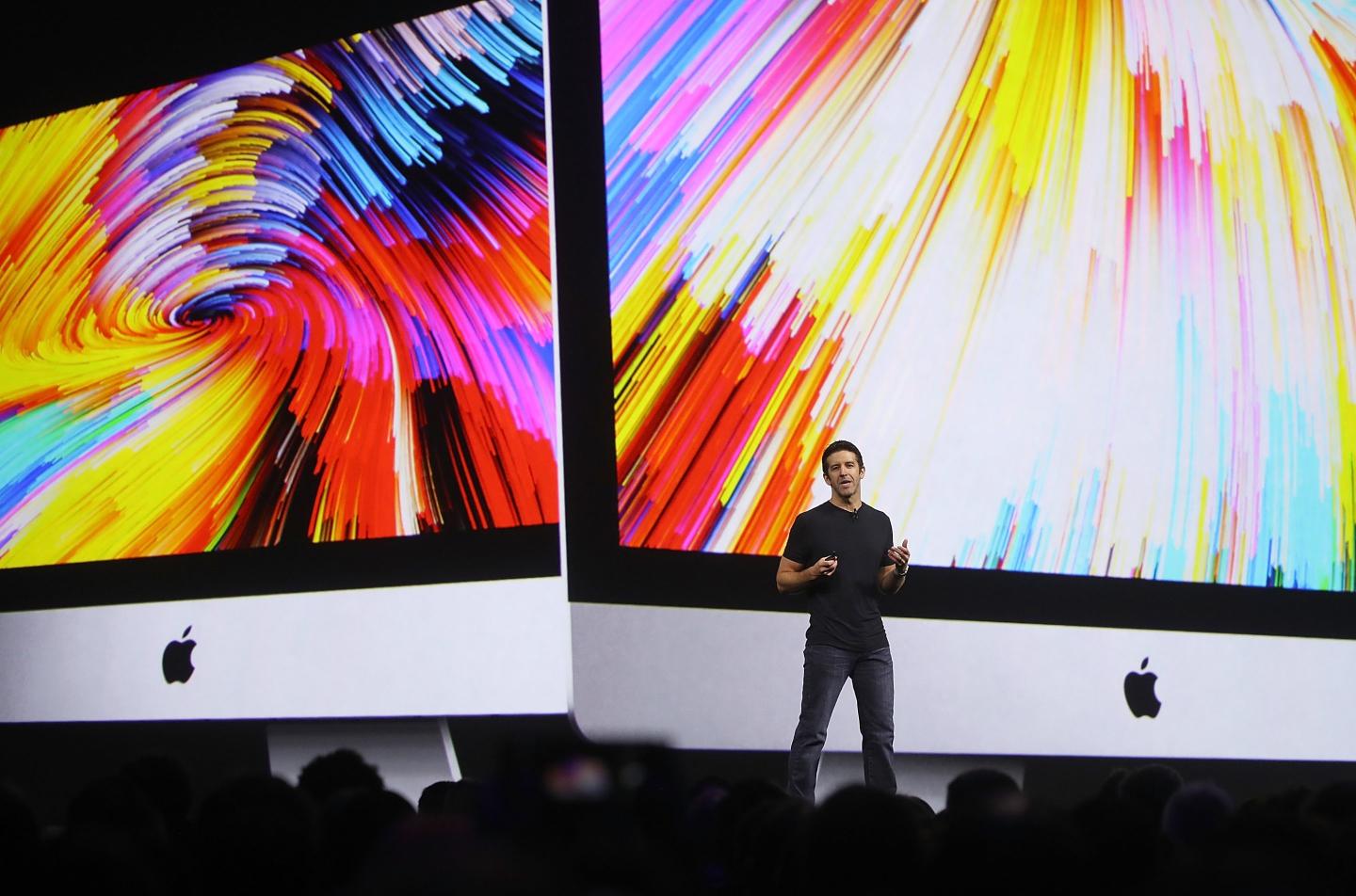
That focus on details does not mean Ternus lives in his own head. Former colleagues describe him as having a knack for establishing quick rapport with those he works with. He smiles and laughs easily, and one of his signature moves has been to call people “dude” in a way that feels like a friendly nickname.
Adam Mittleman, a product design engineer who worked on iPhones at Apple, recalled sitting next to Ternus years ago (Ternus has been known for sitting among rank-and-file workers instead of in his own office). Mittleman said that during the development of the first iPhone, when he was pulling 70-hour weeks and sleeping under his desk, Ternus advised him to go to the cafeteria to take a break and build relationships.
During the development of the second-generation iPhone, Mittleman’s team was struggling with defects in the curved plastic casing when Ternus proactively connected the team with iMac engineers who had developed a quality control technique using so-called structured light to study the curvatures, and eventually manufacture perfect designs. The gesture reshaped how Mittleman’s team thought about their problem.
“Being able to focus on excellence and aggressive speed and everything else in that political environment and still treat people nicely was really wonderful,” Mittleman said of Ternus.
Outside of Apple HQ, Ternus is a fixture at racetracks such as Laguna Seca Raceway in Salinas, Calif., where he has raced his Porsche. Earlier in his life, he owned a Ford Mustang, which he could talk about for hours with high technical specificity—horsepower, torque, and mechanical performance—former colleagues said.
At the crossroads
Ternus will be Apple’s eighth CEO in a line of succession that has largely reflected the company’s needs at a particular moment. Apple’s first CEO, Michael Scott, for instance, was selected by investor Mike Markkula to be the responsible, mature counterpart to cofounders Steve Jobs and Steve Wozniak, who were in their twenties when they started the company.
Jobs was forced out of Apple in 1985 after a power struggle with then-CEO John Sculley, only to return as CEO in 1997 and preside over the company’s extraordinary revival—launching a run of industry-defining products including the iPod, iPhone, and iPad.
When Cook took over as CEO shortly before Jobs’ death in 2011, he brought a supply-chain wizardry that, when applied to Jobs-era innovations like the iPhone, created a tech giant with multiple streams of high-margin businesses and annual revenue that has since grown by more than $300 billion.
With Ternus, as with Cook, Apple’s board of directors chose an insider with deep knowledge of the company’s culture and business lines. Ternus’s expertise in executing on Apple’s product road map and maintaining the company’s high engineering standards signals a commitment to a central pillar of the Apple brand, even as the company seeks to evolve with the times.
Remember, too, that Cook was seen as a nice guy when he took over for Jobs, who famously built a reputation as an intense boss who sometimes courted confrontation. As it turned out, one of Cook’s superpowers has been to project niceness on the surface and in public appearances but maintain a ruthless discipline underneath while extracting every possible efficiency from suppliers.
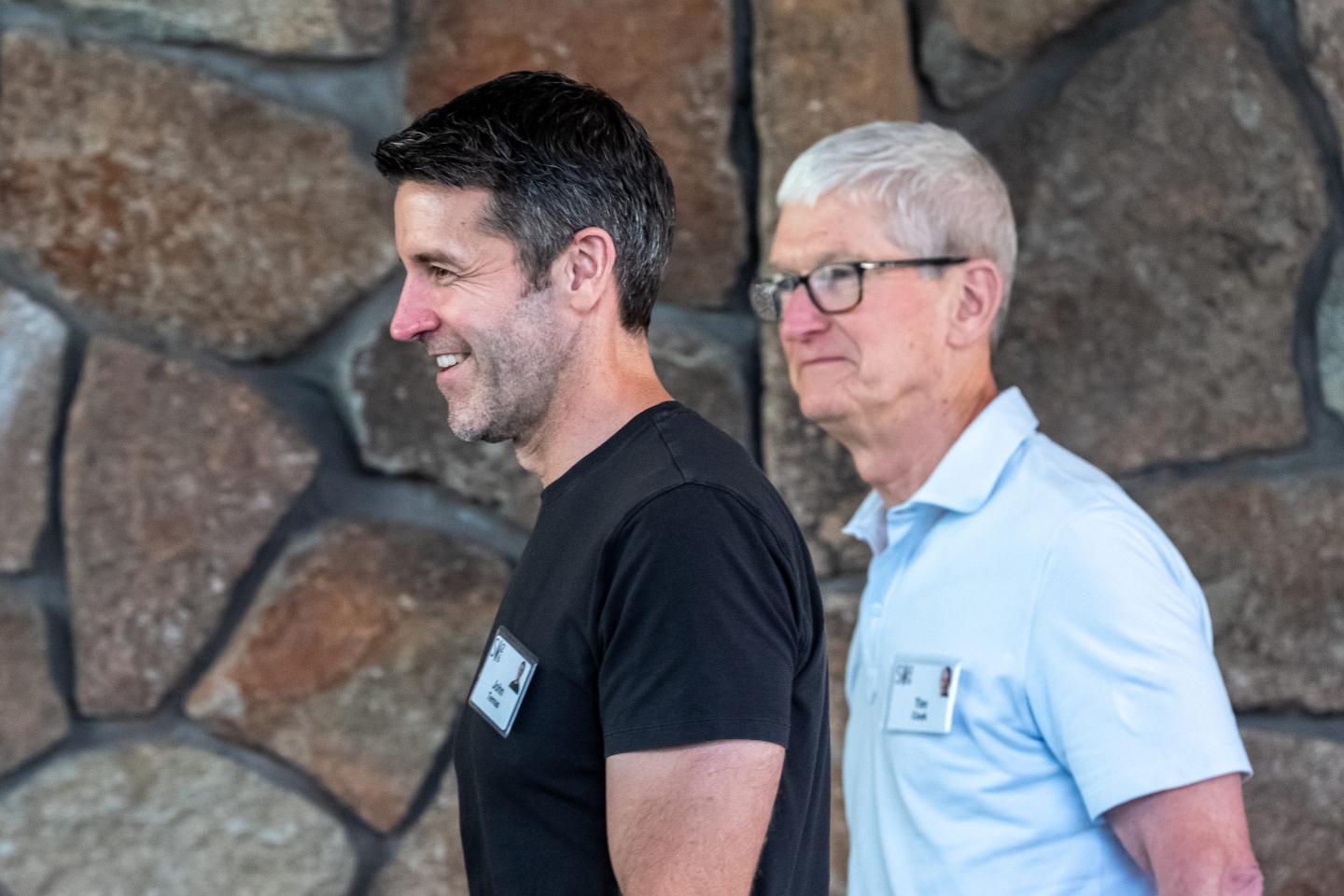
Whether Ternus’s approach will take the same form remains to be seen, but as former colleagues pointed out, Apple’s board chose Ternus for a reason. Nice or not, he has successfully maneuvered through a highly secretive and systemic corporate environment while doling out products that, by and large, sell extraordinarily well.
Some Apple analysts told Fortune that Ternus’s product background is exactly the kind of expertise Apple needs at this moment.
Ternus “has the opportunity to be more prescriptive about device design and about preferences around [the user interface],” said Bank of America analyst Wamsi Mohan, who wrote in a recent note that Apple’s move away from a net cash neutral financial strategy indicated it could devote more investment toward research and development, capital expenditures, and acquisitions, which may be required for Apple to keep pace in the AI era.
The leadership team that Ternus assembles around him will also be key as he takes over a sprawling organization and prioritizes where to invest resources. Instead of mostly focusing on products, Ternus will now be tasked with overseeing a company that includes a streaming TV business, a network of retail stores, data centers, a massive marketing organization, numerous flagship services such as iCloud, and much more. Former colleagues said Ternus has an ability to empower others that can help him deal with the intense responsibilities he is taking on.
“Being under the gun and operating as ‘the buck stops here’ is definitely a lot of pressure” for Ternus, Mohan said, though Ternus will benefit from Cook staying on as Apple’s executive chairman.
‘It requires sacrifice’
Ternus has offered few public clues to his leadership philosophy, but a story he told in a 2024 commencement address has been passed around as a revealing shorthand for his view of craftsmanship and attention to detail.
Ternus told University of Pennsylvania engineering graduates that during the creation of the Cinema Display, a desktop monitor that was one of the first Apple products he worked on, he found himself at a supplier facility past midnight using a magnifying glass to count grooves on steel screws on the back of the monitor. He argued with the supplier because the parts had 35 grooves instead of the 25 Apple wanted.
For a brief moment, Ternus wondered if what he was doing was odd. After all, no customer was likely to notice the difference.
But then he thought, “If you are going to spend that much time on something, you should put in your very best effort,” he told graduates. “Whenever I saw one of those displays on someone’s desk, it mattered to me to know that my teammates and I had considered everything about it and done the very best job we could.
“It’s hard to put that much of yourself into something. It’s stressful. It requires sacrifice. But it’s worth it because our time is finite.”
This article appears in the October/November 2026 issue of Fortune.