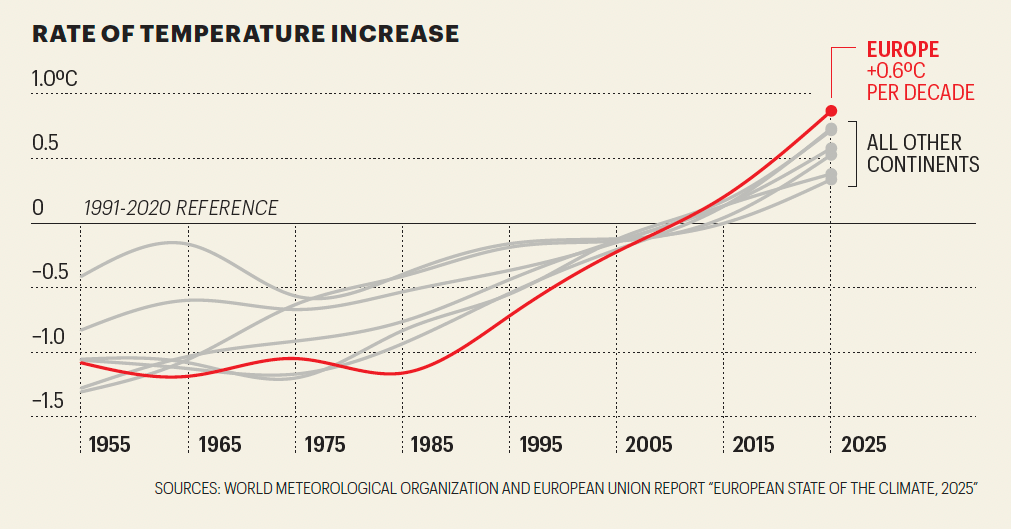
Crippling droughts in Africa’s Sahel region, flash floods in Southeast Asia, sweeping bushfires in Australia, melting permafrost in Siberia: Once the theoretical preserve of scientific models, the impacts of climate change are suddenly becoming a whole lot more real. Europe, to date, has avoided the worst of it. But that looks set to change. According to a landmark study by Copernicus, the EU space program’s Earth observation service, the European continent is now the fastest-warming region on the planet after the Arctic, with temperatures rising at double the global average since the 1990s.
To compound the problem, citizens across Europe are now facing the pending threat of what Copernicus describes as a “very strong” super El Niño. Generated by the warming of the Pacific Ocean, this periodic phenomenon could see temperatures soar to record levels over coming months, scientists warn.
The implications for public health are severe. Up to 25,000 people are estimated to have died during Europe’s worst-ever heat wave in June, with elderly people and vulnerable populations especially affected.
The increasing frequency of extreme heat during the summer months also carries significant implications for business. Most obvious is the hit to employee productivity: The higher the thermometer climbs, the more sluggish and prone to mistakes workers naturally become.
Companies’ output is especially hard-hit during heat waves. Not only are sick-leave rates shown to spike during intense hot spells, but health and safety laws in countries such as Italy and Greece oblige workers to actively stop working during peak midday heat.
Temperatures don’t need to hit boiling point for productivity losses to start showing. According to the World Health Organization, worker output is estimated to drop by 2% to 3% for every degree above 20 degrees Celsius.
Hence the warning from Manal Azzi, an occupational health and safety expert at the International Labour Organization, not to treat heat stress “only as a heat wave issue.” According to ILO figures, 90% of exposure to excessive heat happens outside official heat-wave periods.
Productivity losses aside, excessive heat brings a slew of extra costs, from surging energy bills to emergency maintenance expenses as key equipment overheats and transport systems break down.
While perennially hot regions such as Asia, Africa, and the Middle East have developed strategies to mitigate the business impacts, European companies are comparatively underprepared for the hotter temperatures coming their way. The German financial services company Allianz goes as far as to describe extreme heat as a “structural economic risk” to which Europe is “highly exposed.”
A recent stress test carried out by Allianz confirms as much. Tellingly titled Too Hot to Grow, the report predicts that heat-related losses between now and 2030 could reach $240 billion in France, $147 billion in Italy, $131 billion in Germany, and $120 billion in Spain. Under this forecast, cumulative GDP losses could reach 7% in the most-exposed economies.
Worryingly, the bulk of these losses are not covered by insurance. As Allianz warns: “Most heat damage accumulates through excess mortality, lost working hours, healthcare-system pressure, and infrastructure stress—channels that indemnity contracts are not designed to handle.”
While European companies—especially those located in the cooler climes of northern Europe—may not be historically attuned to the threat of heat stress, many businesses in the region are now mobilizing to address the risks.
Those leading the pack come from sectors where the risks are highest, says Maurizio Curtarelli, a senior researcher at the European Agency for Safety and Health at Work. Topping this list are industries where the workforce typically operates outside, such as agriculture, construction, refuse collection, and logistics, or where heatmaking equipment or heavy protective clothing are commonplace, such as manufacturing, mining, and metallurgy.
That said, a recent Europe-wide survey by EU-OSHA reveals that concerns about excessive heat are becoming increasingly universal, with one in five workers reporting unhealthy exposure to extreme temperatures and around one in eight to intense sun.
Another nuance to consider is workers’ varied ability to acclimatize, Curtarelli notes. So even though temperatures in northern Europe may not hit the scorching levels of Mediterranean countries, employees in the former may still find it “very difficult to adapt” to increases in temperature. “Impacts on workers in southern Italy or southern Spain, for instance, are obviously still important, but they probably have a better capacity of adaptation to changes in temperatures,” he says.
Across Europe, therefore, heat management is finding its way into the occupational health and safety agenda. Demand for EU-OSHA’s Heat at Work guidance paper, published only last year, is already the agency’s most downloaded document ever. The 20-page report offers guidance on how to conduct an assessment of the impacts of extreme heat on the workforce and advises companies to carry out regular employee consultations, staff training, and “health surveillance,” which involves monitoring workers for heat-related illnesses.
Feeling the heat
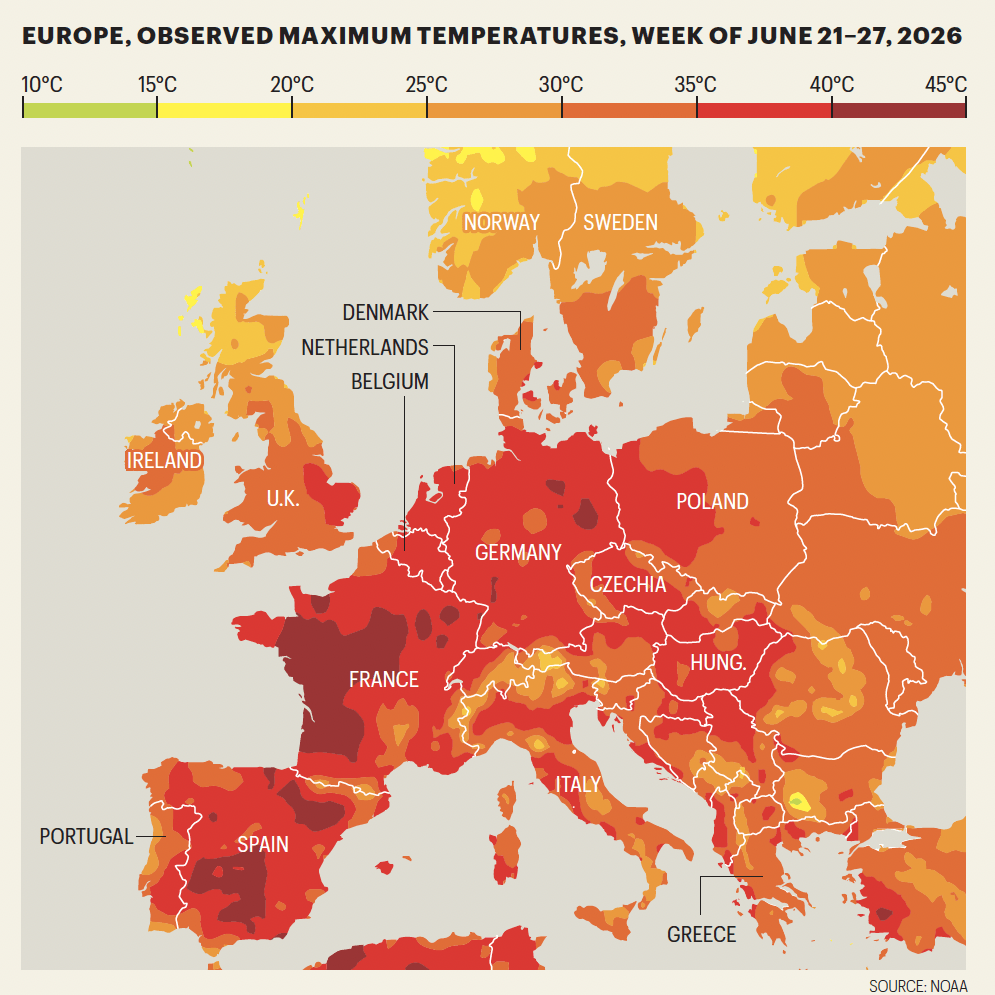
Western Europe experienced its hottest-ever June, with temperatures across the region averaging 3°C higher than previous decades. The soaring temperatures have caused raging infernos across southern France and Spain, with European wildfires burning through 56% more land than in prior years. The pressure is now on for Europe to adapt to these searing summer temperatures as the continent warms faster than anywhere else in the world, bar the Arctic.
One example is technology company IBM, which has established internal safety committees led by employee-based work councils to track heat-related problems, alongside other workplace health issues. “Extreme heat is not coming up as a risk as yet, but we continually review accident data and any emerging trend—whether related to heat or another factor—and would investigate its root cause and ensure it is duly addressed,” says a health and safety spokesperson for IBM in Spain.
The low instance of employee complaints is primarily attributed to IBM’s modern office buildings. Thanks to measures such as cross ventilation, window blinds, and—most important—air-conditioning, employees can remain cool at their desks even when outside temperatures are scorching.
Managing manufacturing units and industrial sites is more complex, but a similar mix of clever architectural design and smart cooling technologies can help mitigate extreme heat conditions, says Dominique Laurent, human resources director for Schneider Electric.
One measure that Schneider has introduced in many of its 70 or so factories and distribution centers in Europe is the creation of air-conditioned rest areas where workers subjected to high temperatures can go to cool off.
As a specialist in energy hardware and software, the company has also installed a range of smart cooling solutions across its entire estate. These include reversible heat pumps, which keep indoor temperatures 6 degrees Celsius below those outside; AI-enabled air-conditioning systems; and insulated roofing sheets, among other measures.
“We use our own dedicated EcoStruxure software solution, which enables us to continuously manage cooling measures like the opening of windows and natural air circulation in the most energy-efficient way,” Laurent explains.
Similar to other leading employers, Schneider also has a series of employee welfare protocols that kick in when temperatures are high. While specific measures vary from site to site, employees are given ready access to energy drinks and can move shift times to earlier or later in the day to avoid periods of peak heat.
Logistics firm DHL makes similar accommodations for its delivery staff. In Germany, for example, every courier is issued a “cool box” on hot days that contains a reusable cooling towel; a water-activated wrist cooler that provides relief through evaporative cooling; and a neck protector that minimizes UV radiation.
“We also offer our employees a comprehensive range of DHL work wear suitable for all weather conditions, from protective long-sleeved shirts to Bermuda shorts,” company spokesperson Sarah Preuß points out.
“We’re at the stage where heat is not a future risk. It’s an active daily stressor that we have to engineer our way out of.”
Ying McGuire, CEO, Cascale
Barring a major global intervention to curb climate change, European businesses can expect more record-breaking heat waves in the years ahead and, as a consequence, growing pressure for safe workspaces from regulators and workers alike.
One lesson from hotter climes outside Europe is the need to consider staff well-being outside of working hours. Employees may be cool on the job, but poorly ventilated homes or stifling commuter transport will still see them arrive at work feeling tired and frazzled.
Responsible employers could take a leaf from the book of nonprofit Practical Action, which is partnering with several city corporations and municipalities in Bangladesh to install rooftop insulation and other heat-regulating measures in the homes of a range of informal workers.
“If someone is working in an air-conditioned garment factory, but then returns to a house without any cooling whatsoever, then their sleep cycles will inevitably be disrupted and their productivity will drop,” says Tamanna Rahman, a climate resilience expert at the charity.
The use of air-conditioning, however, is not always the best solution. For one, the technology is energy-intensive, leaving employers with crippling electricity bills if they are not careful.
Secondly, if the electricity to power it comes from natural gas or coal, then the solution could end up exacerbating Europe’s heat problem rather than solving it. The electricity grids in some of the EU’s hottest countries also have the highest fossil-fuel reliance, including Italy (49%), Greece (52%), Cyprus (76%), and Malta (85%).
Another option that employers might consider is introducing natural heat-regulating measures such as green walls and roofs, trees, or ponds. These so-called nature-based solutions help cool the air through shading and evaporation.
Mark Shayler, head of ESG at Idverde, a Europe-wide landscape-service company, points to the example of Swedish retailer Ikea, which has installed “pocket parks” and rain gardens to increase biodiversity across many of its store and city-center locations. Such solutions act as “nature’s air-conditioning,” he says. “Unlike mechanical cooling, they require no electricity, produce no emissions, and simultaneously clean the air.”
Whatever solutions companies choose, the imperative for all responsible employers is to act—and to act now. The excuse that temperatures are unseasonally high no longer washes. As Ying McGuire, CEO of Cascale, a global nonprofit alliance of consumer goods companies, notes, excessive heat is increasingly becoming the norm, not the exception: “We’re at the stage where heat is not a future risk. It’s an active daily stressor that we have to engineer our way out of.”
This article appears in the August/September 2026: Europe issue of Fortune with the headline “As heat waves send Europe into meltdown, can businesses adapt?”