Disney has historically refused to describe in detail the revenues earned by its growing cruise ship business. Its CFO, Hugh Johnston, has declined to do so on previous earnings calls.
“We don’t break out cruise ships,” explained Hugh Johnston on its Q3 call last year.
But Fortune can reveal that a Disney filing in the U.K.—where its ships are based for tax reasons—reveals that cruise revenue passed the $3 billion mark last year for the first time, fuelled by the addition of a sixth ship to its fleet as part of a $12 billion expansion.
Fortune reached out to Disney for comment.
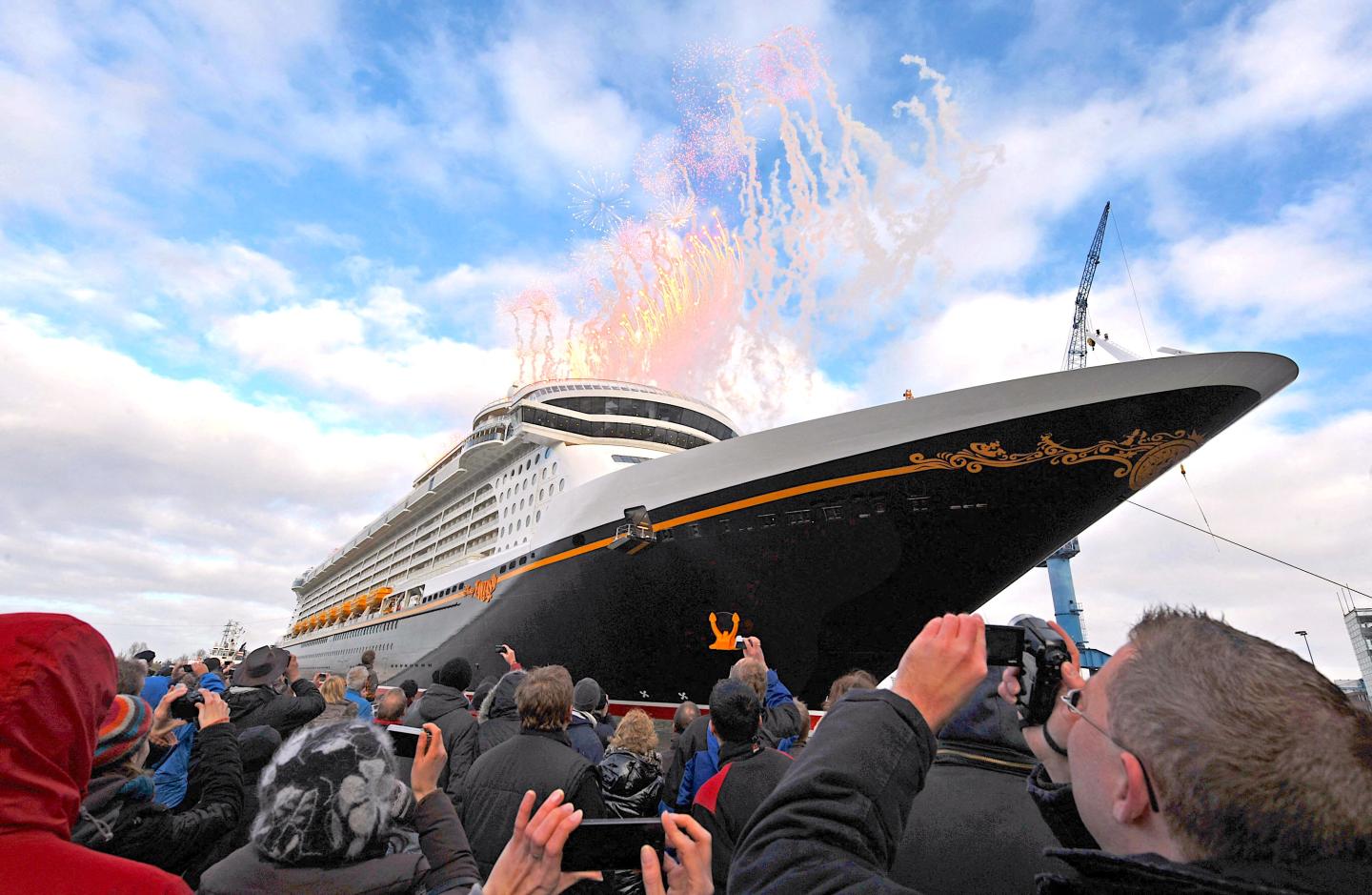
Disney’s ships look more like floating theme parks than cruise liners. They are filled with cuddly characters, Broadway-caliber shows and water slides with screens set into the tubes to tell stories about Mickey Mouse while riders rocket past on rafts.
The ships are part of Disney’s Experiences division, which also includes its theme parks and is the company’s biggest cash cow. Experiences generated 57% of Disney’s $17.6 billion operating income in 2025 and nearly 40% of its $94.4 billion revenue.
However, the company’s financial disclosures in the U.S. don’t break out numbers for the cruise line.
Instead, the company only gives general guidance on its performance in its earnings calls and releases. However, filings for a subsidiary in the U.K.—which, perhaps deliberately, does not use the “Disney” name—shine a spotlight on the success of Disney’s cruise line.
Although Disney’s cruise line is headquartered near its theme park complex in Orlando, Florida, it is directly owned by a subsidiary in London called “Magical Cruise Company.”
Disney chose London for tax reasons
There is a good reason for this shell structure: Shipping companies based in the U.K. benefit from a highly advantageous regulatory scheme known as Tonnage Tax. Instead of paying standard corporate tax on actual income, qualifying cruise lines pay a fixed tax rate based on the net tonnage of their fleet. Decoupling the tax liability from earnings has a particular benefit for high-margin cruise lines like Disney’s, which charges a premium for its unique experience. That’s not all.
The U.K. is also the historic home of global maritime law, finance, and insurance, including the renowned Lloyd’s of London shipping insurer. Incorporating a shipping business in the U.K. gives easy access to these services, which are widely considered to be the industry’s gold standard. The location was also convenient as the Disney Magic and Disney Wonder, which launched in 1999, were built by the Fincantieri shipyard in nearby Italy.
The consequence of being based in the U.K. is that the company has to file annual financial statements, which reveal everything from its revenue and income right down to its staff costs and inventory expenses. The latest set was filed last week and shows that during the year to September 27, 2025, cruise line revenue surged by 20.3% to $3 billion following the launch of its sixth ship, the Disney Treasure, in December 2024. It was also buoyed by a surge in the popularity of cruising—global passenger volume hit a record 37.2 million in 2025.
The Disney fleet
Disney’s connection to the U.K. dates back to the mid-1980s when the company first dipped its toe in the water of cruising. In 1985, Disney signed a partnership with Premier Cruise Lines, which was owned at the time by The Greyhound Corporation, a Fortune 500 company famous for its bus lines. The deal allowed Premier to sell combined cruise, hotel and theme park packages and offer on-board appearances from Disney characters.
In 1993, Premier had a change of heart and abandoned its partnership with Disney. This led Disney to approach Carnival and Royal Caribbean about becoming its exclusive sea partner. But the talks sank without trace.
Following that, Disney took the plunge and in 1998 launched its own ship, the 85,000-ton, 875-room Disney Magic. It didn’t stop there, acquiring a 99-year lease on a 1,000-acre private island from the Bahamian government.
Originally known as Gorda Cay, it is believed that pirates frequented the island in the 1700s. By the 1990s, when cruise ships visited private islands they had to moor at sea and transport guests to land by a tender boat. Disney’s private island became the first to allow ships to dock directly at the shore—eliminating the need for a tender.
The launch of the sixth ship drove up the costs of Disney’s cruise line last year and that increase outstripped the rise in revenue, leading to net profits sinking by 12.9% to $302.7 million. Staff costs alone swelled by 31.4% to $437.2 million due to the addition of 1,765 employees with the bulk of the new recruits being shipboard personnel.
The increase in expenses was also due to preparation for the launch of two new ships—the Disney Destiny and Disney Adventure which were both launched within six months of the financial statements being filed.
“The company remained highly profitable during the financial year while managing various one-time costs associated with business growth initiatives, including pre-operational expenses for upcoming fleet additions such as the Disney Destiny and Disney Adventure,” according to commentary in the financial statements by Jeff Swindell, senior vice president of finance at Disney Signature Experiences, the business segment responsible for attractions outside the theme parks.
With 2,111 rooms, the Disney Adventure is one of the world’s biggest cruise ships, but Disney paid just $44 million for it after its previous owner, Genting Cruise Lines, fell into administration. Disney sprinkled its famous pixie dust on the ship by adding the longest roller coaster at sea, a three-deck-tall castle and an open-air Marvel superhero stunt show.
It is based in Singapore and launched there in March with a 10-minute drone and fireworks show watched by a glittering array of stars including the ship’s godparent Robert Downey Jr. and Disney’s CEO Josh D’Amaro. “The company sees great growth potential in Asia as one of the most dynamic, culturally diverse and well-connected travel regions in the world,” said Swindell. “Consumers in this region have shown a strong affinity for Disney, and the company has ample room to grow based on the current footprint of its fleet and global market share.”
Disney plans 5 more ships as part of $60 billion investment
The two recent launches give Disney a fleet of eight ships but five more are coming by 2031. They are part of a $60 billion investment by Disney in Experiences with 20% allocated to cruises. One of the new ships won’t cost it a dime as it will be fully financed, owned and operated in Japan under license by local leisure giant Oriental Land Company (OLC). Its filings state that if the first ship is a success, “operating multiple ships will be expected in future.”
OLC forecasts that within the first few years one ship alone will generate annual net sales of $650 million (¥100 billion) with an approximate operating margin of 26.7%, yielding profits of around $174 million. It is roughly in line with the Magical Cruise Company’s results as its revenue doubled over the eight years to 2025 during which time it launched two new ships.
In the filings, Swindell said “the company expects to maintain strong profitability in financial year 2026, supported by capacity growth from the Disney Treasure, the Disney Destiny and the Disney Adventure.” The filings don’t disclose how many passengers Disney carried in 2025, but industry tracker CruiseMarketWatch put it at 1 million, giving it just 3.1% of the market. That’s a drop in the ocean compared to the 6.8 million passengers carried by industry leader Carnival, so despite Disney’s aggressive expansion, it is still a relative minnow in the industry.