
• Home
  • Latest
  • Fortune 500
  • Finance
  • Tech
  • Leadership
  • Lifestyle
  • Rankings
  • Multimedia

Trendingnow

1

The U.S. spent $30 billion to ditch textbooks for laptops and tablets: The result is the first generation less cognitively capable than their parents

2

Peter Thiel and other tech billionaires are publicly shielding their children from the products that made them rich

3

Trump embraces Australian retirement system backed by Larry Fink

1

The U.S. spent $30 billion to ditch textbooks for laptops and tablets: The result is the first generation less cognitively capable than their parents

2

Peter Thiel and other tech billionaires are publicly shielding their children from the products that made them rich

3

Trump embraces Australian retirement system backed by Larry Fink
North AmericaWealth

America pays workers just 27% of what its wealth allows — the worst in the OECD

By
Stephen Bagwell
Stephen Bagwell
,
Susan Randolph
Susan Randolph
, and
The Conversation
The Conversation
Down Arrow Button Icon
By
Stephen Bagwell
Stephen Bagwell
,
Susan Randolph
Susan Randolph
, and
The Conversation
The Conversation
Down Arrow Button Icon
July 13, 2026, 3:20 PM ET
usa
Protesters gather outside Zuccotti Park after police removed the Occupy Wall Street protesters from the park early in the morning on November 15, 2011 in New York City. Hundreds of protesters, who rallied against inequality in America, have slept in tents and under tarps since September 17 in Zuccotti Park, which has since become the epicenter of the global Occupy movement. The raid in New York City follows recent similar moves in Oakland, California, and Portland, Oregon. Mario Tama/Getty Images
Add Fortune on Google for similar content.

As the United States celebrates the 250th anniversary of its Declaration of Independence, the global data we collect and analyze shows that the country is failing to “promote the general Welfare,” as the Constitution’s framers promised a little more than a decade later.

Recommended Video

We are scholars of human rights. Alongside the Human Rights Measurement Initiative, a nonprofit that tracks how well more than 200 countries and territories are meeting the human rights commitments their governments have made, we annually update scores measuring whether people can actually get the basics of a decent life, such as healthcare, adequate food and a quality education.

The latest data our team has amassed shows that the U.S. is falling short compared with what it could achieve, given its US$32 trillion economy. This is not a one-year blip – the U.S. has been underperforming for the past 25 years.

Economic and social rights

Two foundational human rights agreements, the Universal Declaration of Human Rights and the International Covenant on Economic, Social and Cultural Rights, describe countries’ obligations to promote the welfare of their people. Countries should improve the health, education and occupational well-being of their people over time, as best they can, given their “resources.”

The United States co-authored and voted in favor of the universal declaration in 1948. Although President Jimmy Carter signed the International Covenant on Economic, Social and Cultural Rights in 1977, U.S. lawmakers never ratified it.

Resources in this context generally mean a government’s wealth and capacity. We measure resources by using per capita gross domestic product – the amount of money in a country evenly divided among its entire population. Because rich countries, like the U.S., can do more than lower-income countries, like Haiti, they are held to a higher standard.

So we don’t just ask how healthy, well-fed or educated the people of a country are. We ask how well a country is providing for its people compared with other countries with similar resources.

A 100% score means a country is doing all it can with what it has, and further improvements would require more resources. A lower score means there’s room for improvement.

Doing all you can with what you have doesn’t mean a government has to provide goods and services directly. Governments can rely on private businesses, employers, nonprofits, public programs or a combination. What we score is the result: Are people actually getting what they need?

We compared the scores of the U.S. over time against 37 other high-income free-market based countries in the Organization for Economic Cooperation and Development, a forum for industrialized economies to exchange information on the best policies and practices to support growth and development. Then we calculated how many Americans would be able to have these things if the U.S. adopted better policies.

Across all five areas we track – health, food, education, work and income – the U.S. has either stalled or lost ground, relative to its own history and to its peers.

Right to health

The U.S. ranks below its peer nations on health. Even Turkey and Hungary, less industrialized countries where the GDP per capita is a fraction of what it is in the U.S., have guaranteed better health outcomes for their people when compared to their resources.

Health scores indicate how well a country keeps its people alive and well, like whether children are born and stay healthy, whether adults live long lives and if the incidence of preventable diseases is kept low.

The U.S. scores about 80% of what it possibly could. By comparison, Canada scores 90%, Japan 88%, Mexico 86% and Australia 93%. Iceland scores the highest at 97%.

U.S. health scores have been relatively flat for a quarter century, rising from 79% in 2000 to a high of 82% in 2012. In 2023, it had receded to 80%. The rising scores were likely due to more Americans gaining health insurance following the Affordable Care Act’s rollout. The later decline was caused primarily by the COVID-19 pandemic.

We anticipate further declines. The Congressional Budget Office estimated that 11.8 million Americans would lose access to government-subsidized health insurance due to changes in the big tax and spending package President Donald Trump signed into law in the summer of 2025. By 2034, that number is projected to rise to 17 million people.

Right to food

People who have realized the right to food and adequate nutrition can reliably access affordable, healthy and nutritious food.

Our score measures the percentage of people who find themselves in that situation. The U.S. is only achieving about 81% of what it possibly could.

If the United States allocated its resources more efficiently, we estimate that roughly 14.8 million more women and 9.1 million more men would always have enough healthy food.

Among countries for which we have food security data, the U.S. ranks 30th out of 37.

Our data for the right to food in the U.S. spans 2015 to 2023. The U.S. food score fell slightly during that period, from 81.9% to 81.1%. This means that as the U.S. got wealthier, Americans got hungrier.

This score peaked in 2020, before the pandemic. Persistent inflation, rising housing costs and changes to the Supplemental Nutrition and Assistance Program led to declines.

Signs point to the share of Americans who have access to affordable and nutritious food declining further.

About 3.4 million people lost access to food assistance from September 2025 to June 2026, also due to cuts in Trump’s 2025 legislative package.

The effects are starker in some places. In Arizona, SNAP enrollment had fallen by about half as of April 2026, with more than 400,000 people losing benefits since July 2025. The Arizonans who were still getting SNAP benefits to help them buy groceries were receiving significantly lower benefits, ProPublica reported.

Right to dignified work and fair income

Can people find work? Do they earn enough to get by? That’s what we measured for this economic right.

We set the bar at half of what a typical American household earns. By that measure, the U.S. reaches just 27% of what a country this wealthy could achieve, which is the worst score for an Organization for Economic Cooperation and Development member country.

It does better at creating conditions where people can find a job, scoring about 75%, ranking 10th alongside countries like the Netherlands and Iceland. But it’s still far behind leaders like South Korea and Mexico.

If the U.S. changed some policies – such as increasing the federal minimum wage – 46 million people could earn enough to rise above that fair pay line. About 5 million more would escape extreme poverty, surviving on less than $4.20 per day.

The country has been losing ground on work and pay for 25 years. After accounting for how much richer the U.S. has grown, its score fell from about 62% in 2000 to 51% today. This reflects the growth in economic inequality, with the gains in wealth skewing toward the richest Americans.
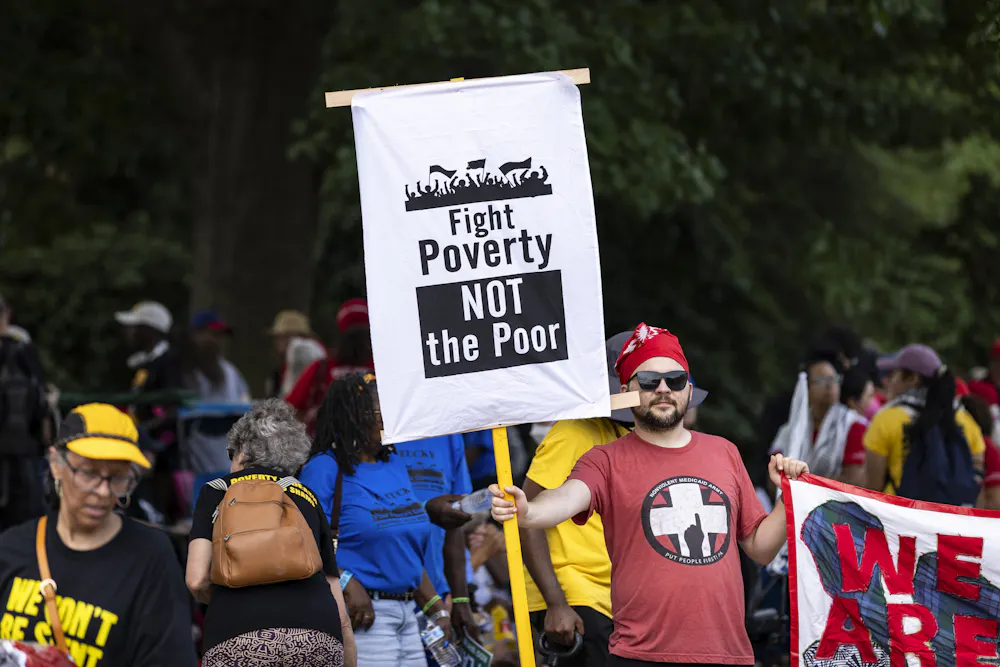
An activist holds a sign that says 'Fight Poverty, Not the Poor' during a rally.
The Poor People’s Campaign holds a rally advocating for living wages, voting rights and other policies that would help poor and low-wage Americans in 2024 in Washington. Samuel Corum/Getty Images

Right to an education

The U.S. scores a 76% on the overall right to education, placing it 20th among 38 OECD countries. It’s behind Japan and the U.K. but ahead of some peers, including Canada and Norway.

We measure education through access – whether students are enrolled in school – and quality – how well they score on tests in science, math and reading.

The U.S. rates a score of 90.7% on access but only averages 61.3% on quality.

An unmet promise

The U.S. is among the wealthiest nations in human history, but it falls far short of what that national wealth makes possible for its people – in terms of health, food, pay and what its students learn.

The reason isn’t that the country can’t afford to do better; we’ve found it’s because the U.S. doesn’t turn that wealth into opportunities for everyone to have a decent life.

Recent cuts to health insurance coverage and food assistance are pushing much of what we measure in the wrong direction.

Promoting the general welfare was written into the country’s founding promise – 250 years later, our data shows how far there still is to go.

Stephen Bagwell, Assistant Professor of Political Science, University of Missouri-St. Louis and Susan Randolph, Associate Professor Emerita of Economics, University of Connecticut

This article is republished from The Conversation under a Creative Commons license. Read the original article.

The Fortune 500 Innovation Forum will convene Fortune 500 executives, U.S. policy officials, top founders, and thought leaders to help define what’s next for the American economy, Nov. 16-17 in Detroit. Apply here.
About the Authors
By Stephen Bagwell
See full bioRight Arrow Button Icon
By Susan Randolph
See full bioRight Arrow Button Icon
By The Conversation
See full bioRight Arrow Button Icon
Add Fortune on Google for similar content.

Latest in North America

Finance
Lorem ipsum dolor sit amet, consectetur adipiscing elit, sed do eiusmod tempor incididunt ut labore et dolore magna aliqua. Ut enim ad minim veniam
By Fortune Editors
October 20, 2025
Finance
Lorem ipsum dolor sit amet, consectetur adipiscing elit, sed do eiusmod tempor incididunt ut labore et dolore magna aliqua. Ut enim ad minim veniam
By Fortune Editors
October 20, 2025
Finance
Lorem ipsum dolor sit amet, consectetur adipiscing elit, sed do eiusmod tempor incididunt ut labore et dolore magna aliqua. Ut enim ad minim veniam
By Fortune Editors
October 20, 2025
Finance
Lorem ipsum dolor sit amet, consectetur adipiscing elit, sed do eiusmod tempor incididunt ut labore et dolore magna aliqua. Ut enim ad minim veniam
By Fortune Editors
October 20, 2025
Finance
Lorem ipsum dolor sit amet, consectetur adipiscing elit, sed do eiusmod tempor incididunt ut labore et dolore magna aliqua. Ut enim ad minim veniam
By Fortune Editors
October 20, 2025
Finance
Lorem ipsum dolor sit amet, consectetur adipiscing elit, sed do eiusmod tempor incididunt ut labore et dolore magna aliqua. Ut enim ad minim veniam
By Fortune Editors
October 20, 2025

Most Popular

Finance
Lorem ipsum dolor sit amet, consectetur adipiscing elit, sed do eiusmod tempor incididunt ut labore et dolore magna aliqua. Ut enim ad minim veniam
By Fortune Editors
October 20, 2025
Finance
Lorem ipsum dolor sit amet, consectetur adipiscing elit, sed do eiusmod tempor incididunt ut labore et dolore magna aliqua. Ut enim ad minim veniam
By Fortune Editors
October 20, 2025
Finance
Lorem ipsum dolor sit amet, consectetur adipiscing elit, sed do eiusmod tempor incididunt ut labore et dolore magna aliqua. Ut enim ad minim veniam
By Fortune Editors
October 20, 2025
Finance
Lorem ipsum dolor sit amet, consectetur adipiscing elit, sed do eiusmod tempor incididunt ut labore et dolore magna aliqua. Ut enim ad minim veniam
By Fortune Editors
October 20, 2025
Finance
Lorem ipsum dolor sit amet, consectetur adipiscing elit, sed do eiusmod tempor incididunt ut labore et dolore magna aliqua. Ut enim ad minim veniam
By Fortune Editors
October 20, 2025
Finance
Lorem ipsum dolor sit amet, consectetur adipiscing elit, sed do eiusmod tempor incididunt ut labore et dolore magna aliqua. Ut enim ad minim veniam
By Fortune Editors
October 20, 2025
Fortune Secondary Logo
Rankings
  • 100 Best Companies
  • Fortune 500
  • Global 500
  • Fortune 500 Europe
  • Most Powerful Women
  • World's Most Admired Companies
  • See All Rankings
  • Lists Calendar
Sections
  • Finance
  • Fortune Crypto
  • Features
  • Leadership
  • Health
  • Commentary
  • Success
  • Retail
  • Mpw
  • Tech
  • Lifestyle
  • CEO Initiative
  • Asia
  • Politics
  • Conferences
  • Europe
  • Newsletters
  • Personal Finance
  • Environment
  • Magazine
  • Education
Customer Support
  • Frequently Asked Questions
  • Customer Service Portal
  • Privacy Policy
  • Terms Of Use
  • Single Issues For Purchase
  • International Print
Commercial Services
  • Advertising
  • Fortune Brand Studio
  • Fortune Analytics
  • Fortune Conferences
  • Business Development
  • Group Subscriptions
About Us
  • About Us
  • Press Center
  • Work At Fortune
  • Terms And Conditions
  • Site Map
  • About Us
  • Press Center
  • Work At Fortune
  • Terms And Conditions
  • Site Map
  • Facebook icon
  • Twitter icon
  • LinkedIn icon
  • Instagram icon
  • Pinterest icon

Latest in North America

usa
North AmericaWealth
America pays workers just 27% of what its wealth allows — the worst in the OECD
By Stephen Bagwell, Susan Randolph and The ConversationJuly 13, 2026
3 hours ago
college
Personal FinanceColleges and Universities
The real reason college costs 43% of family income isn’t tuition
By Thomas Adam and The ConversationJuly 13, 2026
3 hours ago
ph
North AmericaDEI
How Pete Hegseth’s DEI order just put Scouting America’s future at stake
By Seth T. Kannarr, Derek H. Alderman and The ConversationJuly 13, 2026
3 hours ago
dan
PoliticsElections
Meet Dan Sullivan, the retired schoolteacher running for office who insists he’s not trolling sitting Senator Dan Sullivan
By Becky Bohrer and The Associated PressJuly 13, 2026
5 hours ago
na
North AmericaEducation
‘We devalued the trades’: A Native American graduation miracle that isn’t what it seems
By Savannah Peters and The Associated PressJuly 13, 2026
5 hours ago
mm
North AmericaElections
Mitch McConnell breaks silence, said he was ‘briefly unconscious’ after a fall, got treated for mild pneumonia
By Mary Clare Jalonick and The Associated PressJuly 13, 2026
5 hours ago

Most Popular

The U.S. spent $30 billion to ditch textbooks for laptops and tablets: The result is the first generation less cognitively capable than their parents
Innovation
The U.S. spent $30 billion to ditch textbooks for laptops and tablets: The result is the first generation less cognitively capable than their parents
By Sasha RogelbergJuly 12, 2026
1 day ago
Peter Thiel and other tech billionaires are publicly shielding their children from the products that made them rich
Big Tech
Peter Thiel and other tech billionaires are publicly shielding their children from the products that made them rich
By Marco Quiroz-GutierrezJuly 12, 2026
1 day ago
Trump embraces Australian retirement system backed by Larry Fink
Personal Finance
Trump embraces Australian retirement system backed by Larry Fink
By Brianna Sosa and BloombergJuly 12, 2026
1 day ago
Current price of oil as of July 13, 2026
Personal Finance
Current price of oil as of July 13, 2026
By Joseph HostetlerJuly 13, 2026
12 hours ago
Wyoming officials say Meta’s 715,000-square-foot data center is responsible for contaminating its water system with a rare bacterium
Environment
Wyoming officials say Meta’s 715,000-square-foot data center is responsible for contaminating its water system with a rare bacterium
By Sasha RogelbergJuly 10, 2026
3 days ago
Ex-PepsiCo CEO Indra Nooyi worked from midnight until 5 a.m. as a receptionist to pay for her Yale degree—and she says ‘respect went up’ because of it
Success
Ex-PepsiCo CEO Indra Nooyi worked from midnight until 5 a.m. as a receptionist to pay for her Yale degree—and she says ‘respect went up’ because of it
By Preston ForeJuly 6, 2026
7 days ago

© 2026 Fortune Media IP Limited. All Rights Reserved. Use of this site constitutes acceptance of our Terms of Use and Privacy Policy | CA Notice at Collection and Privacy Notice | Do Not Sell/Share My Personal Information
FORTUNE is a trademark of Fortune Media IP Limited, registered in the U.S. and other countries. FORTUNE may receive compensation for some links to products and services on this website. Offers may be subject to change without notice.