
Good morning. Not to make everything about the markets lately, but allow me to direct your attention to South Korea, ground zero for the global memory shortage.
The nation’s Kospi index is now down more than 20% from its record high in June. Just yesterday, it fell more than 5%—as did shares of rival memory makers Samsung and SK Hynix.
Along with Idaho’s Micron Technology, these companies control more than 95% of the market for DRAM, the stuff used in everything from advanced AI accelerators to your personal laptop. (Maybe close some of those tabs, yeah?)
Call it a correction, call it a desire for more clarity on future customer demand—whatever the case, just don’t call the memory shortage over. Unless you’re Michael Burry, that is.
More news follows. —Andrew Nusca
Want to send thoughts or suggestions to Fortune Tech? Drop a line here.
Blue Origin is reportedly fundraising at a $130 billion valuation

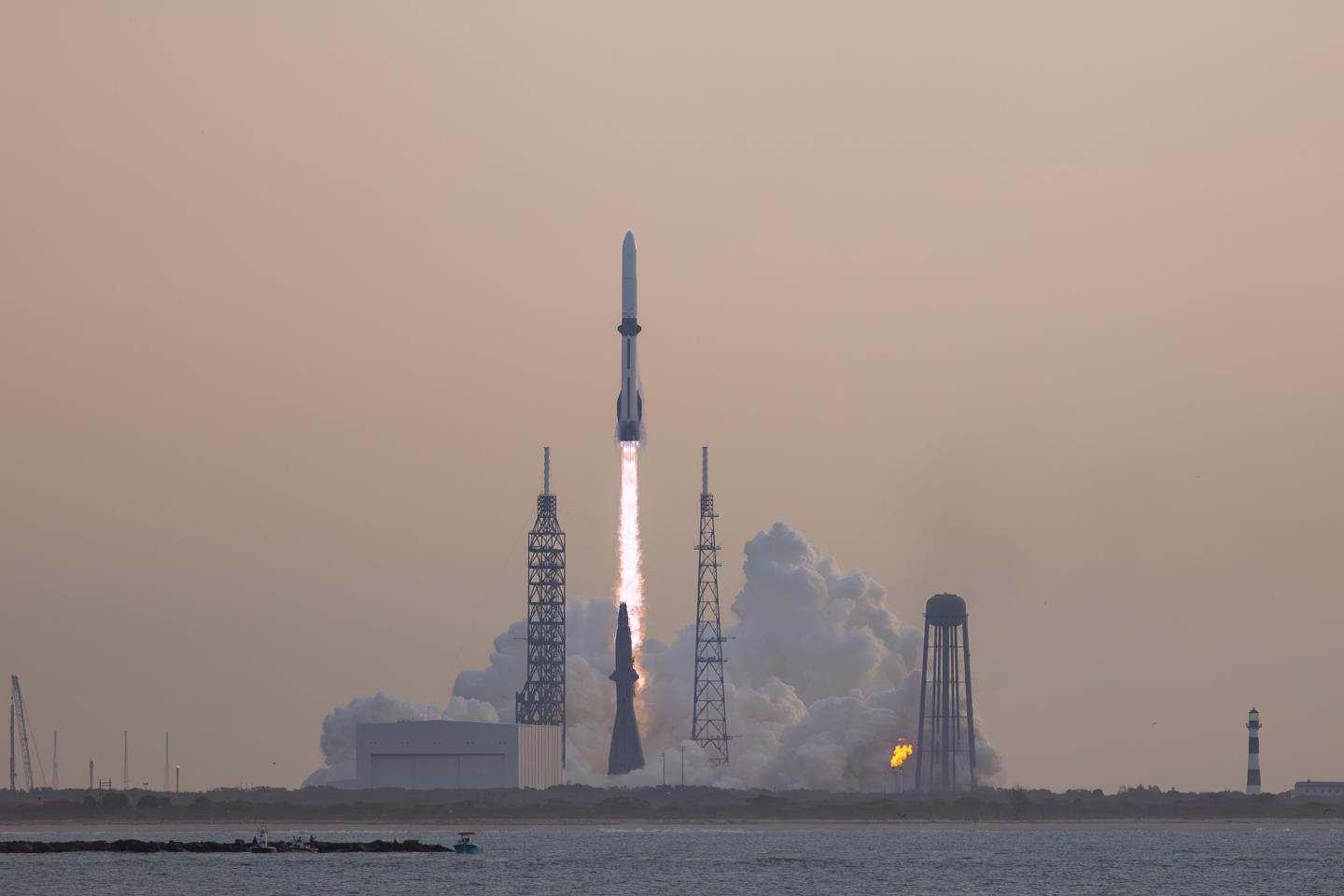
We haven’t heard much from Jeff Bezos’ Blue Origin since its New Glenn rocket exploded on the launch pad at Cape Canaveral in late May.
Until now—via a New York Times report, anyway.
The rocketmaker is reportedly in the midst of raising $10 billion at a $130 billion valuation from external investors including Coatue Management ($4 billion) and unnamed large institutional investors ($4 billion). Bezos will also reportedly re-up with an additional $2 billion.
If true, it would be the first time the Kent, Wash. company raised outside capital.
Why the influx of funds? In a word, SpaceX. The recent record IPO from Elon Musk’s rival rocketmaker (recent valuation: $1.95 trillion) has thrown a spotlight on the commercial space category and investors’ taste for it. The time to pounce appears to be now.
“I think it’s going to be the best business that I’ve ever been involved in,” Bezos said of Blue Origin in late 2024, “but it’s going to take a while.” (Bezos founded Blue Origin way back in 2000—making it two years older than Musk’s space corporation.)
But take note: Blue Origin’s upside isn’t limited to “a road to space for the benefit of Earth,” as the NASA partner likes to put it. Blue’s TeraWave satellite communications network, introduced in January, is a compelling prospect amid an AI boom because it can connect high-capacity customers like data centers.
If it’s anything like SpaceX’s Starlink, it will also end up being Blue’s most profitable business. Satellites are responsible for nearly 70% of SpaceX’s revenue. Rockets? Just 13%. —AN
OpenAI takes the wraps off GPT-Live
OpenAI on Wednesday gave ChatGPT’s voice mode an overhaul with the introduction of GPT-Live.
The San Francisco AI company calls GPT-Live “a new generation of voice models that make talking with AI feel much more like having a real conversation.” In practice, that suggests a chatbot that will interrupt you less and wait for you to finish a thought if you pause.
“GPT‑Live is built on a full-duplex architecture, meaning it can listen and speak at the same time,” the company writes. “During conversations, GPT‑Live can show it’s paying attention with phrases like ‘mhmm’ or ‘yeah,’ engage in quick back-and-forth, or just stay quiet when you need a moment to think.”
It will otherwise do everything that you expect a modern AI chatbot to do, routing queries to the OpenAI model best suited to the task (from web search to deep reasoning) and augmenting conversations with pertinent information such as sports scores or the weather.
Forget not that OpenAI is working on a consumer wearable via its 2025 acquisition of the Jony Ive-founded firm io. Though there have been precious few details available about the company’s forthcoming companion device(s), they’re rumored to be screenless—that is, audio-only—and voice driven. —AN
Meta explores AI glasses that continuously capture audio, images
Did someone say something about an AI wearable?
Mere hours after Meta said its smart glasses would disable the camera if the privacy light is tampered with—a popular hack, it turns out—a Financial Times report says the Facebook and Instagram parent was working on a “super sensing” version of its specs that captures audio and images nearly continuously.
Driving this privacy-piercing approach? AI, of course. Continuous capture would presumably enable Meta’s AI to better respond to the wearer’s queries about what they saw or heard over the course of the day.
“The glasses have prompted internal debates over how to handle novel privacy challenges, including non-wearers finding the technology invasive,” the FT adds. Um, yeah.
There’s a lot to unpack. Can you add the feature to Meta smart glasses already in the wild? (Yes, via a software update, according to the report.) Does the privacy light activate for such features? (As of now, no.) Do you store the raw footage on Meta servers? (No.) Do you make it available to the user? (Unlikely.) How about law enforcement? (Unknown.) Can you use it to train Meta’s AI models? (Probably.)
It promises to be fraught territory. Meta has long touted its commitment to user privacy controls, but it has frequently been the target of regulatory scrutiny about the matter, and its business model is almost entirely based on selling targeted advertising against its customer base.
“People have really gotten comfortable not only sharing more information and different kinds, but more openly and with more people," CEO Mark Zuckerberg said way back in 2010. “That social norm is just something that has evolved over time.” —AN
More tech
—An Apple-Broadcom chip deal is official. Five years, $30 billion, 15 billion chips.
—SpaceX launches Grok 4.5, its first model built in collaboration with Cursor.
—Iluvatar CoreX raises $902 million. The Shanghai chipmaker’s shares are up more than 200% since its January IPO.
—China will reportedly allow its biggest AI companies to buy a small number of Nvidia H200 chips to offset a domestic shortage.
—Marc Lore’s Wonder is steamin’ toward an IPO, based on its recent fundraising.
—DuckDuckGo updates its browser to block most video ads by default. (Take that, Google Chrome!)
—FTC settles with Deere. In a win for the “right to repair” movement, the agriculture icon must provide farmers and shops with equipment and software for 10 years.
—Apple is reportedly testing CXMT's memory chips for devices sold in China.