
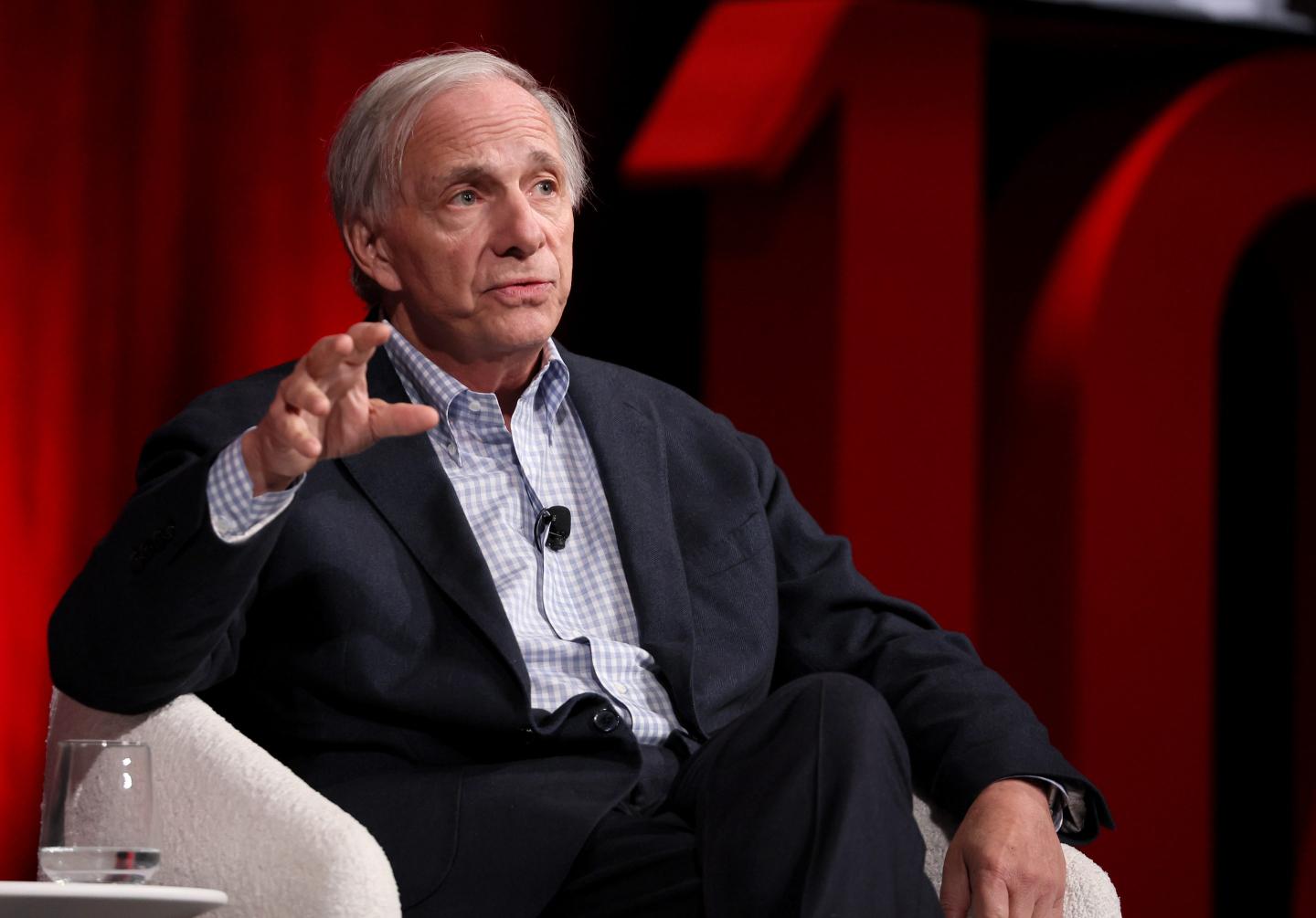
Ray Dalio has spent 42 years visiting China, building relationships with senior officials and studying its political history back to 221 BCE. But after a recent 10-day trip to Beijing—part of a monthlong tour of Asia—the Bridgewater Associates founder says something has changed, and changed fast.
“Over the past few months there has been a big shift in the world order,” Dalio wrote in a sweeping essay published June 18 on LinkedIn, where his newsletter has 750,000 subscribers. (A truncated version of the piece also previously appeared in the Financial Times.)
The catalyst, in Dalio’s telling, was the United States’ handling of Iran’s seizure of the Strait of Hormuz. The episode convinced leaders across Asia—including those who host American military bases—of something they had long suspected but never quite said aloud: that the American public “does not have the willingness to endure the discomforts of war,” and that Washington “doesn’t have what it takes to fight to maintain its empire.”
The historical parallel Dalio reaches for is pointed. “This situation looks a lot like the British handling of Egypt’s taking of the Suez Canal,” he wrote, “which signaled the end of the British Empire.”
It is a comparison that Dalio has been building toward for months: In March, he wrote in Fortune that the 2020s feel like “the rise of a new type of world order” resembling “pre-1945 world orders with great powers conflicts and gunboat diplomacy”—a view he illustrated with a Bank of America chart tracing 2,000 years of GDP dominance that showed China’s current ascent as a return to historical norms, not a disruption of them.
A new hierarchy takes shape and the righting of a 100-year wound
What Dalio observed in Beijing was not an adversarial standoff but rather a diplomatic migration. World leaders, he says, are now traveling to meet President Xi Jinping to “build tribute-type relationships”—a phrase that is the essay’s central thesis. We are, he argued, witnessing the early emergence of a modern version of China’s ancient tribute system: a hierarchical but nonmilitary order in which smaller powers acknowledge Chinese primacy in exchange for economic access and stability.
The diplomatic traffic has been visible: President Trump made a state visit to Beijing in May, a trip that McKinsey’s China practice leaders believe reflects a U.S.-China relationship that is no longer “in free fall”—though Dalio would argue the direction of that stabilization matters as much as the fact of it.
The tribute system governed Chinese foreign relations for roughly 2,000 years, from about 200 BCE until the late 19th century. It was not an empire in the Western sense, as China did not occupy or control subordinate states. Instead, it expected deference and received it—with rewards for good relationships and punishments, typically economic, for bad ones. “In the tribute system, relations are not between equals,” Dalio wrote, “but between superiors and subordinates that recognize their relative positions in the hierarchy.”
The last tribute system, historians know, crumbled under what the Chinese call the “100 Years of Humiliation”—a century of foreign invasion, unequal treaties, and national trauma that began with Britain’s defeat of China in the Opium War of 1839 and ended only with the founding of the People’s Republic in 1949.
Dalio’s lens on the dramatic events that saw the British take control of Hong Kong and open Chinese ports to foreign trade, among other things, focuses on the terms of trade that China was forced to accept and its diminishing influence over Taiwan, Korea, and the South China Sea. These are all situations that, he argues, China will seek to reverse now that the U.S. has played its hand—but China will do so in a very un-American way. “The full story of the 100 Years of Humiliation remains vivid in Chinese leaders’ and most Chinese people’s minds,” Dalio wrote, arguing that it is not history to them, but a wound that reunification with Taiwan would help close.
Xi has been saying as much publicly. In April, as the Iran crisis was roiling global markets and the IMF was cutting its global growth forecast to 3.1%, Xi told Spanish Prime Minister Pedro Sánchez that the international order was “crumbling into disarray”—using a Chinese phrase that connotes not just chaos but moral decay. Fortune reported at the time that the comment reflected Beijing’s view that the current moment of U.S. retrenchment represented not a crisis to be weathered, but an opportunity to be seized.
Dalio said he suspects that Xi wants that reunification achieved during a potential new term beginning in 2028. Taiwan’s own presidential election is scheduled for January of that year, and the island’s KMT opposition party—which favors closer ties with Beijing—has been quietly meeting with both Xi and members of the U.S. Congress. A KMT victory could open the door to a Hong Kong–style arrangement, Dalio suggests, without requiring American military intervention or Chinese military force.
Dalio believes that the model is returning and that Xi is actively engineering it through a new version of the 19th-century tribute system.
Fighting without fighting
Dalio’s framework for understanding Chinese strategy draws heavily on Sun Tzu’s The Art of War, which he recommended that readers study. Its central insight, as Dalio applies it: “To subdue the enemy without fighting is the acme of skill.”
In practice, that means China will pursue reunification with Taiwan and the dismantling of U.S. containment policies not through direct military confrontation but through relentless indirect pressure—economic, diplomatic, financial. The analogy Dalio offers is the difference between chess and Go. Chess is about annihilating your opponent. Go is about limiting their area of influence.
“China can gain ground by simply making the threats and not facing resistance,” he wrote. “There is a good chance that the war will be so subtly fought that we won’t see it being fought.”
The most significant sign of this shift, Dalio says, was a private exchange between Xi and President Trump: Xi made clear, “in the form of a veiled threat,” that planned U.S. arms sales to Taiwan “would not be appreciated.” Dalio expects Trump to ultimately cancel those sales. If he doesn’t, Dalio predicted China will respond with a dramatic demonstration of force—something far more severe than the military exercises that followed Nancy Pelosi’s 2022 visit to Taipei.
The leverage China holds over Taiwan is not merely military. It is technological. Taiwan produces the overwhelming majority of the world’s most advanced semiconductors—the chips that power AI. Dalio puts it bluntly: “AI is everything, and AI without Taiwan is nothing.”
A Chinese blockade of chip exports, he noted, would not need to happen. The threat alone would be enough to crater global stock markets, particularly AI-related equities. And China is racing toward the moment when such leverage becomes even more one-sided—Dalio said Beijing plans to achieve chip self-sufficiency by late 2027, while the U.S. and its allies remain dependent on Taiwanese production.
What this means for markets
For investors, Dalio’s message is structurally bearish on U.S. primacy. China’s external economy—what he calls “China, Inc.”—is generating massive export surpluses and accumulating financial assets at speed. The renminbi’s role in global trade is growing. Chinese companies are “understandably reluctant to accumulate American assets that can be sanctioned.” Capital is flowing away from the dollar-denominated system that has underpinned global finance for 80 years.
“The world order is now in the process of changing from a U.S.-led, multilateral, rules-based order to a bipolar, power-based, hierarchical order,” Dalio wrote.
Fortune senior contributing columnist Steve Hanke made a similar case ahead of Trump’s May state visit to Beijing, arguing that China had spent six years methodically building leverage the U.S. no longer has—dominating rare earths, critical minerals, and materials supply chains that underpin both defense and AI hardware. “China has intellectual firepower and technical firepower,” Hanke said in May. “The real strategic winner has been China.” Where Dalio frames that leverage in historical and cultural terms, Hanke frames it in the blunter language of commodity markets: The U.S. simply doesn’t control what it needs to control.
Dalio, who has been wrong about a third of his market calls by his own accounting, was careful to hedge, but not on the big picture. The tribute system, he believes, is not a metaphor for what is coming. It is the operating manual.
“Just having power, showing it, and not having to use it is very effective,” he concludes, “and in keeping with the Chinese approach.”
For this story, Fortune journalists used generative AI as a research tool. An editor verified the accuracy of the information before publishing.