Some of the most consequential decisions in the global economy of the 1990s were worked out in a bathtub.
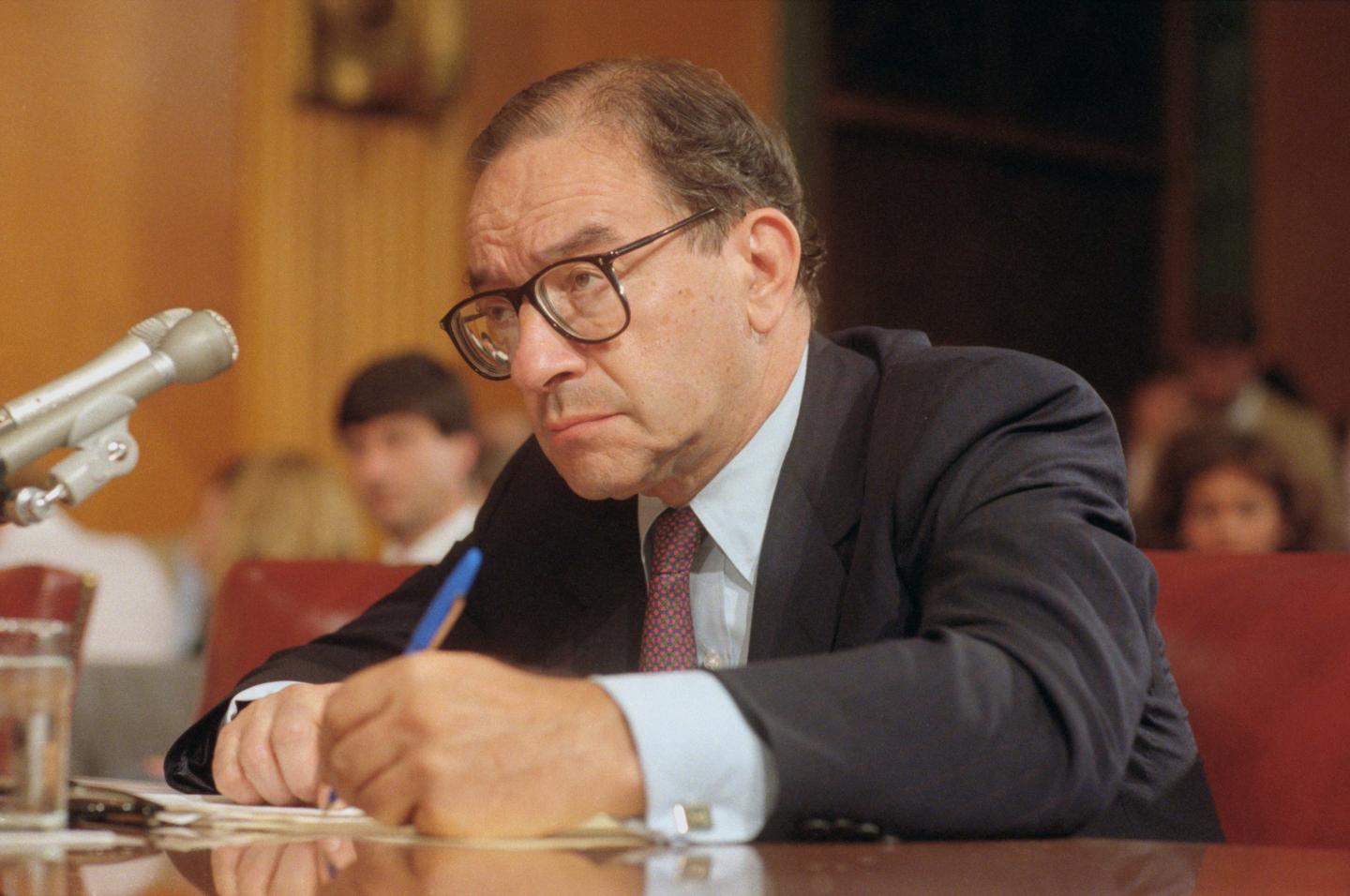
Alan Greenspan, who died Monday at 100 from complications of Parkinson’s, had a bad back. He soaked it at dawn in a deep tub at home, thinking through the economy before the day began, and it was there, said Peter Petre, the former Fortune editor who co-wrote his memoir, where his best ideas were formed, including the famous phrase “irrational exuberance.”
Greenspan died just as the U.S. stock market began another rout over “irrational exuberance,” but this time with a new target. The AI trade has left some AI-adjacent companies trading at valuations that Greenspan’s longtime vice chair at the Fed (and once considered heir apparent), Alan Blinder, described as “wild” to Fortune.
“The question is, are they crazy?” Blinder said. “This is very much analogous to the questions that Greenspan faced in the late ‘90s.”
When Greenspan presided over the bubbling internet age, he made an early bet that most economists, including Blinder, rejected: that the internet boom was allowing the economy to grow faster than official projections estimated. So, he kept interest rates low, even as inflation started heating up, to allow the boom to run.
That decision proved prescient: inflation stayed contained while the new technology delivered one of the strongest economic expansions of the modern era. Greenspan became a rockstar, hailed as the “Maestro,” the “Oracle,” a man who could sense the economic shifts better than anyone else. Soon even his own colleagues at the Fed feared challenging him, for it felt, Blinder said, like “challenging Zeus on the mount of Olympus.”
But that forecast was really a creed, one that would sully his reputation just as fast as it made it. Markets, he believed, were self-correcting, and could price assets correctly. If there were bubbles, the Fed can’t do anything about it without disrupting the natural balance of things. He made his comment about “irrational exuberance,” but never again tried to stymie the speculative fever that would soon boil over into the dot-com bust. And then he famously stood by as the housing bubble grew.
Now, as an AI boom drives asset prices to heights its productivity gains may not yet justify, it falls to Kevin Warsh—a proponent of Greenspan’s—to decide whether to lean against it or let it run.
“It has some eerie parallels,” said Alan Blinder, Greenspan’s former vice chair, of the moment underway now. “Hopefully, it won’t end the same way.”
“The Undertaker”
Greenspan spent 18 years running the Federal Reserve and came to be synonymous with the institution he headed; often cloaking his statements in a code that deepened his mystique, and turned the central banker into a kind of rock star in Washington and beyond. On his walks to and from the Federal Reserve admirers would flank him, asking for autographs on dollar bills.
But the people who worked closely to him knew a second Greenspan. He was acutely aware of how he was perceived, amused by it, sometimes shy, sometimes somber ( The famous libertarian intellectual Ayn Rand, who had known Greenspan since his young adulthood, called him “the Undertaker” for his dark fashion sense and demeanor).
“It was a magic trick—acting the guru, but not really knowing,” Petre said. “It probably pleased him to be able to play in both registers.”
But the trick outlived its originator. Greenspan understood early that in a market economy—and especially one organizing around the capital demands of an internet revolution—the central banker’s words are a tool to match the federal funds rate. Donald Kohn, who spent 13 years at his side and later became the Fed’s vice chair, told Fortune that half their work together was calibrating exactly how Greenspan should speak, “to make sure he was having the effect he wanted on people’s attitudes on market prices.”
It fueled markets for two decades of prosperity, but it contradicted his own Randian principles. He had come up believing markets policed themselves, that people answered for their own risks; but the “maestro” built a Fed that ran on faith on him and his ability to keep money easy for markets on the way up, and catch them when they fell.
A risky bet that made and then ultimately undid his legacy. He let the dot-com bubble inflate and was proven right when the economy shrugged off its collapse; he trusted the banks through the housing boom and was proven catastrophically wrong.
The “man about town”
Greenspan always had the same inner life: data-obsessed. As a boy growing up in Washington Heights, Petre said, he collected railroad timetables and memorized them; he could tell you exactly when the 12:02 out of Phoenix reached Wichita. A talented clarinetest, he trained at Juilliard as a teenager and toured the country with a popular be-bop band, but could usually be found reading about the economy rather than engaging with post-concert revelry. He told 60 Minutes he did his Julliard peers’ income taxes.
After obtaining a bachelor’s in business and a PhD in economics from New York University, Greenspan spent three decades as an economic consultant. It was then he became more of “a man about town,” Petre said—dapper, somewhat mysterious, dating widely, including a long stretch with Barbara Walters before he found his longtime partner, the journalist Andrea Mitchell.
But even as his social circle broadened, there was perhaps no one more influential on Greenspan than Ayn Rand.
As a young man, Greenspan was part of the social circle called the “Collective” that would convene in Rand’s Midtown living room, arguing far past midnight on all matters political and economic. Rand, 20 years his senior, “taught him not only the way the economy worked, but that it had a moral dimension,” Petre said—that a market left alone wasn’t just efficient, it was just, and the people inside it would answer for their own risks.
Blinder watched what that faith became; Greenspan’s vice chair from 1994 to 1996, he traces the chairman’s lightest-touch instincts on the banks straight back to that living room. “It came from the Ayn Rand school,” he said. “He believed that the markets would get it right… and there was no talking him out of it.”
The bet that made him
That belief led Greenspan to a now-familiar argument in the late ’90s: that an economy being remade by computers could not accurately measure its own productivity revolution in real time. So he held onto rates and didn’t cut. It was a risky bet that contradicted the much-loved Phillips curve. “He saw a genuine phenomenon before it was visible in the data,” said Blinder, who was among the hawks who thought he was wrong at the time. Was it genius or luck? “I’m sure Joe DiMaggio had some luck” hitting in 56 straight games, Blinder said. “But it was mostly skill.”
The difficulty was that his insight fueled the speculation of the dot-com bubble. If the economy really could grow faster without inflation, stocks were worth more than the old models suggested. But how much more was the question. In December 1996, Greenspan gave that question its famous name, asking whether “irrational exuberance” had “unduly escalated asset values.” Markets recoiled for a moment, then kept climbing, the Nasdaq tripling before the decade was out.
That became the pattern for Greenspan. He had chosen those words—literally, in the bathtub—to send the market a signal: that as real as the promise of a technological revolution was, so were the signs of speculation. But he didn’t believe he could use interest rates to stop it safely, because a hike big enough to deflate the bubble would have taken the rest of the economy down with it. “You may bring the whole economy down in an effort to deflate what you believe is a bubble,” Blinder said.
And he didn’t think it was worth trying again. The lesson he drew, Blinder said, was that “Fed chairs almost never talked about what’s the right value of the stock market, and probably I shouldn’t either.” He never repeated himself.
After the dot-com bubble burst in 2000, Greenspan seemed vindicated: the broader economy didn’t collapse with the market, even as companies liquidated overnight. The Nasdaq lost nearly four-fifths of its value from its peak, but eventually recovered.
That’s the trap that awaits Warsh. He’s hinted at a desire to replicate a Greenspan-like-bet; that AI will eventually be disinflationary, so the Fed should refuse to hike rates even as the economy overheats, as its shown signs of doing. When his Board meets next month to decide what to do, he will almost certainly try to sway them from their now-Hawkish bias. But if the productivity improvements come too late—or never arrive at all—he could be blamed for a much deeper crisis than dotcom.
The bet that failed him
That sort of crisis found Greenspan.
In Greenspan’s final years, housing lenders began to write “NINJA” loans; loans made to borrowers with no income, no job, and no assets, often signed off without checking any paperwork. Certainly Greenspan knew something was awry, Blinder said. The Fed “knew plenty,” he said—enough that it “could have cracked down more as the bank supervisor, never mind interest rates.” It didn’t. Greenspan held back, trusting that institutions risking their own money would not risk too much, Blinder said. “Stern words from the Fed go a long way,” Blinder said. “And the banks didn’t get them.”
When those loans expired, with no money repaid, the facade finally gave way. The housing market collapsed, the banks with it, leading to the crisis known as the Great Recession.
In October 2008, called before Congress, Greenspan conceded he had found a flaw in the worldview that he’d held for 40 years, since those times in the living room salons. The self-interest he had trusted to safeguard the system had failed, he said, leaving him in a state of “shocked disbelief.”
It was, Petre said, perhaps the most traumatic moment of his life, and it took a career’s worth of nerve. “He could admit his mistakes,” he said.
Yet even with Greenspan’s reputation sullied, the market psychology he helped create kept thriving with every crisis. Through the dot-com bust, the financial crisis, the pandemic crash and every rescue that followed, investors learned to trust that the Fed would not let a bust become fatal.
That is the inheritance now facing Warsh, who has openly cast Greenspan as a model for his own chairmanship. In some ways, AI has handed markets another version of the 1990s dream: a technological revolution that could make the economy more productive without setting off inflation.
But in other ways, the moment could hardly be more different. The disinflationary tailwinds Greenspan enjoyed—cheap imported goods, a shrinking deficit—have all reversed. And where Greenspan’s productivity surge eventually showed up in the data, AI’s has not yet, leaving the Fed to decide whether the boom is the kind that cools prices or the kind that overheats them. Greenspan made his bet and was proven right. Whether Warsh is that lucky, no one can say for sure.
“I’d love to talk AI with Alan Greenspan,” Petre said. “There’s something new going on.”