
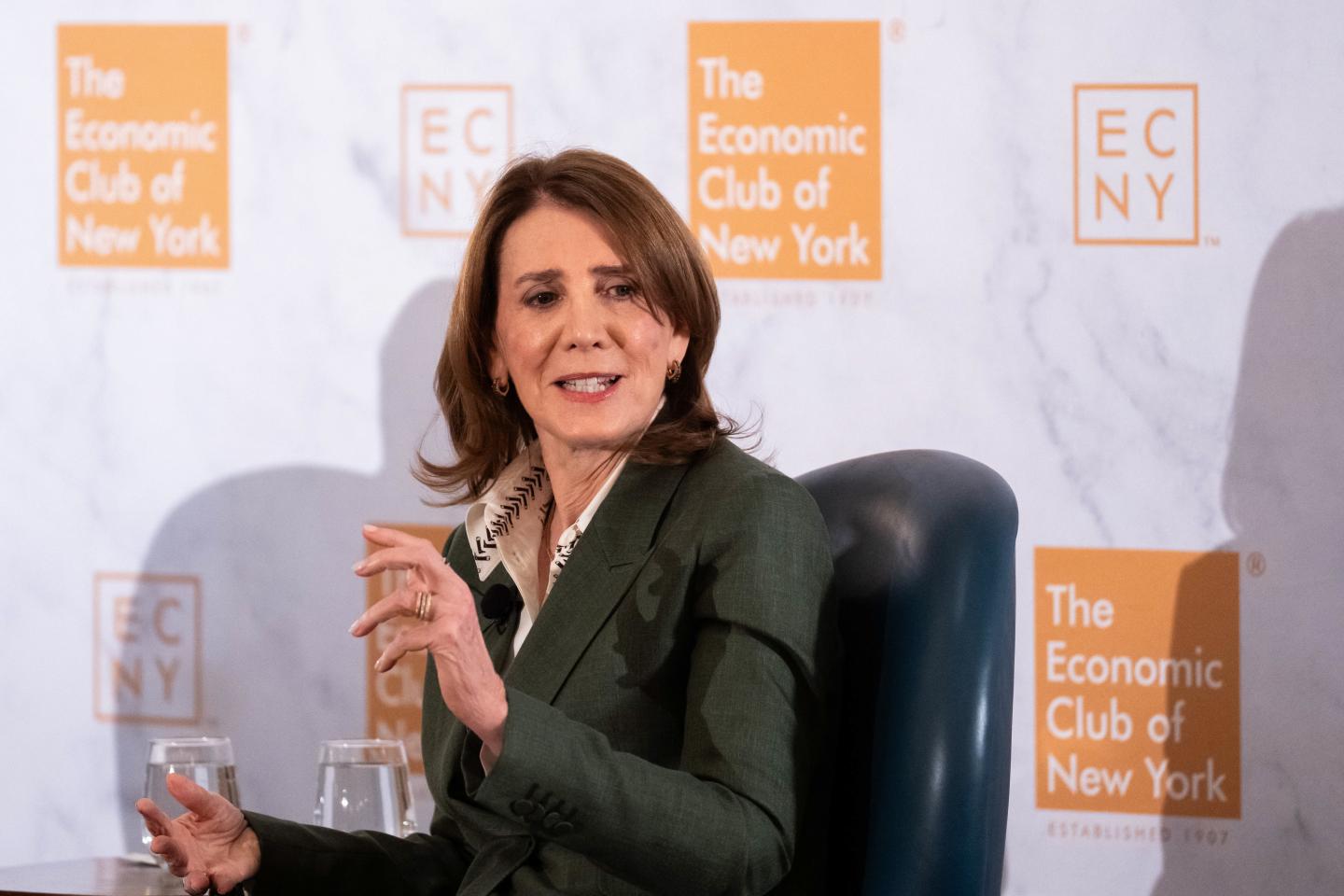
Yesterday afternoon, I stopped by the Economic Club of New York for lunch. The featured speaker was Ruth Porat—Alphabet’s former CFO, current president and chief investment officer, and No. 11 on the 2026 Most Powerful Women list.
I wanted to hear Porat’s thoughts on the state of AI and the economy. At Google, she leads decision-making about AI’s physical infrastructure and is a key face of the company’s relationships with governments determining AI regulation and communities affected by the rapid building of data centers. Google is projecting capital commitments as high as $190 billion in 2026, the largest infrastructure bet in its history. Earlier this month, Alphabet revealed plans for an $80 billion sale of equity to fund spending on AI infrastructure—expected to become the largest equity capital markets transaction of all time, per Bloomberg. Porat is behind much of that work.
Yesterday, she painted a pretty rosy picture of AI’s impact. She was in conversation with IBM CEO Arvind Krishna, who asked her about the upside and downside of AI. “If the upside is worth fighting for, then we have a responsibility to protect against the downside,” she said.
But she mostly emphasized the upside of many of the much-maligned aspects of AI. Energy costs? Data centers have helped enterprises fix costs over a larger base, keeping energy prices growing at a slower rate through 2024, she argued. And she places the blame for any lack of capacity not on the rapid investment in AI, but on years of under-investment in the United States’ energy infrastructure.
Impact on communities? Data centers are a “job creator,” she says. “This is a secure job, it’s a career, and enabling people to stay in their communities,” she argues. For every job a company like Google creates at its own data centers, third parties create nine additional jobs, she adds.
These points are probably similar to the ones Porat is making in meetings with policymakers around the world. But consumers still have concerns—just take a look at Erin Brockovich’s campaign for more transparency from companies building data centers, which I wrote about earlier this week. Earlier this year, Porat signed the Ratepayer Protection Pledge at the White House, promising that Google would foot the bill for any energy price hikes rather than passing those on to consumers. Whatever your take on her POV, she is making decisions that influence the future of the global economy and Americans’ day-to-day lives. That’s why she ranked so highly on this year’s Most Powerful Women list.
Emma Hinchliffe
emma.hinchliffe@fortune.com
The Most Powerful Women Daily newsletter is Fortune’s daily briefing for and about the women leading the business world. Subscribe here.
ALSO IN THE HEADLINES
A new CEO to watch. Lynne Fitzpatrick is taking over as CEO of the derivatives exchange CME. It's not quite a Fortune 500 CEO job (CME comes in at No. 559), but Fitzpatrick will now be one of the top women on Wall Street, alongside Citi chief Jane Fraser and Nasdaq's Adena Friedman.
Speaking of top women in finance... TIAA's Thasunda Brown Duckett (No. 7 on the MPW list!) is on the latest episode of the Fortune podcast Titans and Disruptors. She chats with EIC Alyson Shontell about her longtime philosophy—"live your life like a diversified portfolio"—and what it's really like to be recruited to a Fortune 100 CEO job. Listen here or watch here.
A new leader in D.C. Janeese Lewis George is on track to win the Democratic primary for D.C. mayor, setting her up to succeed Muriel Bowser. She's a democratic socialist candidate and has positioned herself as a strong opponent to Trump in Washington. Bowser has been mayor since 2015, so this would be the first time D.C. has another mayor under Trump.
Meet the new Allbirds. Who even remembers the shoes? After selling off its footwear business and laying off most of its workforce, what remains of the company is now "Smartbird," an AI infrastructure provider. New CEO Nadia Carlsten, an AWS alum, says she never wore Allbirds and is "more of a high heels person."
Next up for the WNBA. The league will expand its season to 50 games next year, up from its usual 44. Its new collective-bargaining agreement with players allowed for the season's extension, which commissioner Cathy Engelbert says is a sign that "demand for the WNBA has never been greater."
ON MY RADAR
Did Kamala Harris's silence on Gaza cost her the White House? Vanity Fair
Can Colin Walsh save Glossier? Puck
A new generation of moms who get high The Atlantic
PARTING WORDS
"Cooking is a life skill and I just want everybody to be able to do it. ... And I also want women to know that they can make money from cooking—they can have a whole career from it, like me."
— Tineke “Tini” Younger, who has a following of 12.5 million as a chef on TikTok. Her new book is Today We Are Cooking: Recipes That Teach You to Think Like a Chef.