

• Home
  • Latest
  • Fortune 500
  • Finance
  • Tech
  • Leadership
  • Lifestyle
  • Rankings
  • Multimedia

New

Watch Fortune Daily, our new video show that brings you inside the Fortune newsroom and the boardroom

Watch Fortune Daily, our new video show that brings you inside the Fortune newsroom and the boardroom

Watch Fortune Daily, our new video show that brings you inside the Fortune newsroom and the boardroom

Watch Fortune Daily, our new video show that brings you inside the Fortune newsroom and the boardroom

Watch Fortune Daily, our new video show that brings you inside the Fortune newsroom and the boardroom

Watch Fortune Daily, our new video show that brings you inside the Fortune newsroom and the boardroom

Watch Fortune Daily, our new video show that brings you inside the Fortune newsroom and the boardroom

Watch Fortune Daily, our new video show that brings you inside the Fortune newsroom and the boardroom

Watch Fortune Daily, our new video show that brings you inside the Fortune newsroom and the boardroom

Watch Fortune Daily, our new video show that brings you inside the Fortune newsroom and the boardroom

EconomySocial Security

Social Security faces a 24% cut in 2032—that’s a $345 billion hit to retirees nationwide, watchdog says

Nick Lichtenberg
By
Nick Lichtenberg
Nick Lichtenberg
Business Editor
Down Arrow Button Icon
Nick Lichtenberg
By
Nick Lichtenberg
Nick Lichtenberg
Business Editor
Down Arrow Button Icon
June 5, 2026, 3:00 AM ET
Add Fortune on Google for similar content.

Social Security is barreling toward a 24% across-the-board benefit cut in 2032 that would slash roughly $500 a month from the average retiree’s check — a hit that totals about $345 billion a year nationwide, according to a first-of-its-kind report from the Committee for a Responsible Federal Budget, a Washington fiscal watchdog. Yet as that fiscal cliff draws closer, the Trump administration is simultaneously pushing Wall Street-style Trump Accounts and quietly reshaping the Social Security Administration in ways that already make it harder for millions to access disability benefits.

Recommended Video

The group warns that without congressional action, “no state would be spared” from what it calls “potentially devastating” reductions, with roughly 60 million Americans — about one in six — directly affected. That includes 54 million retired workers and 9 million survivors and dependents.

A looming 24% haircut

The CRFB warns that Social Security’s main retirement trust fund is on track to be exhausted in 2032, at which point, by law, the program can only pay out what it collects in payroll taxes and other dedicated revenues. Without congressional action, that mechanical constraint would trigger an immediate 24% cut for every beneficiary—even current retirees who built their plans around the promise of full benefits.

On paper, that’s a line in an actuarial report; in practice, it’s a pay cut bigger than the average retired household’s food budget. CRFB calculates that the typical retiree would see their monthly check shrink by about $500, more than they currently spend on groceries in a month, while total annual retirement benefits would fall by $345 billion, or about 1.1% of U.S. gross domestic product.
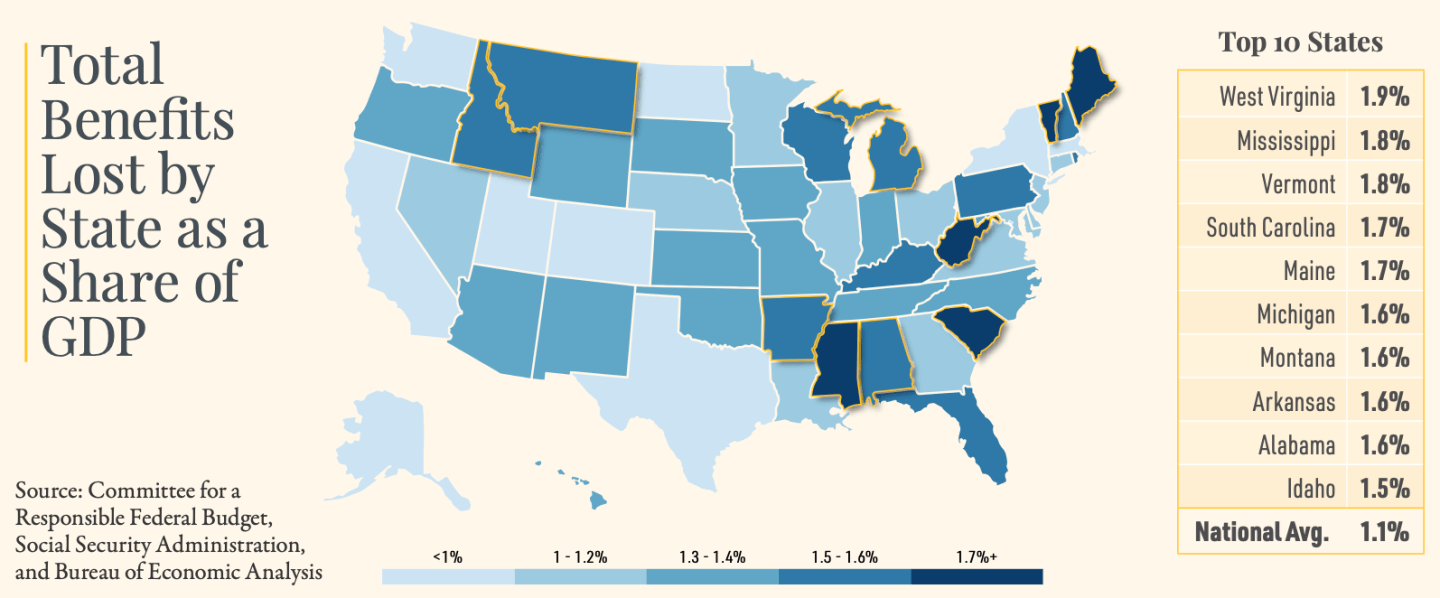
The new state-by-state breakdown is part of the CRFB’s Tell the Truth About Social Security campaign, which seeks to raise awareness about Social Security’s worsening finances and urges candidates to offer concrete plans to strengthen the program. With insolvency projected for 2032, the reckoning would likely occur within the terms of the next president and Congress elected in 2028, even if the current crop of politicians continues to punt.

‘No state spared’—and some hit much harder

The report maps the hypothetical cut onto state-level data to illustrate just how widespread the pain would be. Roughly 60.1 million Americans, or 17.7% of the population, would be directly affected today, including 54 million retired workers and 9 million survivors and dependents.

Average monthly cuts would range from about $459 to $556 across the 50 states and the District of Columbia, with 29 states seeing average losses above $500. Connecticut, New Jersey, and New Hampshire top the list with cuts of $556, $554, and $553, followed by Delaware and Maryland; in many smaller, older, and poorer states, the impact on local economies is even starker.

Measured as a share of gross domestic product, total benefit losses would exceed 1% in 40 states, peaking at 1.9% in West Virginia, 1.8% in Mississippi, and 1.8% in Vermont. Even large, diversified states would take a hit: California retirees would lose about $33.4 billion in benefits in a single year under the 24% cut, while Florida would lose $26.6 billion, Texas $23.7 billion, New York $19.7 billion, and Pennsylvania $15.5 billion.

“This is not a crisis that only touches ‘someone else’ or only future generations,” the report warns. “No state would be spared from the potentially devastating effects of insolvency.”

As the trust fund frays, Trump tries to rewire retirement

The solvency threat is arriving just as Trump’s Treasury Secretary Scott Bessent is trying to overhaul how Americans save for retirement through the launch of Trump Accounts—tax-advantaged investment accounts marketed as a way to turn more workers, especially young people, into stock market investors.

Bessent called the accounts “a back door for privatizing Social Security” last year, a comment he later walked back by insisting they would only “supplement the sanctity” of guaranteed benefits. But allies like Sen. Ted Cruz have been more explicit in calling them “personal Social Security accounts,” touting them as a pillar of long-term Social Security reform, even as the administration publicly promises not to touch current benefits.

More recently, Bessent has staked the program’s future on what he casts as a Trump‑era “manufacturing renaissance” and faster growth, arguing that stronger productivity and investment will make it easier for the country to afford both Trump Accounts and existing entitlements. That optimism contrasts sharply with the arithmetic in CRFB’s state-by-state map, which shows older, manufacturing-heavy states like Michigan and Pennsylvania facing some of the largest benefit reductions as a share of their economies if Congress allows the 24% cut to take effect.

The system is already changing on the ground

Even before any formal benefit cuts, parts of Social Security are already being quietly rewired through administrative changes that affect who can get help and how quickly. A recent analysis by several social work professors, published originally in The Conversation, found that in the early months of Trump’s second term, the Social Security Administration has shed more than 7,100 jobs—over 13% of its workforce—in its largest staffing cut ever, while closing six of ten regional offices, moving more services online, and expanding the use of automated and AI systems on public phone lines.

The administration touts a 73% drop in call wait times as proof of efficiency, but the professors conducted in-depth interviews with 52 advocates at 32 nonprofits that collectively assist over 8,000 people every year and described terminally ill clients dying before their disability claims were processed and pointed to a 7% decline in disability applications in the first half of 2025 compared with a year earlier. Those trends suggest that policy and operational changes are already constricting access to disability benefits that 16 million Americans rely on, even as the larger retirement program barrels toward a fiscal cliff.

Taken together, the watchdog’s insolvency modeling, Bessent’s push for market-based Trump Accounts, and the on-the-ground retrenchment in SSA staffing point to a slow but profound reshaping of America’s retirement safety net. For now, the 24% cut remains a hypothetical anchored to a date in 2032—but the politics, and the bureaucracy, around Social Security are changing much faster than that.

Just this Wednesday, Sen. Bill Cassidy (R-LA) confronted Bessent at a congressional hearing over the looming insolvency, saying, “This is just incredible. It’s just going down.”

“In our plan,” Bessent responded, “the senior citizen does not pay more taxes and the senior citizen does not get less benefits.”

Fortune Daily breaks the traditional barrier between audience and newsroom. The show transforms Fortune’s trusted reporting into actionable, conversational, and entertaining insights for an emerging class of business leaders. Watch here.
About the Author
Nick Lichtenberg
By Nick LichtenbergBusiness Editor
LinkedIn icon

Nick Lichtenberg is business editor and was formerly Fortune's executive editor of global news.

See full bioRight Arrow Button Icon
Add Fortune on Google for similar content.

Latest in Economy

Finance
Lorem ipsum dolor sit amet, consectetur adipiscing elit, sed do eiusmod tempor incididunt ut labore et dolore magna aliqua. Ut enim ad minim veniam
By Fortune Editors
October 20, 2025
Finance
Lorem ipsum dolor sit amet, consectetur adipiscing elit, sed do eiusmod tempor incididunt ut labore et dolore magna aliqua. Ut enim ad minim veniam
By Fortune Editors
October 20, 2025
Finance
Lorem ipsum dolor sit amet, consectetur adipiscing elit, sed do eiusmod tempor incididunt ut labore et dolore magna aliqua. Ut enim ad minim veniam
By Fortune Editors
October 20, 2025
Finance
Lorem ipsum dolor sit amet, consectetur adipiscing elit, sed do eiusmod tempor incididunt ut labore et dolore magna aliqua. Ut enim ad minim veniam
By Fortune Editors
October 20, 2025
Finance
Lorem ipsum dolor sit amet, consectetur adipiscing elit, sed do eiusmod tempor incididunt ut labore et dolore magna aliqua. Ut enim ad minim veniam
By Fortune Editors
October 20, 2025
Finance
Lorem ipsum dolor sit amet, consectetur adipiscing elit, sed do eiusmod tempor incididunt ut labore et dolore magna aliqua. Ut enim ad minim veniam
By Fortune Editors
October 20, 2025

Most Popular

Finance
Lorem ipsum dolor sit amet, consectetur adipiscing elit, sed do eiusmod tempor incididunt ut labore et dolore magna aliqua. Ut enim ad minim veniam
By Fortune Editors
October 20, 2025
Finance
Lorem ipsum dolor sit amet, consectetur adipiscing elit, sed do eiusmod tempor incididunt ut labore et dolore magna aliqua. Ut enim ad minim veniam
By Fortune Editors
October 20, 2025
Finance
Lorem ipsum dolor sit amet, consectetur adipiscing elit, sed do eiusmod tempor incididunt ut labore et dolore magna aliqua. Ut enim ad minim veniam
By Fortune Editors
October 20, 2025
Finance
Lorem ipsum dolor sit amet, consectetur adipiscing elit, sed do eiusmod tempor incididunt ut labore et dolore magna aliqua. Ut enim ad minim veniam
By Fortune Editors
October 20, 2025
Finance
Lorem ipsum dolor sit amet, consectetur adipiscing elit, sed do eiusmod tempor incididunt ut labore et dolore magna aliqua. Ut enim ad minim veniam
By Fortune Editors
October 20, 2025
Finance
Lorem ipsum dolor sit amet, consectetur adipiscing elit, sed do eiusmod tempor incididunt ut labore et dolore magna aliqua. Ut enim ad minim veniam
By Fortune Editors
October 20, 2025
Fortune Secondary Logo
Rankings
  • 100 Best Companies
  • Fortune 500
  • Global 500
  • Fortune 500 Europe
  • Most Powerful Women
  • World's Most Admired Companies
  • See All Rankings
  • Lists Calendar
Sections
  • Finance
  • Fortune Crypto
  • Features
  • Leadership
  • Health
  • Commentary
  • Success
  • Retail
  • Mpw
  • Tech
  • Lifestyle
  • CEO Initiative
  • Asia
  • Politics
  • Conferences
  • Europe
  • Newsletters
  • Personal Finance
  • Environment
  • Magazine
  • Education
Customer Support
  • Frequently Asked Questions
  • Customer Service Portal
  • Privacy Policy
  • Terms Of Use
  • Single Issues For Purchase
  • International Print
Commercial Services
  • Advertising
  • Fortune Brand Studio
  • Fortune Analytics
  • Fortune Conferences
  • Business Development
  • Group Subscriptions
About Us
  • About Us
  • Press Center
  • Work At Fortune
  • Terms And Conditions
  • Site Map
  • About Us
  • Press Center
  • Work At Fortune
  • Terms And Conditions
  • Site Map
  • Facebook icon
  • Twitter icon
  • LinkedIn icon
  • Instagram icon
  • TikTok icon
  • YouTube icon

Latest in Economy

Photo of Bessent at a table with Trump’s cabinet
EconomyJapan
Scott Bessent is using moves from his hedge fund days to prop up Japan’s yen—and America’s $40 trillion national debt
By Mia OsmonbekovAugust 4, 2026
11 hours ago
bessent
CommentaryU.S. Department of the Treasury
Bessent’s Yen gamble is a warning sign — buckle up
By Steve H. Hanke and Roger KopplAugust 4, 2026
12 hours ago
Federal Reserve Chair Kevin Warsh speaks during a news conference at Federal Reserve Headquarters on July 29, 2026 in Washington, DC.
EconomyFed
Kevin Warsh told Wall Street he’d be sharing less—Goldman Sachs fears a void of Fed facts will only amplify misinformation and instability
By Eleanor PringleAugust 4, 2026
13 hours ago
jobs
EconomyJobs
Why a measly 100,000 job openings is normal for the Trump economy
By Paul Wiseman and The Associated PressAugust 4, 2026
14 hours ago
JPMorgan Chase, Accenture and others are teaming up on a new venture to standardize how AI token use is measured
AICFO Daily
JPMorgan Chase, Accenture and others are teaming up on a new venture to standardize how AI token use is measured
By Sheryl EstradaAugust 4, 2026
17 hours ago
t
EconomyWhite House
Trump called his own housing bill a ‘yawn.’ Now he’s heading for a west coast tour with a 32% approval rating on the economy
By Darlene Superville and The Associated PressAugust 4, 2026
17 hours ago

Most Popular

How Zohran Mamdani's pied-à-terre tax exposed an epidemic of 'ghost cars' instead
Personal Finance
How Zohran Mamdani's pied-à-terre tax exposed an epidemic of 'ghost cars' instead
By Catherina GioinoAugust 4, 2026
22 hours ago
Bars, bowling alleys, and movie theaters cost too much to run and visit. Americans have run out of places to hang out and we're paying with our health
North America
Bars, bowling alleys, and movie theaters cost too much to run and visit. Americans have run out of places to hang out and we're paying with our health
By Catherina GioinoAugust 2, 2026
3 days ago
Ray Dalio on the AI bubble nearing 1929, 2000 levels and the lesson people always forget: 'Wealth is not the same as money'
Investing
Ray Dalio on the AI bubble nearing 1929, 2000 levels and the lesson people always forget: 'Wealth is not the same as money'
By Nick LichtenbergAugust 4, 2026
22 hours ago
Forget Gen Z: People in their 70s and 80s are some of the earliest Americans to welcome physical AI into their homes and daily routines
AI
Forget Gen Z: People in their 70s and 80s are some of the earliest Americans to welcome physical AI into their homes and daily routines
By Marco Quiroz-GutierrezAugust 3, 2026
2 days ago
Current price of oil as of August 4, 2026
Personal Finance
Current price of oil as of August 4, 2026
By Joseph HostetlerAugust 4, 2026
20 hours ago
Scott Bessent is using moves from his hedge fund days to prop up Japan's yen—and America's $40 trillion national debt
Economy
Scott Bessent is using moves from his hedge fund days to prop up Japan's yen—and America's $40 trillion national debt
By Mia OsmonbekovAugust 4, 2026
11 hours ago

© 2026 Fortune Media IP Limited. All Rights Reserved. Use of this site constitutes acceptance of our Terms of Use and Privacy Policy | CA Notice at Collection and Privacy Notice | Do Not Sell/Share My Personal Information
FORTUNE is a trademark of Fortune Media IP Limited, registered in the U.S. and other countries. FORTUNE may receive compensation for some links to products and services on this website. Offers may be subject to change without notice.