
Last week, U.S. Treasury Secretary Bessent joined with Japan’s Ministry of Finance to intervene in currency markets in an effort to boost the yen to levels that Bessent proclaimed would be more appropriate. Bessent decided that markets are not valuing the yen correctly. Apparently, a host of traders with skin in the game have it all wrong; Bessent knows better. Bessent started tongues wagging by saying in a Fox Business interview that the yen was “very undervalued” and “excess volatility” isn’t healthy.
There is no question that Bessent’s activity in the yen market qualifies as that of a Big Player. Recall our earlier piece in Fortune, in which we laid out the characteristics of a Big Player. Big Players are big because their words and deeds move markets. They are insensitive to profit and loss. They are also discretionary because they are not bound by any simple, understandable rules. They act on judgments that oscillate with their mood swings. So, fasten your seat belts. Forget the exchange rates thrown up by the markets. Bessent will act to move the yen to levels he deems appropriate, whatever they might happen to be.
Following the intervention of Bessent and Japan’s Ministry of Finance, the yen strengthened in what may or may not turn out to be a dead cat bounce. Just why did the yen strengthen? First, there was the actual intervention, which consisted of direct purchases of the yen. Second, and more importantly, there was jawboning from U.S. Treasury Secretary Scott Bessent and Japanese Finance Minister Satsuki Katayama. Both made it clear that they wanted a stronger yen and that they were going to intervene to give the dying yen a little life. Big Players’ say-so moves markets. This sort of manipulation produces volatility and perplexes markets.
As it turns out, Bessent is following an old and discredited playbook. In 1887, Ivan Vyshnegradsky replaced Nicolai Bunge as czarist Imperial Russia’s finance minister. Bunge was a principled non-interventionist. He was not a Big Player. Vyshnegradsky, however, was the very archetype of a Big Player. He eagerly manipulated the ruble’s exchange rate against the gold-based German mark. He was even reported to have rubbed his hands in glee once when he thought he had gotten the better of Berlin speculators. Just take a look at the accompanying figure. It shows what Big Player Vyshnegradsky’s interventions accomplished.
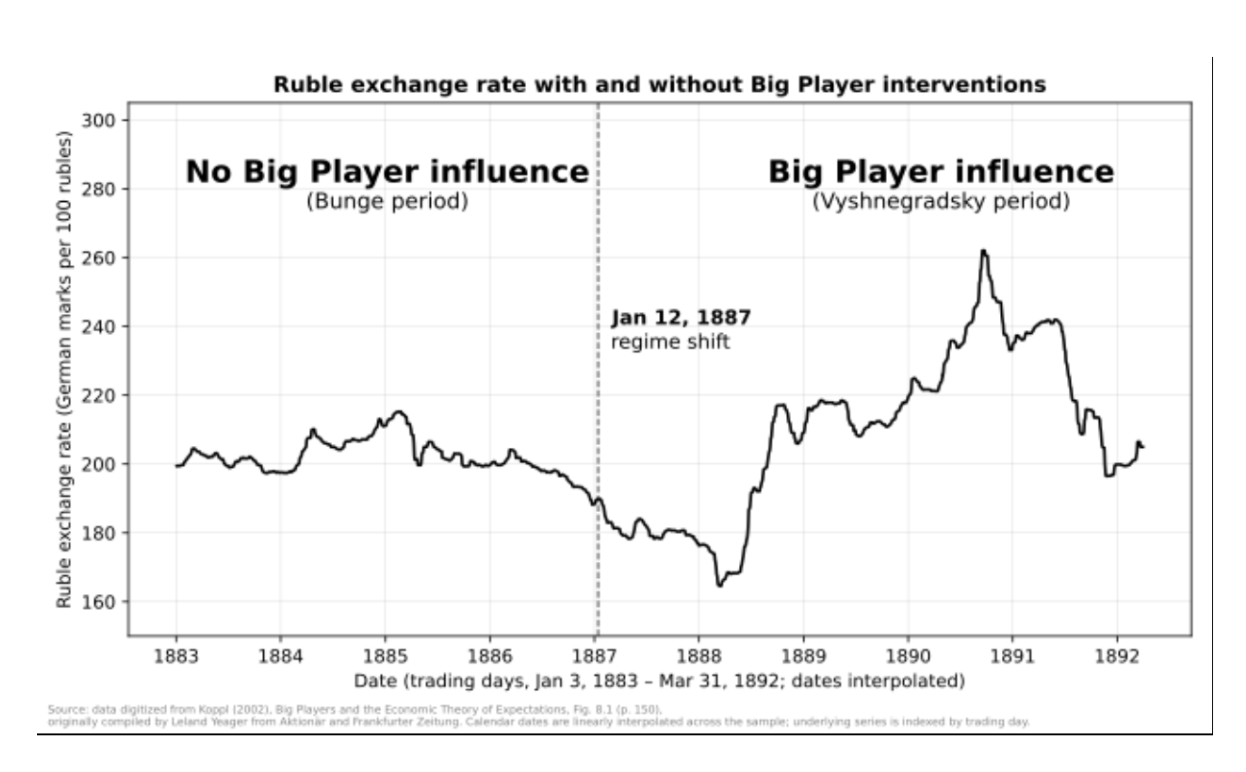
Vyshnegradsky’s interventions increased volatility. Vyshnegradsky’s successor, Sergei Witte, offers the counterpoint. Rather than freelancing with discretionary interventions, Witte committed the ruble to the gold standard in 1897. For Witte, the rule-based gold standard was a symbol of Imperial Russia’s standing and equality with others in the international capitalist order. The calm that followed was no accident: research on central bank interventions shows they work far better when defending a currency’s rise than when trying to force it down, exactly the kind of asymmetry a rules-based system sidesteps entirely. Rules constrain; Big Players improvise. This is just what the economic theory of Big Players predicts. Contrary to Bessent’s assertions, Big Player interventions in currency markets create more volatility, not less.
This is just what the economic theory of Big Players predicts. Contrary to Bessent’s assertions, Big Player interventions in currency markets create more volatility, not less.
Now that he’s become a Big Player in currency markets, Bessent will launch a whole new industry of Treasury watching. Traders will hang on every word slipping from Bessent’s lips, every passing remark and every whispered rumor.
What counts the most will no longer be “underlying fundamentals.” What counts the most will be the moves of the Big Player, guesses about those moves, and guesses about those guesses. All that guessing will create herding and noise trading as the crowd chases the crowd like a dog chases its tail, in a futile attempt to get ahead of the next unpredictable change in what humors the Big Player. Economic fundamentals, in the meantime, will fade into irrelevancy. Welcome to the age of Big Players.
The opinions expressed in Fortune.com commentary pieces are solely the views of their authors and do not necessarily reflect the opinions and beliefs of Fortune.