
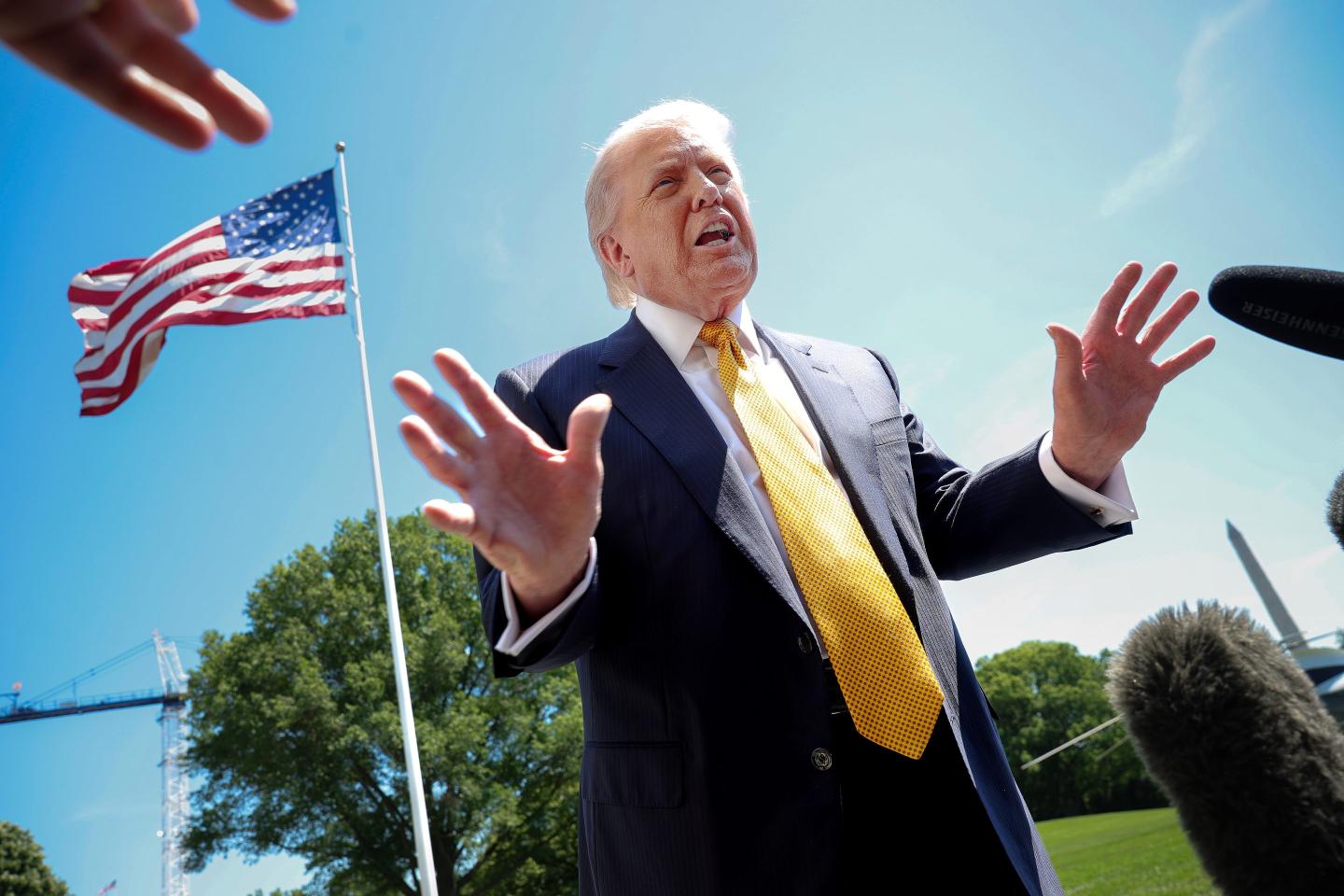
- In today’s CEO Daily: Fortune’s editorial director for Asia Lee Williamson takes the pulse in the region ahead of Trump’s bilateral meeting in Beijing.
- The big leadership story: ‘Tokenmaxxing’ at Amazon
- The markets: Up globally as investors await Trump-Xi talks.
- Plus: All the news and watercooler chat from Fortune.
Good morning. Today all eyes are firmly fixed on Beijing ahead of President Donald Trump’s two-day state visit, the first time a sitting U.S. president has travelled to China in almost a decade.
Despite its historic weight, few anticipate substantive policy breakthroughs. A deescalation of tensions and normalization of the bilateral trade relationship between the two countries, which together comprise over 40% of global GDP, are what business leaders and China watchers I’ve spoken with expect to see. This will be a meeting big on symbolism, leaning in on the personal relationship—what some have dubbed the “bromance”—between the two leaders.
That doesn’t mean that deals won’t be made by Trump and the 17 CEOs travelling with the president, including Tesla CEO Elon Musk, Apple CEO Tim Cook, Boeing CEO Kelly Ortberg, and Nvidia CEO Jensen Huang, who was a last-minute addition to the delegation. China is conversant with the Trump playbook, and the president is likely to return to the United States with a list of trade deals in non-strategic sectors that can be totaled as a big dollar figure and paraded as victories. Purchase commitments on U.S. commodities—including soybeans, beef, and other agricultural products—as well as the completion of a long-delayed deal for China to buy up to 500 Boeing 737 MAX jets are likely to be among the big wins touted on Air Force One on the way home. The U.S. also wants China to commit to purchases of American coal, oil, and natural gas.
No big trade policy moves are expected as both sides seek to stabilize the relationship. The one-year trade truce established on the sidelines of the APEC summit in October 2025—in which the U.S. walked back threatened tariff increases and Beijing paused expanded rare-earth export controls—is expected to hold or be extended. Discussions on the formation of a board of trade, a mechanism to boost commerce in non-sensitive areas without compromising either side’s national security, will also move forward in an effort to solidify relations.
A tactical stabilization of the trade relationship is necessary, particularly in light of heightened geopolitical tensions resulting from the Iran war, which will dominate discussions. (Analysts are also closely observing if Trump will weaken official language on U.S. support for Taiwan, either as a bargaining chip for more favorable trade deals or as a result of unscripted remarks.)
But a focus on trade risks overlooking the issue that’s already defining the future of the relationship: artificial intelligence. As one economist put it to me recently, unlike the country Trump visited in 2017, China is no longer getting rich by stocking the shelves of Costco. The trade war is now a tech war, with the AI supply chain its most critical battlefront. Rather than tariffs, which impact imports, today both countries’ most powerful economic weapons are its export controls on advanced semiconductors, in the case of the U.S., and rare earths, in the case of China.
The countries can reduce vulnerability to these strategic chokepoints by building domestic capacities and diversifying supply chains—both of which take time—rather than haggling at the negotiating table.
This week’s summit is the first of four expected meetings between the two leaders this year, including a likely reciprocal state visit to the U.S. Expectations may be low this week, but for the world’s most consequential bromance, talking is an important start.—Lee Williamson
Contact CEO Daily via Diane Brady at diane.brady@fortune.com
Top leadership news
Amazon employees race to top AI leaderboards
Amazon employees are “tokenmaxxing” to climb internal scoreboards ranking employees by AI use. Analyst Gil Luria told Fortune that the behavior is a red flag given that hyperscalers are on track to spend a combined $700 billion on AI in 2026.
India brings back COVID-era WFH policies
Indian Prime Minister Narendra Modi is reinstating work-from-home policies and asking farmers to halve fertilizer use as the Iran war chokes the country's oil supply. India imports 85% of its fuel, and roughly half transits the now-disrupted Strait of Hormuz.
Inflation hits a 3-year high
U.S. inflation surged to 3.8% in April, its highest in three years, as the Iran war drove energy prices up nearly 18% and pushed the national gas average to $4.50 a gallon. That’s the first time in three years wages failed to outpace prices.
The markets
S&P 500 futures are up 0.25% this morning. The last session closed down 0.16%. The STOXX Europe 600 was up 0.40% in early trading. The U.K.’s FTSE 100 was up 0.32% in early trading. Japan’s Nikkei 225 was up 0.84%. South Korea’s KOSPI was up 2.63%. China’s CSI 300 was up 1.02%. Hong Kong’s Hang Seng was up 0.15%. India’s NIFTY 50 is up 0.22%. Bitcoin was at $81K.
Around the watercooler
Japanese snack giant resorts to black-and-white bags of potato chips as Iran War literally sucks color out of the world by Marco Quiroz-Gutierrez
The Bezos family just donated $100 million to help achieve one of Mayor Zohran Mamdani’s top campaign promises by Jake Angelo
It’s not just Canadian tourists snubbing U.S. cities. Business leaders are cancelling more trips to America as geopolitical tensions continue by Sasha Rogelberg
The U.S. auto industry went from global hegemon to running a $3.3 trillion trade deficit with the world: ‘That’s not acceptable’ by Tristan Bove
CEO Daily is curated and edited by Joseph Abrams, Jason Ma, Claire Zillman, and Lee Clifford.