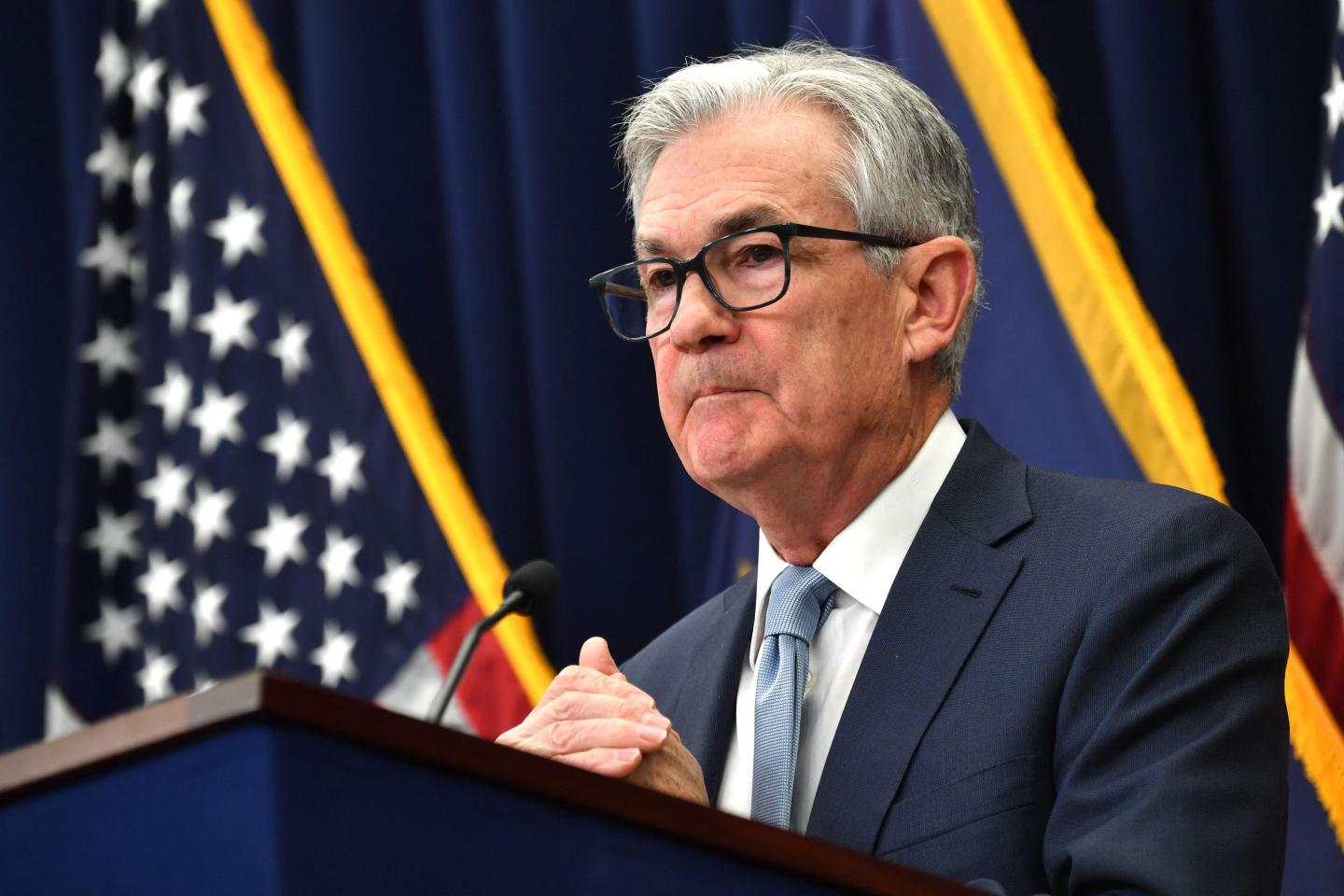
When Jerome Powell steps down as chair of the Federal Reserve on May 15, ending an eight-year tenure that spanned three administrations, a pandemic, and two wars, he will be lionized as one of the last institutionalists in government—a man who held the line on Federal Reserve independence while the rest of the scaffolding began to collapse.
It’s the right read—but it’s an incomplete one.
In November 2022, Christopher Leonard wrote a Fortune cover feature asking the business question of the time: “Will Jay Powell blink?” The premise was that Powell, having spent a decade flinching—first as a 2013 skeptic of the tactic known as quantitative easing, who then turned around to praise the program; then as the architect of the 2018 “Powell Pivot,” when a Christmas Eve market rout convinced him to abandon tightening—couldn’t be trusted to do the hard thing and raise interest rates to crush inflation. Senator Rick Scott told Leonard he wasn’t sure Powell would be serious; markets weren’t either.
But he was. Starting in March 2022, the Fed raised rates from near-zero to over 5% in just sixteen months, a startlingly aggressive tightening cycle. Everyone was screaming at him: Wall Street, which kept getting crushed when he hiked again. President Donald Trump, who had appointed him during his first term, called him a “major loser” and an “enemy” and repeatedly floated firing him outright (despite having limited authority to do so). Meanwhile, from the left, Sen. Elizabeth Warren accused Powell of risking millions of jobs. Bank CEOs warned of a hard landing—a drop in consumer spending, drop in business investment, rise in unemployment, or even a recession—on every earnings call and CNBC appearance.
Yet, somehow, it worked. Inflation, which peaked at 9.1% in June 2022, fell back to around 3%. Unemployment, which Powell himself warned would have to rise meaningfully, mostly didn’t. Powell had waddled his way through a near-impossible soft landing.
It wasn’t clean, in the end. Powell spent most of 2021 calling inflation “transitory”—a misread he eventually owned, years later, only after the word had become something of a joke on Wall Street. Across his eight years and 66 policy meetings, his committee raised rates 15 times and cut them 11: the record of a chair who reversed course, corrected, flinched, and eventually held his head high and did the unglamorous work.
But while everyone else eased up on the Fed chair, Trump escalated his campaign. In November 2025, Trump’s Justice Department opened a criminal probe over Fed headquarters renovations—an investigation Powell immediately denounced in a rare video-speech, and described in his final press conference as “unprecedented in our 113-year history.”
Even when U.S. attorney Jeanine Pirro pulled the investigation back, Powell’s response was to refuse to leave the board when his chairmanship expired, citing the probe directly: the things that have happened, he said, left him “no choice” but to stay until they’re seen through.
That is the gesture his tenure will be remembered for. The Fed under Powell became the last federal institution where the question of political pressure was answered with “no” rather than “how much.”
His successor Kevin Warsh, advanced by the Senate Banking Committee on a 13-11 party-line vote, inherits a chair where only half of CNBC-surveyed economists believe he’ll conduct policy independently. The bipartisan confirmation tradition is over, at least for now. But at least Powell never blinked.