
When Tony Capuano’s daughter called to tell him he was going viral on TikTok, he knew exactly why.
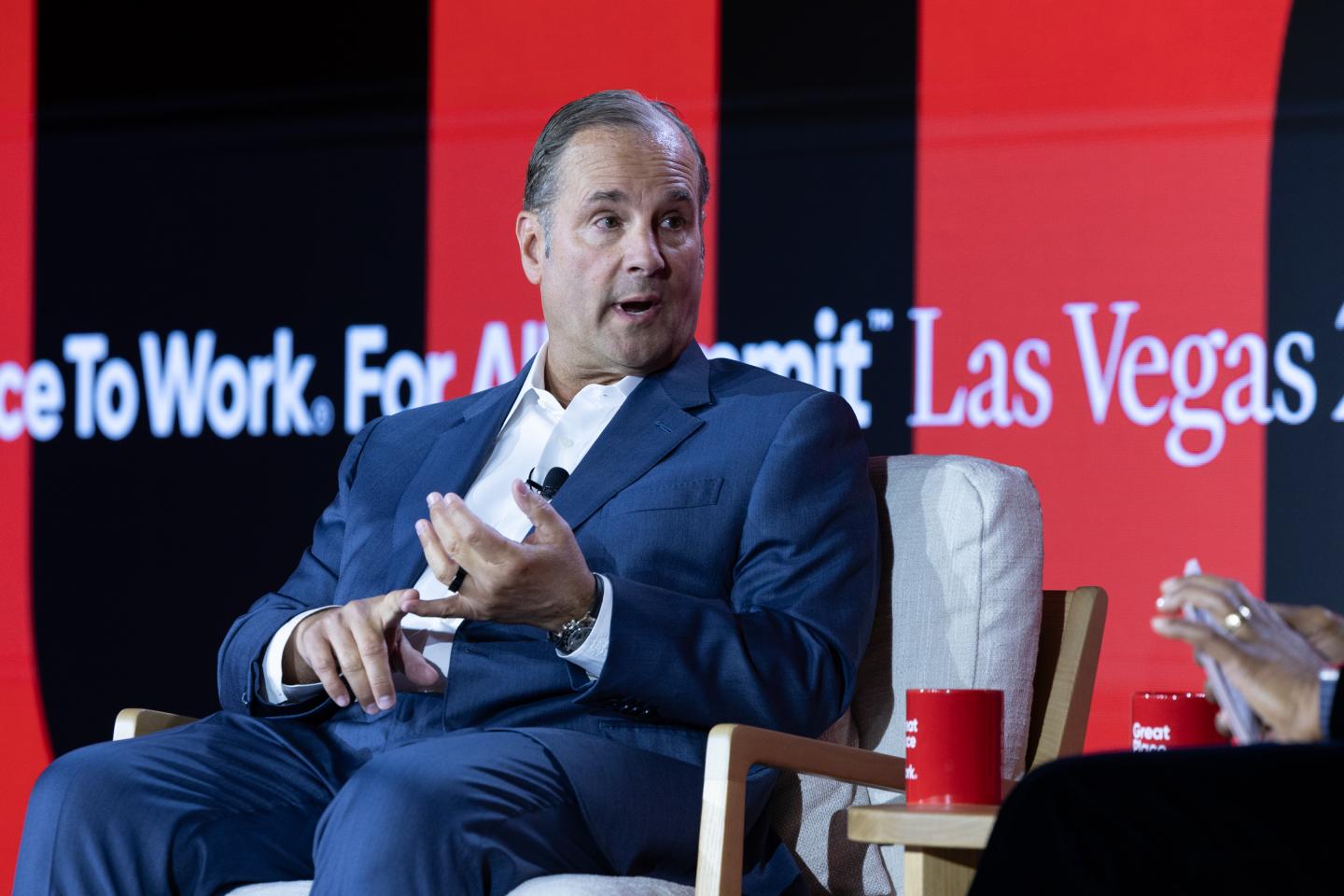
“I pray the only time in my life that my daughter calls me and says, ‘Dad, you’re viral on TikTok’ came from this conference,” the Marriott International CEO said, speaking with Fortune at the Great Place to Work For All Summit in Las Vegas. He was referring to an appearance in 2025 at the same annual event, which came just days after President Trump signed an executive order targeting diversity, equity, and inclusion programs across the federal government. In an environment where many corporate leaders were going quiet on DEI, Capuano said Marriott welcomed all and created opportunity for all. The clip spread quickly. The thank-you notes poured in.
Now, roughly a year later, he told Fortune that nothing has changed. “Just strengthening our resolve,” he said, “around living those core values and staying true to who we are.” He said it’s not different from what his friend Chris Nassetta, the President and CEO of Hilton Worldwide, recently experienced at Hilton, when a front-desk agent at a franchised hotel refused service to an ICE agent. “I think it’s a bad place for the country” to refuse hospitality to people you disagree with. “You don’t want me deciding, ‘I like your point of view, so you’re welcome at my hotel. I don’t like your point of view, so you should go elsewhere.’ That’s just not what we should be doing.”
(Capuano shared that he is on a group chat with rivals including Nassett and Hyatt CEO Mark Hoplamazian and the hospitality CEOs always enjoy socializing, a fact confirmed to Fortune by Hoplamazian in a separate conversation.)
For the Marriott CEO, a commitment to inclusion isn’t a diversity initiative that can be walked back under political pressure—it’s a founding principle that predates the current controversy by nearly a century. Marriott was founded in 1927, and Capuano speaks about the company’s five core values as foundational texts, not policy positions.
“The core values our founders created 99 years ago—they’re etched in a block of granite,” he told Fortune. “They are absolute. They never change.”
Core values, in his telling, are the immovable bedrock: care for associates, welcome all guests, create opportunity. Culture, on the other hand, is “a living, breathing, evolving thing” that has to be constantly nurtured. Get complacent about the health of your culture, he warned onstage at the summit, in conversation with Great Place to Work CEO Michael C. Bush, and “you’re at real risk of going into a death spiral.”
That framework helps explain why Capuano is able to project calm in what he acknowledges are genuinely chaotic times. When the DEI debate was raging in January 2025, he didn’t need to convene an emergency leadership meeting or commission a policy review. He reached for a nearly century-old document.
“We often talk about that, the benefit of having these hundred-year-old core values and this time-tested culture,” he said. “It’s a great true north when you’re trying to navigate these crazy times.”
That approach reflects a hospitality philosophy Capuano traces directly to the company’s founders. He described Marriott’s mission to Bush as being “woven into the fabric of people’s lives,” present at birthdays, anniversaries, weddings, job interviews. That intimacy, he argues, requires a commitment to welcoming everyone, not as a values statement for a corporate website, but as an operational necessity.
That sense of hospitality isn’t just metaphor for Capuano. During the pandemic lockdowns, while his travel dropped from 200-plus days a year to zero, he turned to a stack of books about his longtime obsession: the Roman Empire. (He said he unaware of the memes about how some men think about this subject on a daily basis.) One passage stopped him cold. The Stoic philosopher Seneca had written: “Travel and change of place impart vigor to the mind.” Capuano said he wrote it down and slipped it into his briefcase, where it has stayed ever since.
“People didn’t decide they wanted to explore the world once they saw it on Instagram,” he said. “It’s part of our genetic predisposition.” The quote, for him, is not just inspiration—it’s a kind of competitive intelligence. It tells him that Marriott’s business, whatever crazy times it has to weather, was built on something that has existed for decades and even centuries, like Marriott itself.
The data, he said, backs that up, even in an uncertain moment. Consumer confidence has hit multi-decade lows, and yet Capuano noted that Marriott’s credit card partnerships with JPMorgan Chase and American Express show spending on travel and experiences continuing to accelerate. What the media once dismissed as “revenge travel” in the early days of the pandemic recovery has, years later, started to look more like a permanent reordering of consumer priorities.
“I hated this term,” Capuano said, explaining that he thought it was used to describe a one-time, short phenomenon. “Here we are several years removed from the recovery, and the data suggests that it’s a more structural shift … and I think it’s fairly permanent, and the consumer spending data would suggest that that’s the case.” He shared that a good barometer is his 25-year-old daughter and her friend’s own traveling habits. “I spend a lot of time with her friends and colleagues. They all go into credit card debt to travel.”
Marriott employs 800,000 people globally and manages some 10,000 hotels across its portfolio. The company currently ranks number five on Fortune‘s World’s Best Workplaces list and has been in the top ten of the 100 Best Companies to Work For since 2022. Capuano attributes those rankings, in large part, to a workforce that has chosen careers in the service of others and believes company leadership shares their values.
“Make sure you pick a company whose values match your own,” Capuano told Bush onstage, about advice he tells his own daughter—and advice he gives to early-career employees as well. “You’re human beings. You care about title and salary and how big your office is and where your parking space, I get it. But even if all of those things are fantastic, if you make a poor choice and choose a company whose values don’t match your own, it’s not going to last long term.”
As Marriott approaches its 100th anniversary in 2027—the Great Place to Work conference will celebrate at the Marriott Marquis in Atlanta that year—Capuano was asked whether the values would still hold in another 100 years.
“Absolutely,” he said, without pausing.