
Good morning. It’s a big day for Big Tech earnings: Alphabet, Amazon, Meta, Microsoft, and more report after the closing bell.
We’ll break it down for you tomorrow. In the meantime, consider colleague Amanda Gerut’s look at Meta, which recently gave five of its top execs staggeringly high stock option targets:
“To get to the highest rung, at which the final tranche of options would become profitable, Meta would need to reach a market capitalization of $9.46 trillion,” she writes. “No company in history has ever hit that market cap, which is nearly twice the size of $5.3 trillion Nvidia, currently the world’s most valuable company.”
Move fast and break things, y’all. Today’s tech news below. —Andrew Nusca
Want to send thoughts or suggestions to Fortune Tech? Drop a line here.
Judge to Altman and Musk: Keep a lid on it
You can’t deny that there isn’t something poetic about a judge telling the owner of a social media platform to put a sock in it.
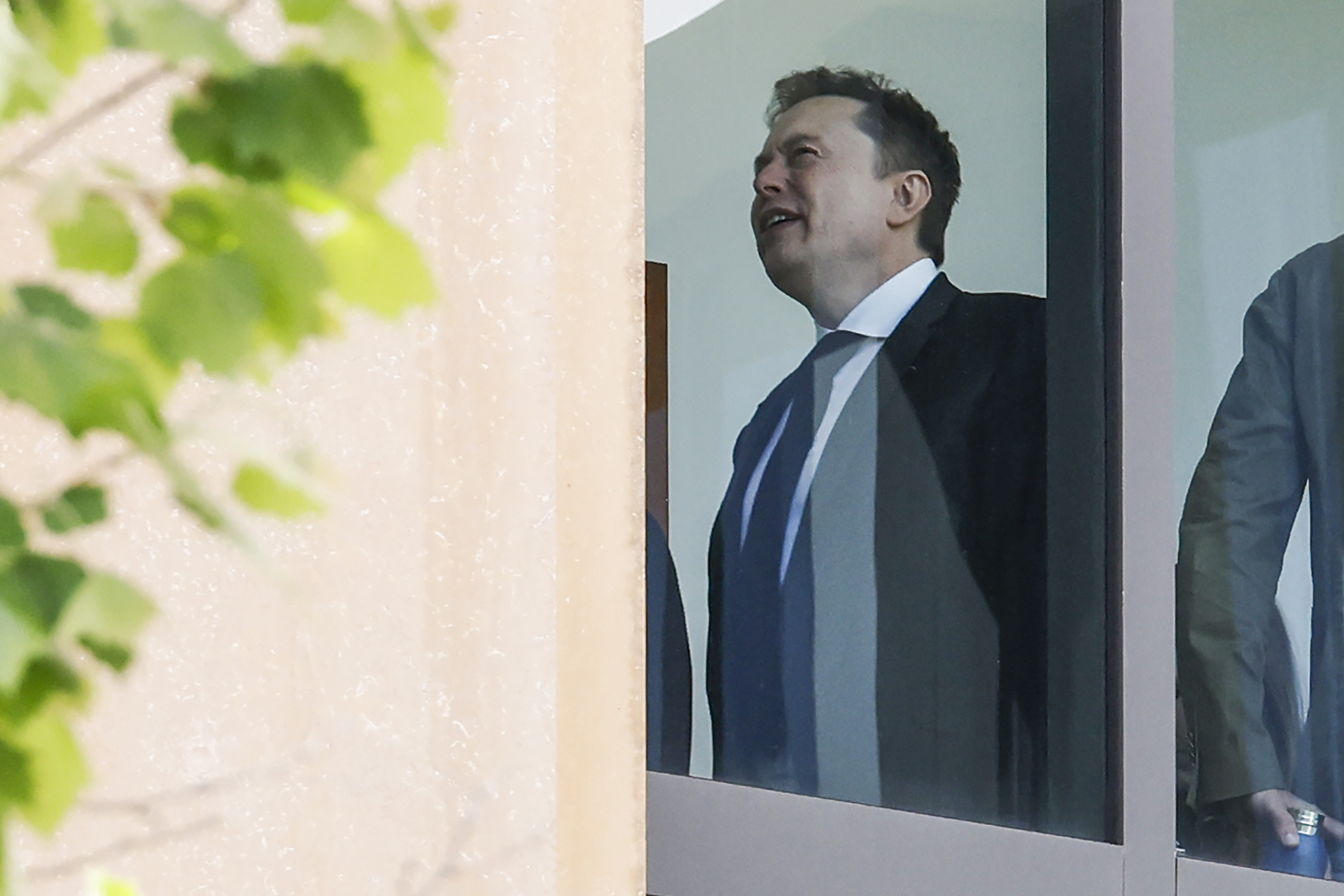
But that’s precisely what happened yesterday at the Musk v. Altman trial.
xAI CEO Elon Musk and OpenAI CEO Sam Altman—the Voldemort and Harry Potter of the Wizarding World of AI—haven’t shied away from trading barbs over social media about their lawsuit, in which Musk accused Altman and OpenAI president Greg Brockman of “stealing a charity.”
“Really excited to get Elon under oath in a few months, Christmas in April!” Altman posted two months ago.
“Scam Altman,” Musk posted two days ago, just as judicial proceedings got underway.
In court on Tuesday, the judge made her disapproval known. “Control your propensity to use social media to make things worse outside this courtroom,” U.S. District Judge Yvonne Gonzalez Rogers warned both parties.
Musk said he was merely responding to public statements that OpenAI’s leadership had made. “Only after they posted very publicly about this case, only then did I respond,” Musk said.
The judge’s solution? “Clean slate beginning today,” she said. Musk, Altman, and Brockman agreed.
The trial stands to be a memorable one, if only because it will expose communications from the early days of the most valuable private AI company on the planet. Stay tuned. —AN
NXP shares jump 13% on auto, industrial chip resurgence
Shares of NXP Semiconductors jumped 14% to $267 on Tuesday after the Dutch chipmaker offered a positive revenue forecast for its fiscal second quarter.
The magic number, or rather, range—$3.35 billion to $3.55 billion—was comfortably above analyst expectations of $3.27 billion. The company said it also expects quarterly adjusted profit per share of between $3.29 and $3.72, well above estimates of $3.17 per share.
What’s it all mean? Continued recovery in the automotive and industrial chip markets, where NXP makes most of its sales. New orders for the specialized and embedded chips that NXP and its peers make—not to be confused with the high-performance AI silicon that gets all the news headlines—are finally rising after a long slump going all the way back to the COVID-19 pandemic.
With an AI revolution underway and national security winds in their sails, struggling chipmakers like NXP are finally seeing relief from the supply chain craziness that shocked their business six years ago. That’s good news for everyone who’s in the business of so-called software-defined vehicles and that oh-so-hot thing called physical AI. —AN
Poolside debuts its first open-weight model
While AI titans OpenAI and Anthropic duke it out in the limelight, the San Francisco AI startup Poolside has been quietly working on its first open-weight AI model.
The three-year-old company, led by former GitHub CTO Jason Warner and backed by Nvidia, this week took the wraps off two new large language models, dubbed Laguna M.1 and Laguna XS.2.
Poolside describes M.1 as “the foundation for everything else we're building” and the open-weight XS.2 as “remarkably capable for its size.” Both models are marketed as affordable (they’re free to use for a limited time), agentic workflow-optimized, and like the chefs working the line at The Bear, trained from scratch.
Who would use them? In a blog post, Poolside wrote that it’s “focused on serving our government and public sector clients with capable models deployable into the highest-security environments.” But the company is also interested in supporting “the wider research community” by releasing the weights of Laguna XS.2.
Valued at $12 billion, Poolside is competing to be a top choice for AI-driven software development alongside Microsoft’s GitHub Copilot, Google’s AlphaEvolve, and soon-could-be-SpaceX’s Cursor…plus coding agents from OpenAI and Anthropic, naturally. —AN
More tech
—Apple’s iOS photo editing may get an AI overhaul.
—Robinhood shares drop 6%. A Q1 revenue miss and softer-than-expected crypto sales.
—Amazon and OpenAI expand their cloud computing deal, because of course they did.
—Seagate shares rise 13% on a rather rosy Q4 outlook for AI-driven data storage.
—Polymarket wants to bring its main exchange back to the U.S. market.
—OpenAI’s coding agent, Codex, is forbidden to talk about goblins, gremlins, and more.
—SBF’s request for a new trial: denied by a U.S. judge.