• Home
  • Latest
  • Fortune 500
  • Finance
  • Tech
  • Leadership
  • Lifestyle
  • Rankings
  • Multimedia
CommentaryDisney

Disney’s $60 billion bet on the one thing AI can’t replace

By
Roland Betancourt
Roland Betancourt
Down Arrow Button Icon
By
Roland Betancourt
Roland Betancourt
Down Arrow Button Icon
April 28, 2026, 9:15 AM ET

Roland Betancourt is a historian at University of California, Irvine and author of the forthcoming book, “Disneyland and the Rise of Automation: How Technology Created the Happiest Place on Earth.”

damaro
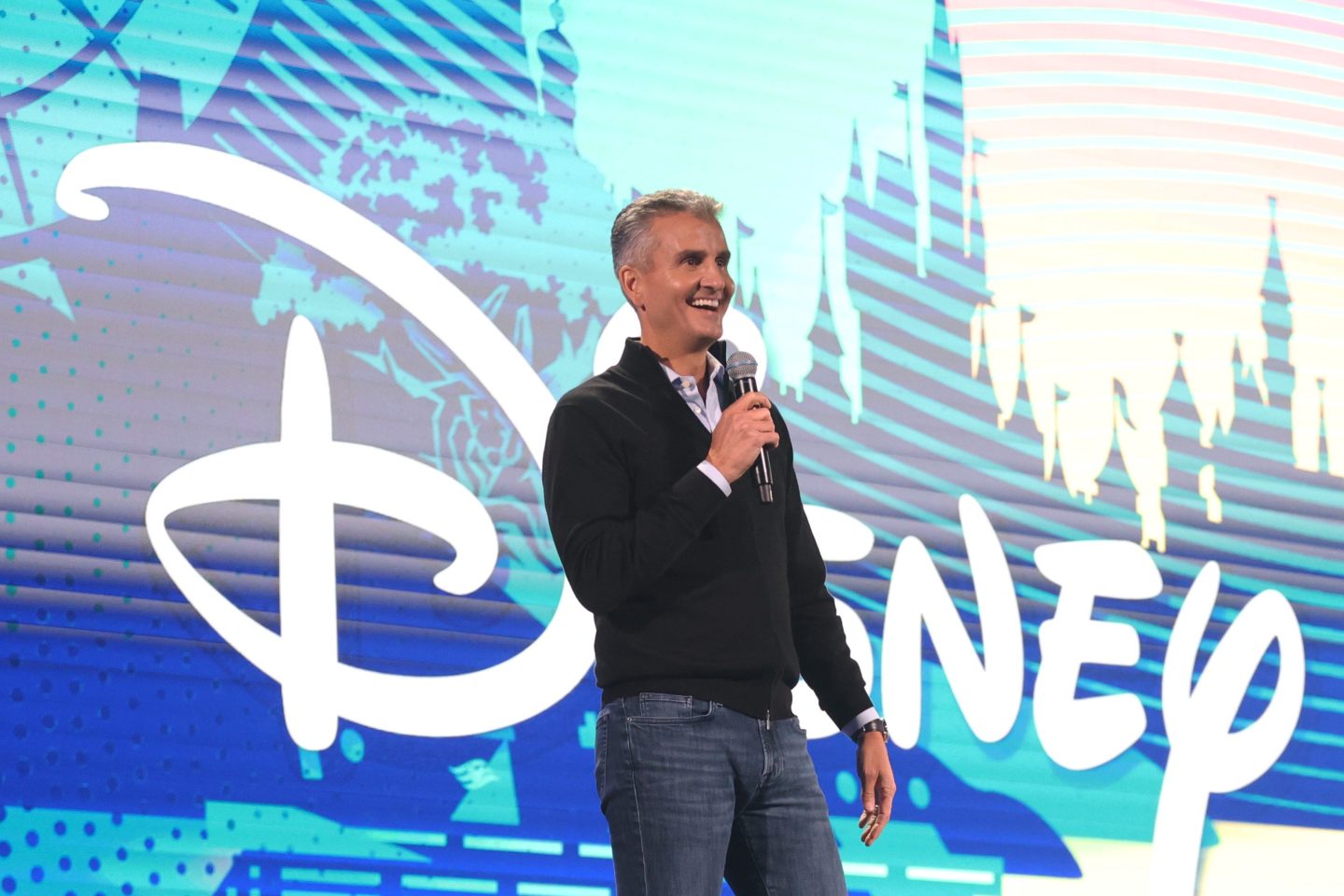
Josh D'Amaro, Chairperson of Walt Disney Parks and Resorts, speaks during Day 2 of the D23 Brazil: A Disney Experience at Transamerica Expo Center on November 09, 2024 in Sao Paulo, Brazil. Ricardo Moreira/Getty Images for Disney

Disney’s CEO faces an existential crisis brought about by an emerging technology that threatens to make its core product — expensively produced, tightly controlled entertainment — cheap enough for anyone to create, keeps audiences at home instead of sending them out into the world, and has thrown the economics of the entire entertainment industry out the window.

Recommended Video

The year is 1955. The emerging technology is television. And Disney’s CEO is Walt Disney. 

Today, as the company’s ninth CEO in its 102-year history takes the reins, Josh D’Amaro is forced to navigate his own existential crisis brought about by an emerging technology—artificial intelligence. How Disney’s founder, namesake, and first CEO overcame the crisis of his day may give D’Amaro a blueprint for his. 

After World War II, the explosion of home television sets had devastated the motion picture business. A study by the Stanford Research Institute found that movie theater attendance dropped 64% between 1946 and 1954, with similar losses across what the study called “related forms of spectator entertainment.” Hollywood executives tried to rally the broader entertainment industry against television as a shared threat. But the data was more complicated: overall leisure spending had not actually declined. What had changed was how people spent their time and money. Participatory forms of recreation, the kind that got families out of the house and into the car, had held steady or grown.

At the 1952 conference of the National Association of Amusement Parks, Pools, and Beaches, Ed Schott of Cincinnati’s Coney Island put it plainly. As Billboard summarized his talk, “parkmen need not be fearful of [television] as a competition because the medium cannot give the sense of participation that parks can provide.”

Walt Disney’s response was to do something the rest of Hollywood considered reckless, even traitorous: he embraced the enemy. In 1954, Disney sold a weekly television series called Disneyland to ABC in exchange for $2.5 million and a one-third ownership stake in his planned theme park. The deal horrified the motion picture establishment, which had been trying to keep talent away from the small screen. But Disney recognized what his peers refused to accept: television was not going away, and the studios that treated it as a threat rather than a tool would be the ones left behind.

When Walt Disney opened Disneyland, he was not making a desperate gamble on a pipe dream. He was diversifying into the two fastest-growing sectors of the entertainment economy at a moment when his studio’s core business was in freefall. And he understood, crucially, that television and the park were not separate ventures but a single ecosystem. As he told his TV audience on October 27, 1954: “Later on in the show you’ll find that Disneyland the place and Disneyland the TV show are all part of the same.” The show promoted the park, the park promoted the films, the films sold the merchandise.

The results bore this out. By the end of the 1959-1960 season, Disneyland’s attendance had grown 43.6 percent above its opening year, generating roughly $1.5 million in new revenue, while Walt Disney Productions’ studio income had dropped by over a million dollars. The park was the lifeline that allowed the studio to survive a seismic technological shift.

The lesson was clear enough: when new technology commoditizes content, the company that invests in irreplaceable physical experience is the one that survives. Seven decades later, the Walt Disney Company is being tested on whether it remembers.

Given the challenges the company faces today—an underperforming studio, a streaming business yet to sustain real profitability, and a creative pipeline criticized as too derivative—many expected outgoing CEO Bob Iger would select a studio executive to revive Disney’s core creative business. But for the second time in less than six years, Iger has selected the theme park guy as his successor.

The first did not last long or end well. Bob Chapek was CEO less than three years before the board ousted him and brought Iger back. Chapek’s failure had many causes, but the core problem was that he treated the whole company the way he had treated the parks in their most cynical mode: as a revenue-optimization machine. He raised prices, stripped amenities, and alienated both the creative community and the audience. This, however, was antithetical to how the theme parks were meant to work in Disney’s media ecosystem. 

That Iger and the board have chosen to try again with another parks executive suggests genuine conviction that the experiences business is the company’s center of gravity going forward. With the saturation of AI-generated content across platforms, the theme park once again offers something necessary: the physical, the immersive, the irreplaceable experience of being somewhere that was built with craft and intention. It also suggests a certain confidence that D’Amaro, who is by most accounts more attuned to the guest experience than Chapek ever was, will not repeat his predecessor’s mistakes. 

Unlike Chapek, D’Amaro has been a visible fixture on the ground at the parks, respected by fans and workers alike, putting in the facetime to garner loyalty from these critical stakeholders. Disney has also committed roughly $60 billion over the next decade to expanding its parks, cruise lines, and resorts, including a new destination in Abu Dhabi. That is an enormous bet on physical experience at a moment when the digital side of the entertainment business is being rapidly commoditized. The question is whether that investment will be guided by the philosophy that made the original Disneyland transformative — building proprietary technology in service of irreplaceable experiences — or by the financialized logic that has governed the parks in recent years, where every interaction is a monetization opportunity and every new land is an ad for a franchise.

In the 1950s, Walt Disney understood that Disneyland was the necessary lifeline that allowed the Walt Disney Studios to survive the arrival of television. The company is in a structurally similar position today. D’Amaro will be judged not on whether he can manage the theme parks, which he plainly can, but on whether he can do what Walt did: take a moment of technological upheaval and use it to reinvent what the company means. Disney’s history gives him a template. The recent track record gives good reason to wonder if anyone at Disney still knows how to follow it.

The opinions expressed in Fortune.com commentary pieces are solely the views of their authors and do not necessarily reflect the opinions and beliefs of Fortune.

Join us at the Fortune Workplace Innovation Summit May 19–20, 2026, in Atlanta. The next era of workplace innovation is here—and the old playbook is being rewritten. At this exclusive, high-energy event, the world’s most innovative leaders will convene to explore how AI, humanity, and strategy converge to redefine, again, the future of work. Register now.
About the Author
By Roland Betancourt
See full bioRight Arrow Button Icon

Latest in Commentary

Finance
Lorem ipsum dolor sit amet, consectetur adipiscing elit, sed do eiusmod tempor incididunt ut labore et dolore magna aliqua. Ut enim ad minim veniam
By Fortune Editors
October 20, 2025
Finance
Lorem ipsum dolor sit amet, consectetur adipiscing elit, sed do eiusmod tempor incididunt ut labore et dolore magna aliqua. Ut enim ad minim veniam
By Fortune Editors
October 20, 2025
Finance
Lorem ipsum dolor sit amet, consectetur adipiscing elit, sed do eiusmod tempor incididunt ut labore et dolore magna aliqua. Ut enim ad minim veniam
By Fortune Editors
October 20, 2025
Finance
Lorem ipsum dolor sit amet, consectetur adipiscing elit, sed do eiusmod tempor incididunt ut labore et dolore magna aliqua. Ut enim ad minim veniam
By Fortune Editors
October 20, 2025
Finance
Lorem ipsum dolor sit amet, consectetur adipiscing elit, sed do eiusmod tempor incididunt ut labore et dolore magna aliqua. Ut enim ad minim veniam
By Fortune Editors
October 20, 2025
Finance
Lorem ipsum dolor sit amet, consectetur adipiscing elit, sed do eiusmod tempor incididunt ut labore et dolore magna aliqua. Ut enim ad minim veniam
By Fortune Editors
October 20, 2025

Most Popular

Finance
Lorem ipsum dolor sit amet, consectetur adipiscing elit, sed do eiusmod tempor incididunt ut labore et dolore magna aliqua. Ut enim ad minim veniam
By Fortune Editors
October 20, 2025
Finance
Lorem ipsum dolor sit amet, consectetur adipiscing elit, sed do eiusmod tempor incididunt ut labore et dolore magna aliqua. Ut enim ad minim veniam
By Fortune Editors
October 20, 2025
Finance
Lorem ipsum dolor sit amet, consectetur adipiscing elit, sed do eiusmod tempor incididunt ut labore et dolore magna aliqua. Ut enim ad minim veniam
By Fortune Editors
October 20, 2025
Finance
Lorem ipsum dolor sit amet, consectetur adipiscing elit, sed do eiusmod tempor incididunt ut labore et dolore magna aliqua. Ut enim ad minim veniam
By Fortune Editors
October 20, 2025
Finance
Lorem ipsum dolor sit amet, consectetur adipiscing elit, sed do eiusmod tempor incididunt ut labore et dolore magna aliqua. Ut enim ad minim veniam
By Fortune Editors
October 20, 2025
Finance
Lorem ipsum dolor sit amet, consectetur adipiscing elit, sed do eiusmod tempor incididunt ut labore et dolore magna aliqua. Ut enim ad minim veniam
By Fortune Editors
October 20, 2025
Fortune Secondary Logo
Rankings
  • 100 Best Companies
  • Fortune 500
  • Global 500
  • Fortune 500 Europe
  • Most Powerful Women
  • World's Most Admired Companies
  • See All Rankings
  • Lists Calendar
Sections
  • Finance
  • Fortune Crypto
  • Features
  • Leadership
  • Health
  • Commentary
  • Success
  • Retail
  • Mpw
  • Tech
  • Lifestyle
  • CEO Initiative
  • Asia
  • Politics
  • Conferences
  • Europe
  • Newsletters
  • Personal Finance
  • Environment
  • Magazine
  • Education
Customer Support
  • Frequently Asked Questions
  • Customer Service Portal
  • Privacy Policy
  • Terms Of Use
  • Single Issues For Purchase
  • International Print
Commercial Services
  • Advertising
  • Fortune Brand Studio
  • Fortune Analytics
  • Fortune Conferences
  • Business Development
  • Group Subscriptions
About Us
  • About Us
  • Press Center
  • Work At Fortune
  • Terms And Conditions
  • Site Map
  • About Us
  • Press Center
  • Work At Fortune
  • Terms And Conditions
  • Site Map
  • Facebook icon
  • Twitter icon
  • LinkedIn icon
  • Instagram icon
  • Pinterest icon

Latest in Commentary

damaro
CommentaryDisney
Disney’s $60 billion bet on the one thing AI can’t replace
By Roland BetancourtApril 28, 2026
4 hours ago
bob
CommentaryMarkets
Bob Diamond: The settlement window is closing as 24/7 trading opens up
By Bob DiamondApril 28, 2026
6 hours ago
keith
CommentaryLabor
Trump’s Labor Secretary: We’re rewriting the rules on joint employment. Here’s what businesses need to know
By Keith SonderlingApril 28, 2026
6 hours ago
mukund
CommentaryAI agents
Mark Zuckerberg is building an AI clone of himself. Most people just need help with their inbox
By Mukund JhaApril 28, 2026
9 hours ago
quesada
Commentaryfertilizer
Former president of Costa Rica on de-risking fertilizer shocks: how $700 billion in subsidies can do more
By Carlos Alvarado QuesadaApril 27, 2026
21 hours ago
Woman tired while looking at computer
CommentaryProductivity
AI is frying our brains — here’s what leaders need to do about It
By David Rock and Chris WellerApril 26, 2026
2 days ago

Most Popular

Apple cofounder Ronald Wayne—whose stake would be worth up to $400 billion had he not sold it in 1976—says that at 91, he has no regrets
Success
Apple cofounder Ronald Wayne—whose stake would be worth up to $400 billion had he not sold it in 1976—says that at 91, he has no regrets
By Preston ForeApril 27, 2026
1 day ago
Current price of silver as of Monday, April 27, 2026
Personal Finance
Current price of silver as of Monday, April 27, 2026
By Joseph HostetlerApril 27, 2026
1 day ago
‘The cost of compute is far beyond the costs of the employees’: Nvidia executive says right now AI is more expensive than paying human workers
AI
‘The cost of compute is far beyond the costs of the employees’: Nvidia executive says right now AI is more expensive than paying human workers
By Sasha RogelbergApril 28, 2026
10 hours ago
Current price of oil as of April 27, 2026
Personal Finance
Current price of oil as of April 27, 2026
By Joseph HostetlerApril 27, 2026
1 day ago
Current price of gold as of April 27, 2026
Personal Finance
Current price of gold as of April 27, 2026
By Danny BakstApril 27, 2026
1 day ago
The U.S. military may have already used up half of its most expensive missiles, and it could take up to 4 years to rebuild its stockpiles
Politics
The U.S. military may have already used up half of its most expensive missiles, and it could take up to 4 years to rebuild its stockpiles
By Sasha RogelbergApril 24, 2026
4 days ago

© 2026 Fortune Media IP Limited. All Rights Reserved. Use of this site constitutes acceptance of our Terms of Use and Privacy Policy | CA Notice at Collection and Privacy Notice | Do Not Sell/Share My Personal Information
FORTUNE is a trademark of Fortune Media IP Limited, registered in the U.S. and other countries. FORTUNE may receive compensation for some links to products and services on this website. Offers may be subject to change without notice.