
• Home
  • Latest
  • Fortune 500
  • Finance
  • Tech
  • Leadership
  • Lifestyle
  • Rankings
  • Multimedia
EconomyKevin Warsh

Wall Street won’t like it—but Kevin Warsh may mark the end of your chatty, neighborhood Fed chairman

Eleanor Pringle
By
Eleanor Pringle
Eleanor Pringle
Senior Reporter, Economics and Markets
Down Arrow Button Icon
Eleanor Pringle
By
Eleanor Pringle
Eleanor Pringle
Senior Reporter, Economics and Markets
Down Arrow Button Icon
April 22, 2026, 6:38 AM ET
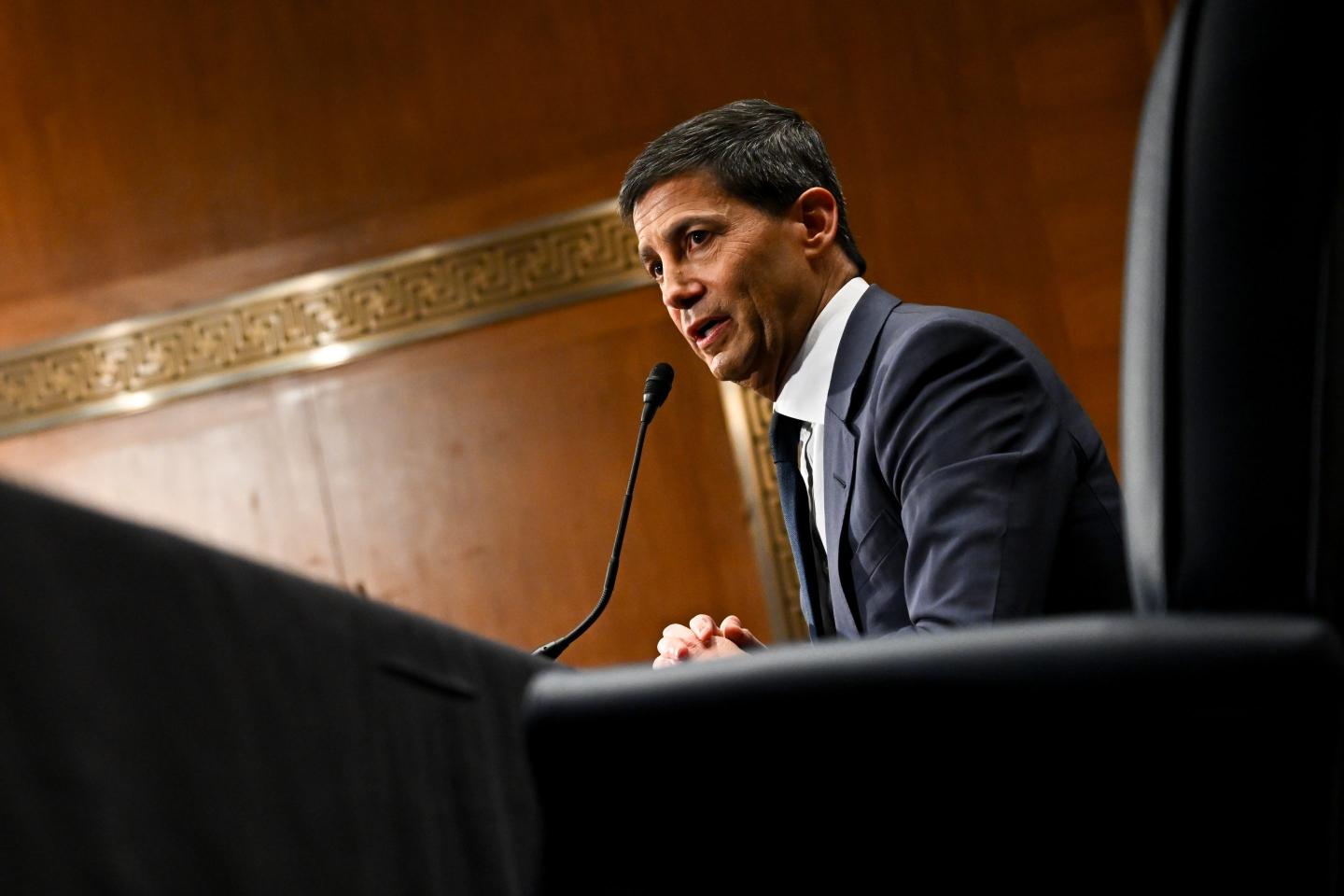
Kevin Warsh, chairman of the US Federal Reserve nominee for US President Donald Trump, during a Senate Banking, Housing, and Urban Affairs Committee confirmation hearing in Washington, DC, US, on Tuesday, April 21, 2026.
Kevin Warsh, nominee for chair of the U.S. Federal Reserve, during a Senate confirmation hearing, April 21, 2026.Graeme Sloan—Bloomberg/Getty Images

When Jerome Powell leaves the meetings that set the U.S. Federal Reserve’s base rate to go talk to the press, analysts and investors are on the edge of their seats. His nominated replacement, Kevin Warsh, wants their butts firmly and comfortably planted—preferably on a deep, overstuffed couch. “The central bank should find new comfort in working without applause and without the audience at the edge of its seats,” he told the International Monetary Fund last year.

For many years, Warsh has advocated for a “back-seat Fed.” He has been critical of the central bank’s perceived overcommunication, which, he says, leads to market expectations and potentially broken promises. Wall Street, in the early days, will likely be uncomfortable with the change.

Investors and analysts have grown accustomed to a level of transparency from the Fed. Powell helpfully shares his views on the economy in monthly press briefings, and there are updates from regional bank presidents on how they see the path of monetary policy shaping up. During the recent period of heightened economic uncertainty, such signals have been all the more welcome.

Recommended Video

Until yesterday, many might have hoped that Warsh’s criticism of forward guidance was an ideal rather than an actionable opinion. They were wrong.

Warsh said during the Senate Banking Committee hearing: “The Fed tells the whole world what their dots are going to be, what their forecasts are going to be. Well, the Fed’s human then—they hold on to those forecasts longer than they should.” Here, Warsh is referring to the dot plot, a chart published by the Fed four times a year that shows where each of its top policymakers expect short-term interest rates to head—it’s one of the most closely watched tools in central banking communications.

“If the Fed were to wait until it gets into a meeting before making a decision, incremental deliberation can keep the central bank from compounding its errors. I think these are big changes that are needed, and if confirmed, I look forward to doing it,” he added.

Wall Street won’t like to lose any insights it can glean into the thinking of the Fed—but neither will it deny that in the long term, it might be what’s best for the central bank.

Wall Street versus reality

“I don’t think the market would like it” if the beloved dot plot and its ilk were removed from the hands of investors, Jack Manley, global strategist at J.P. Morgan Asset Management, told Fortune in an exclusive interview. “I don’t think the market would permanently be in a tizzy about it,” he adds.

“It is an extraordinarily helpful way to at least figure out where multiples should be,” Manley explained. “Having a rough idea of the trajectory of monetary policy helps to feed into how we think about whether something is considered richly valued, or not so richly valued. It would be sorely missed.”

However, as Fortune reported last year, despite criticism from the White House that the base rate is contributing to a housing crisis, the correlation between Powell’s policy stance and mortgage rates is tenuous at best. As Morgan Stanley noted in October, the spread between mortgage rates outstanding and new mortgage rates was over 2%, the highest it had been in 40 years.

“We pay a lot of attention to the Federal funds rate even though almost nobody actually experiences it,” Manley added. “Those of us that do experience it—namely the big banks—haven’t really changed their behaviors in any way. It is fascinating and also very sad that the overnight rate in the United States is compressed by 175 basis points since September ’24, [but] a 30-year fixed-rate mortgage is now higher than it was back then.”

Moreover, analysis from Cox Automotive last year found that despite the Fed cuts, the average auto loan rate was continuing to increase year on year, while LendingTree reported that in the final quarter of 2025, monthly auto repayments hit a record average of $767—up 2.8% from Q4 2024.

“The benchmark rates that consumers have paid have been totally disconnected from Fed funds for a very long time,” Manley added. “If you’re thinking about the Fed funds rate as the thing that’s going to dictate the cost of money more broadly across the U.S. economy, and as a result through U.S. capital markets, you’ve been wanting on that for quite some time.”

The argument might sound similar to that of JPMorgan Chase CEO Jamie Dimon, who is backing the Trump administration’s push to scrap quarterly reporting in favor of longer-term thinking: “Why not be structural, strategic stewards of capital as opposed to managing day-to-day like buybacks and dividends or whatever?” Manley added. “It’s a very similar argument, and the market would be fine.”

Question of transparency

A central theme of Warsh’s hearing was the question of sock puppetry: rather, whether he will defend central bank independence from political pressure from the White House. At any normal hearing, the question would be inevitable (the nomination, after all, is made by the sitting president), but following President Trump’s remarkable attacks on the Fed and its chairman since returning to office, the scrutiny on Warsh is all the keener.

While the former Fed governor insisted the president had never asked him to commit to a course of action, “markets will need convincing,” Paul Donovan of UBS noted to clients this morning. “That will come through actions rather than words.”

“Less forward guidance would mean less transparency,” Aditya Bhave, head of U.S. economics at Bank of America, told Fortune this morning. “Warsh has been clear that he views this as a feature rather than a bug. The risk is that market volatility could increase if forward guidance is pared back.”

Markets have come to rely on the dot plot (precisely the behavior Warsh wants to end), but with investors’ hackles already raised over the autonomy of the Fed, a step away from certainty wouldn’t be fatal, but may be unpopular. Bhave adds: “We don’t think there will be any immediate consequences for markets. But volatility could increase at some stage if the Fed decision is a close call and markets are left guessing in the run-up to the meeting.”

Communnication and volatility

On the other hand, some critics of Powell have suggested that the Fed chair’s current strategy is adding volatility to the market, as investors overreact to any hints from rate-setters. Mohamed El-Erian, former CEO of Pimco, argued last year, “The whole point of forward guidance is predictability and stability,” but he noted investors were trading rapidly on hints about either a hold or cut.

Bond investors like volatility, pointed out Thierry Wizman, global foreign exchange and rates strategist at Macquarie Group. It opens up pockets of opportunity. The federal government may not be so thrilled, because “the lower the volatility, the lower the risk premium in the yields, and the federal government wants to issue at the cheapest possible. But it’s not clear that too much communication reduces volatility, ultimately.”

Wizman is of the opinion that the Fed operated well before the dot plot was invented in 2012, adding: “It’s very possible that with less communication or more coherent communication … you might get a more transparent, clearer Fed, a more transparent and clearer outlook on the economy and what the Fed is thinking.” 

His concern would intensify if Warsh were to scrap planning at the more “extreme” end. Warsh indicated that central bankers may speak too frequently to the press, but Wizman is focused on policy targeting rather than the qualms of economic journalists.

In Warsh’s shoes, “I’m inclined to get rid of the dot plot; I’m inclined to get rid of the long-term forecast,” Wizman tells Fortune. “I’m not inclined to get rid of the inflation target, as long as it’s construed to be a long-term inflation target or an average inflation target over the course of the next, say, 10 years. 

“From time to time it behooves the Fed to try to produce inflation above the target, and sometimes it might actually behoove the Fed in the short term to try to produce inflation below the target. I don’t want to be held to a target that the market assumes I’m going to shoot for in any given six-month period. That’s not good monetary policy actually, because monetary policy needs to be more flexible than that.”

Subscribe to Fortune Gulf Brief. Every Tuesday, this new newsletter will deliver clear-eyed, authoritative intelligence on the deals, decisions, policies, and power shifts shaping one of the world’s most consequential regions, written for the people who need to act on it. Sign up here.
About the Author
Eleanor Pringle
By Eleanor PringleSenior Reporter, Economics and Markets
LinkedIn icon

Eleanor Pringle is an award-winning senior reporter at Fortune covering news, the economy, and personal finance. Eleanor previously worked as a business correspondent and news editor in regional news in the U.K. She completed her journalism training with the Press Association after earning a degree from the University of East Anglia.

See full bioRight Arrow Button Icon

Latest in Economy

Finance
Lorem ipsum dolor sit amet, consectetur adipiscing elit, sed do eiusmod tempor incididunt ut labore et dolore magna aliqua. Ut enim ad minim veniam
By Fortune Editors
October 20, 2025
Finance
Lorem ipsum dolor sit amet, consectetur adipiscing elit, sed do eiusmod tempor incididunt ut labore et dolore magna aliqua. Ut enim ad minim veniam
By Fortune Editors
October 20, 2025
Finance
Lorem ipsum dolor sit amet, consectetur adipiscing elit, sed do eiusmod tempor incididunt ut labore et dolore magna aliqua. Ut enim ad minim veniam
By Fortune Editors
October 20, 2025
Finance
Lorem ipsum dolor sit amet, consectetur adipiscing elit, sed do eiusmod tempor incididunt ut labore et dolore magna aliqua. Ut enim ad minim veniam
By Fortune Editors
October 20, 2025
Finance
Lorem ipsum dolor sit amet, consectetur adipiscing elit, sed do eiusmod tempor incididunt ut labore et dolore magna aliqua. Ut enim ad minim veniam
By Fortune Editors
October 20, 2025
Finance
Lorem ipsum dolor sit amet, consectetur adipiscing elit, sed do eiusmod tempor incididunt ut labore et dolore magna aliqua. Ut enim ad minim veniam
By Fortune Editors
October 20, 2025

Most Popular

Finance
Lorem ipsum dolor sit amet, consectetur adipiscing elit, sed do eiusmod tempor incididunt ut labore et dolore magna aliqua. Ut enim ad minim veniam
By Fortune Editors
October 20, 2025
Finance
Lorem ipsum dolor sit amet, consectetur adipiscing elit, sed do eiusmod tempor incididunt ut labore et dolore magna aliqua. Ut enim ad minim veniam
By Fortune Editors
October 20, 2025
Finance
Lorem ipsum dolor sit amet, consectetur adipiscing elit, sed do eiusmod tempor incididunt ut labore et dolore magna aliqua. Ut enim ad minim veniam
By Fortune Editors
October 20, 2025
Finance
Lorem ipsum dolor sit amet, consectetur adipiscing elit, sed do eiusmod tempor incididunt ut labore et dolore magna aliqua. Ut enim ad minim veniam
By Fortune Editors
October 20, 2025
Finance
Lorem ipsum dolor sit amet, consectetur adipiscing elit, sed do eiusmod tempor incididunt ut labore et dolore magna aliqua. Ut enim ad minim veniam
By Fortune Editors
October 20, 2025
Finance
Lorem ipsum dolor sit amet, consectetur adipiscing elit, sed do eiusmod tempor incididunt ut labore et dolore magna aliqua. Ut enim ad minim veniam
By Fortune Editors
October 20, 2025
Fortune Secondary Logo
Rankings
  • 100 Best Companies
  • Fortune 500
  • Global 500
  • Fortune 500 Europe
  • Most Powerful Women
  • World's Most Admired Companies
  • See All Rankings
  • Lists Calendar
Sections
  • Finance
  • Fortune Crypto
  • Features
  • Leadership
  • Health
  • Commentary
  • Success
  • Retail
  • Mpw
  • Tech
  • Lifestyle
  • CEO Initiative
  • Asia
  • Politics
  • Conferences
  • Europe
  • Newsletters
  • Personal Finance
  • Environment
  • Magazine
  • Education
Customer Support
  • Frequently Asked Questions
  • Customer Service Portal
  • Privacy Policy
  • Terms Of Use
  • Single Issues For Purchase
  • International Print
Commercial Services
  • Advertising
  • Fortune Brand Studio
  • Fortune Analytics
  • Fortune Conferences
  • Business Development
  • Group Subscriptions
About Us
  • About Us
  • Press Center
  • Work At Fortune
  • Terms And Conditions
  • Site Map
  • About Us
  • Press Center
  • Work At Fortune
  • Terms And Conditions
  • Site Map
  • Facebook icon
  • Twitter icon
  • LinkedIn icon
  • Instagram icon
  • Pinterest icon

Latest in Economy

calbee
EnergyIran
Japanese snack giant resorts to black-and-white bags of potato chips as Iran War literally sucks color out of the world
By Marco Quiroz-GutierrezMay 12, 2026
1 hour ago
Musk stands with his arms cross next to Trump who sits a table.
Politicschief executive officer (CEO)
Elon Musk, Tim Cook and Larry Fink expected to join Trump’s entourage to Beijing this week
By Michelle Chapman and The Associated PressMay 12, 2026
3 hours ago
cam
PoliticsWhite House
Cameron Hamilton, fired by Trump for defending FEMA’s right to exist, tapped to lead FEMA by Trump
By Gabriela Aoun Angueira and The Associated PressMay 12, 2026
3 hours ago
robot
AIRobots
This South Korean hotel worker is training a robot to fold a banquet napkin: ‘I’ve been doing this about once a month’
By Kim Tong-Hyung and The Associated PressMay 12, 2026
3 hours ago
starmer
PoliticsUnited Kingdom
Keir Starmer’s deputies are starting to quit. Some are urging him to ‘do the right thing for the country’
By Brian Melley, Pan Pylas and The Associated PressMay 12, 2026
3 hours ago
bezos family
Politicsphilanthropy
The Bezos family just donated $100 million to help achieve one of Mayor Zohran Mamdani’s top campaign promises
By Jake AngeloMay 12, 2026
4 hours ago

Most Popular

Forget U.S. debt, China's total borrowing is in 'a league of its own'—much worse and deteriorating faster, analyst says
Economy
Forget U.S. debt, China's total borrowing is in 'a league of its own'—much worse and deteriorating faster, analyst says
By Jason MaMay 11, 2026
1 day ago
Microsoft’s CFO admits she joined the tech giant without even knowing her salary—and then missed her first day of work
Success
Microsoft’s CFO admits she joined the tech giant without even knowing her salary—and then missed her first day of work
By Preston ForeMay 11, 2026
1 day ago
U.S. hotels are calling the World Cup a 'non-event' and 80% warn bookings are falling short of expectations, report finds
North America
U.S. hotels are calling the World Cup a 'non-event' and 80% warn bookings are falling short of expectations, report finds
By Sasha RogelbergMay 12, 2026
16 hours ago
OpenAI CEO Sam Altman says Gen Z and millennials are using ChatGPT like a 'life advisor'—but college students might be one step ahead
Tech
OpenAI CEO Sam Altman says Gen Z and millennials are using ChatGPT like a 'life advisor'—but college students might be one step ahead
By Sydney LakeMay 10, 2026
2 days ago
Trump Mobile quietly rewrote its fine print to say the gold Trump phone may never be made, a year after taking $100 deposits
North America
Trump Mobile quietly rewrote its fine print to say the gold Trump phone may never be made, a year after taking $100 deposits
By Marco Quiroz-GutierrezMay 11, 2026
1 day ago
AI isn't paying off in the way companies think. Layoffs driven by automation are failing to generate returns, study finds
Future of Work
AI isn't paying off in the way companies think. Layoffs driven by automation are failing to generate returns, study finds
By Jake AngeloMay 11, 2026
1 day ago

© 2026 Fortune Media IP Limited. All Rights Reserved. Use of this site constitutes acceptance of our Terms of Use and Privacy Policy | CA Notice at Collection and Privacy Notice | Do Not Sell/Share My Personal Information
FORTUNE is a trademark of Fortune Media IP Limited, registered in the U.S. and other countries. FORTUNE may receive compensation for some links to products and services on this website. Offers may be subject to change without notice.