
In the past few days, headlines are buzzing over the possibility of a mega-mega-merger that before the news broke would have seemed inconceivable: a possible tie-up between United Airlines and American Airlines. American already ranks as the world’s largest carrier by passengers flown, and United stands fourth. At their current sizes, the combo would be twice the size of both second place Delta and number three Ryanair on the global stage, and ferry over three-and-a-half times as many folks as continental Europe’s largest stalwart, Lufthansa. In the U.S., the deal would break a near three-way tie with Delta for available seats and catapult a new behemoth into by far the most dominant stateside position in the annals of air travel.
Anytime one airline seeks to buy a rival, the proposed transaction attracts antitrust scrutiny and political controversy practically unmatched in any other realm of M&A. And because of its scale in an already highly concentrated sector, and potential to raise fares, limit choice, and curb the frequency of service to dozens of smaller markets, this mother of all unions would face far fiercer than usual opposition on multiple fronts. Hence, it’s a long shot. But the industry insiders Fortune interviewed swear that it’s by no means impossible. The reason: the Trump administration’s attraction to grand gestures—you can call it broad exercises in industrial policy—that remake wide swaths of the economy (and may sideline the usual top goals such as ensuring strong competition).
Here are five burning questions this potential mega-merger raises.
How did United’s unusual quest come about?
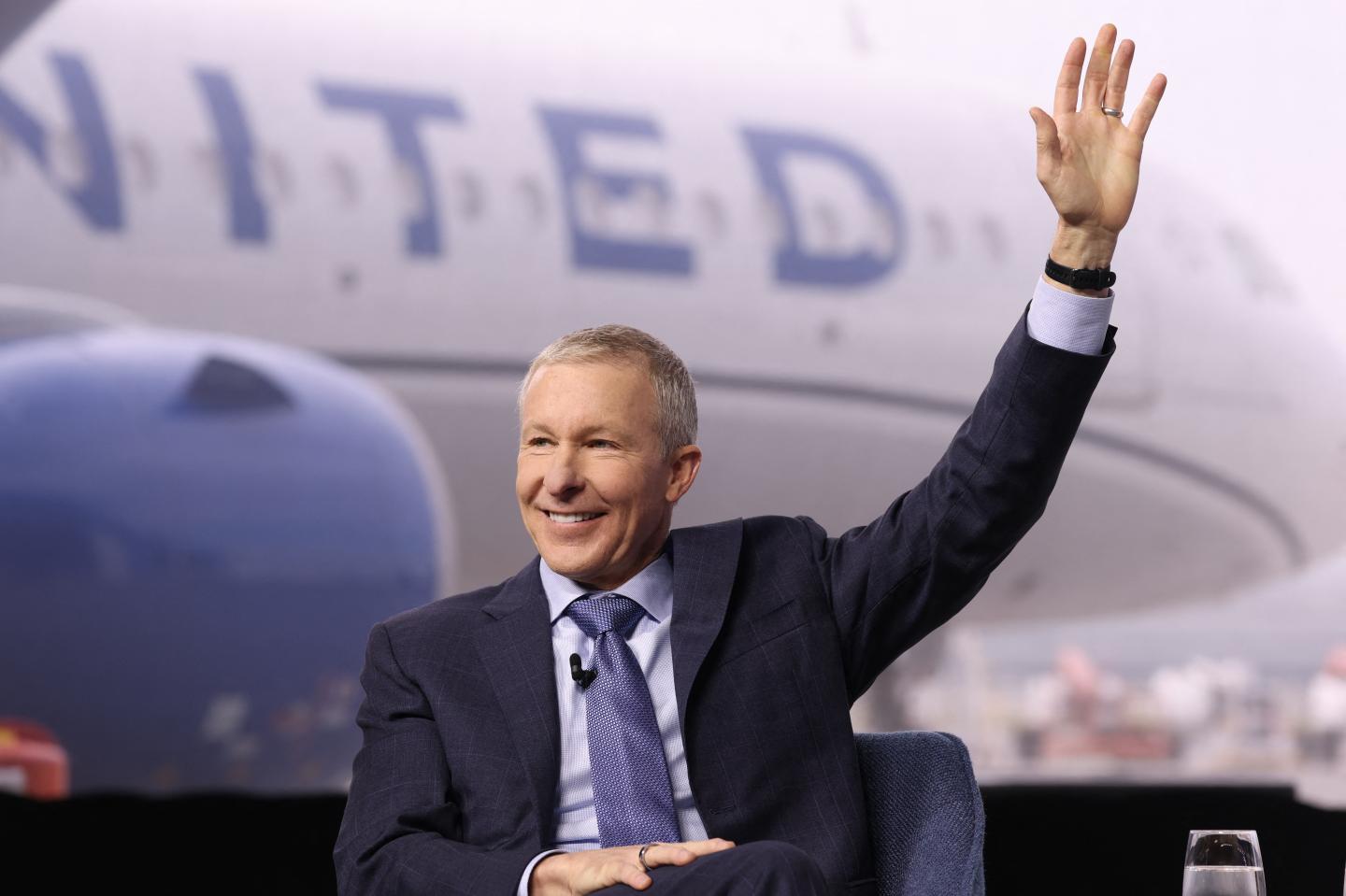
The week of April 13, Reuters revealed, apparently for the first time, a White House meeting held on Feb. 25 to discuss the over half-a-billion-dollar redevelopment project planned for Dulles International Airport near Washington, D.C. Reuters reported that President Trump hosted United Airlines CEO Scott Kirby at the confab. United is the dominant carrier at Dulles, claiming an 82% market share. Fortune has further learned from people familiar with the talks that Susie Wiles, the president’s chief of staff, was instrumental in organizing the discussion. According to these sources, Wiles is strongly committed to the sweeping Dulles revamp that includes a new United concourse and would like to see Trump receive recognition for the new Dulles. “The president won’t rename Ronald Reagan Washington National for himself!” quips an industry insider. Texas Gov. Greg Abbott also attended, say people Fortune spoke to. Both airlines are crucial to the Lone Star State’s economy: American is headquartered in Fort Worth, and United dominates George Bush Intercontinental in Houston.
According to the Reuters piece and other accounts, Kirby floated the joining-of-forces concept directly to the president. Kirby contended that the combination would achieve the giant scale required to better battle international airlines that, he’s noted in the past, are often heavily subsidized by their governments, handing them an unfair edge. In a September 2025 interview, Kirby observed that foreign-flagged carriers supply two-thirds of seats on flights headed abroad from U.S. airports. Yet around 60% of the passengers are U.S. citizens. Kirby reportedly emphasized to Trump that by attracting a larger proportion of international traffic, this super-carrier would hike American competitiveness and reduce our overall trade deficit. Neither Reuters nor other news organizations reported that Trump expressed a pro or con view on the Kirby idea.
Asked about the proposed prospect of a United acquisition of American at a briefing on April 15, press secretary Karoline Leavitt stated, “It’s not anything we have a position on or are commenting on. I know the idea has been proposed by private industry but it’s not something the president or White House have an opinion on or are weighing in on at this time.”
How do soaring fuel prices play a role in United/American merger interests?
From 2005 to 2016, the U.S. airline industry endured a consolidation wave that reduced the number of major players from nine to the current Big Four—American, United, Delta, and Southwest—the group that now controls 80% of the domestic market. In many of those deals, a jump in the price of jet fuel proved the tipping point, forcing weaker carriers into the arms of stronger rivals, including America West’s takeover of US Airways (2005), Delta’s acquisition of Northwest (2008), and Southwest’s purchase of AirTran (2011). Since the start of the Iran conflict on Feb. 28, the price of jet fuel has jumped from $100 a barrel to nearly $200. That spike—and especially the likelihood that after the conflict ends, costs will remain well above the prewar level—is hitting the weaklings far harder than the thriving warriors, especially the two biggest profitmakers, Delta and United.
Of course, the leap triggered by the damage to oil infrastructure in the Middle East and closure of the Strait of Hormuz happened after the White House session on Dulles International. But American’s fragile financial state makes it highly vulnerable to any oil shock: In 2025, it earned just $111 million on $55 billion in revenues, and the interest expense on its crushing $37 billion in debt pretty much erased its operating income. By comparison, United posted $3.5 billion in profits on $59 billion in sales, numbers that give it lots of cushion to withstand all rough weather. Like Delta, United has thrived by luring premium customers, especially the business crowd that pays extra to reserve at the last minute, while American has struggled in attracting that highly lucrative tier.
Once again, a leap in fuel costs—they represent between 20% and 30% of operating expenses—promises to unleash a new wave of buying that further narrows the roster. As Delta CEO Ed Bastian said on Delta’s Q1 earnings call, “Over my career, I’ve seen many periods of disruption in this industry. And time and time again, high fuel prices have been the most powerful catalyst for change, separating the winners and forcing weaker players to rationalize, consolidate, or be eliminated.” American, the largest airline in the world, is also one of the most vulnerable to the force that more than any other has reshaped the industry.
How would routes be affected if American merged with United?
A deal would create a colossus potentially wielding much greater power, in far more markets, than any airline ever. As of today, one of the two carriers holds market shares of 44% or more in one of the nation’s 50 largest airports. American’s captured 44% in Phoenix, 66% in Miami, 72% in Philadelphia, and 86% in Dallas/Fort Worth, while United towers at 50% in Denver, 55% in San Francisco, and 75% in Houston. Locking arms would lift their slice of the passenger pies in the New York and Chicago airports, and in LAX, respectively, to 45%, 70%, and 46%. They would also rise to number one from lesser status in Honolulu, Fort Myers, West Palm Beach, Pittsburgh, and San Antonio.
A recent report from Raymond James observes that today, American and United command 70% or more of traffic respectively on 35% and 27% of their routes. Prior to any divestitures, United-American would reach or exceed that “highly concentrated” benchmark on around two-thirds of their city pairs.
The rub for passengers and regulators: Airlines make the most money when they’re either a monopoly carrier on a route, or face just one other competitor. Mike Fitzgerald, an analyst for Cowen & Co., projects that the pro forma carrier would have no fewer than 287 of those metro-to-metro connections. What’s good for United could be a downer for travelers, and traditionally, anything that shrinks the list of rivals linking the same two metros from a longer roster to just one or two raises red flags for regulators.
Let’s get real: How likely is the deal to happen?
The Trump approach to airline consolidation represents a sharp departure from the Biden template. The previous administration quashed JetBlue’s purchase of Spirit in 2024—Spirit then went, and remains, bankrupt—and successfully sued to nix a joint venture between American and JetBlue called the Northeast Alliance. By comparison, under the Trump regime, Allegiant in mid-March gained antitrust approval for its acquisition of Sun Country after a quick review. The posture of Transportation Secretary Sean Duffy is particularly revealing. In a recent interview on CNBC, Duffy stated that he “sees room” for airline mergers. He also declared that the president “loves big deals,” suggesting that the POTUS might get a kick from green-lighting a biggie in this fabled, super-high-profile sphere.
Still, a United purchase of American would unleash strong opposition from state attorneys general who would fear that their residents would suffer shrunken schedules and pricier tickets. Unions might also rebel since it’s notoriously hard to integrate seniority lists for the likes of pilots and flight attendants. Most of all, even though the Trump administration favors a lighter regulatory touch, the near monopoly clout the combination would exert on so many routes might prove a no-go for its DOJ.
But here’s the roadblock that may be decisive, and it has nothing to do with the opposition of regulators, AGs, or unions. Duffy has cautioned that a major merger would require that the airlines “peel off some of their assets,” meaning ax gates and landing slots at airports where they hold extremely strong positions. Those requirements would clear the runways for competitors, including low-cost carriers, and ramp up the competitive heat. That’s a big negative for United: The obligation to sacrifice many lucrative routes would undermine a lot of the potential benefits of the deal. The acquirer would also need to assume all of American’s massive debt. Yet United wouldn’t be getting full value because of all the carve-outs at airports where competition is lowest and its profits potentially the highest. Plus, past cases show that it’s time-consuming and expensive to combine reservation and computer systems, as well as fleets and workforces. So big expenses come upfront, and the benefits of consolidation may be minimal, considering what’s “peeled off.”
So by conventional standards, the odds are long. On the other hand, the industry’s seldom seen a more daring swashbuckler than Scott Kirby. He’s done it twice before, and he recognizes that if it doesn’t happen under fellow wheeler-dealer Trump, it will never happen. News of Kirby’s proposal to Trump at the White House was a big surprise. A United and American flying under the same flag is probably a surprise too far.
Is Carl Icahn waiting in the wings?
Until all the speculation over United-American erupted, the takeover talk centered on JetBlue. In early 2024, legendary investor Carl Icahn took a 10% stake in the airline, and subsequently won two board seats. The Icahn blueprint typically revolves around buying into troubled targets on the cheap, then putting them in play. Now, JetBlue has reportedly hung out a “for sale” sign. Media reports say the Queens-based carrier has hired advisors to pitch Alaska Airlines, Southwest, and United. At age 90, the wily Icahn must know that the chances that Kirby wins American are long. But the mere size and scariness of that whale may make United’s, or another airline’s, bid for JetBlue look harmless by comparison, especially since the Trump administration has already shown leniency on the Allegiant takeover of Sun Country.
No one’s talking about Icahn in the scenario making all the noise. But when the condensation trail clears, it could be this seasoned warrior behind the scenes who helps orchestrate the next big sale—a sale that’s part of still another fuel-shock-driven upheaval where the weak performers will need shelter. Who ends up with whom is a game to flummox even the greatest oddsmakers.