America has a problem with young people and AI. Gen Z has looked clearly at what the AI revolution is doing to their lives and rendered a verdict: The institutions that were supposed to prepare them for this moment have failed; the employers that were supposed to hire them have vanished; and the government that was supposed to manage the transition has been absent without leave.
That verdict is arriving in numbers that are hard to dismiss: The more young people engage with the technology, the worse they feel about it.
Gen ’s excitement about artificial intelligence dropped 14 points over the past year to just 22%, according to Gallup polling released this week. Hopefulness fell nine points to 18%. Anger rose nine points to 31%. And here’s the data point that deserves the most attention: Even daily AI users saw bigger drops in sentiment than nonusers; excitement among that group fell by 18 points, and hopefulness tumbled by 11. Separate polling aligns with this: Gen Z rates AI satisfaction at just 69 on the American Customer Satisfaction Index—below airlines, social media, and mortgage lenders.
The paradox is telling: 62% of Gen Z and millennials believe that AI will unlock financial opportunities they can’t currently access. Something is going wrong here, on the cusp of a supposed Fifth Industrial Revolution, and, as with so many things in the wider AI discourse, this seems to be a sort of Rorschach test, reflecting back humanity’s own foibles. They believe in the technology’s potential, but don’t trust the system surrounding it to let them benefit.
Schools chose the wrong side
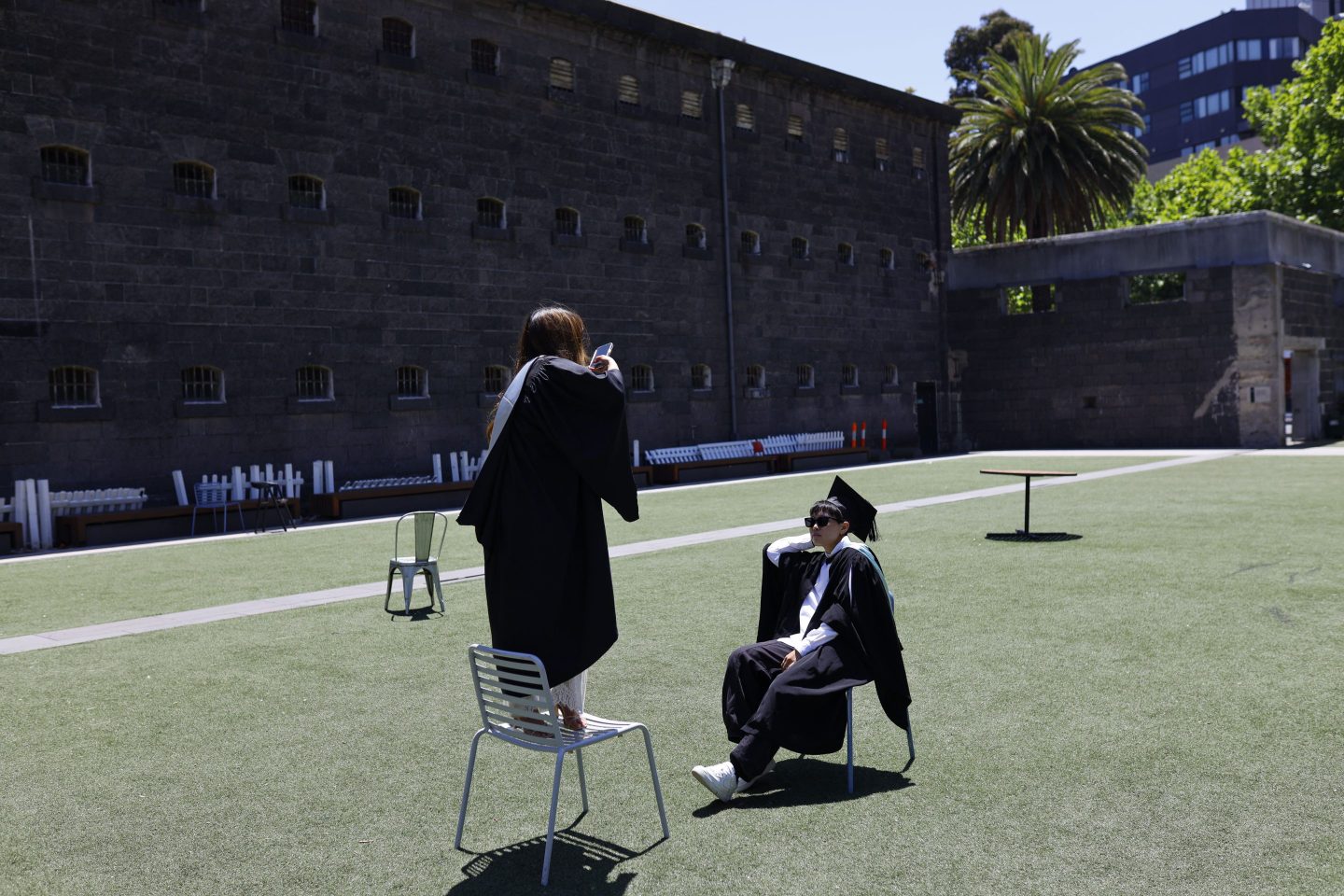
The first institution to stand in the dock is higher education. At the exact moment AI literacy became a foundational workplace skill, most colleges went in the opposite direction. More than half of college students say their school either discourages (42%) or outright bans (11%) the use of AI, according to Gallup. Faculty are aware of the damage: 63% believe their schools’ 2025 graduates were not very or not at all prepared to use AI in the workplace, per the American Association of Colleges and Universities. But what is the first thing employers are asking for from any qualified candidate? AI literacy.
This editor has personally visited the KPMG Lakehouse, where new consulting interns are training up in how to prompt, and talked to thought leaders in human resources and economics who fear the mismatch between what employers want and what workers have to offer. AI skills are the missing link in the stagnant labor market, and Gen Z knows it—and they know they’ve been underprepared for this revolutionary moment.
A Fortune investigation last fall found the same fault line from a different angle: Nine in 10 educators told researchers their graduates were workforce-ready, while nearly half of those graduates said they didn’t feel prepared even to apply for an entry-level job in their field. Rather than adapt, some students are engineering their own work-arounds: Double-majoring has surged as a hedge against AI disruption, Fortune reported in November, and graduates who steered toward so-called AI-proof fields—psychology, education, social work—are now finding those degrees carry negative financial returns as AI moves into white-collar work faster than anticipated.
This lands inside a broader legitimacy collapse that elite universities have spent years engineering for themselves. A Yale faculty committee released a sweeping, self-critical report this week documenting the ruin—runaway tuition; an opaque admissions process that systematically advantages the wealthy; and campuses increasingly hostile to free inquiry. A decade ago, 57% of Americans said they had a great deal or quite a lot of confidence in higher education; by 2024, that figure had cratered to a historic low of 36%. The institutions most responsible for equipping the next generation to navigate a turbulent economy have spent years losing the public’s trust—and then they turned their backs on AI, the one thing Gen Z most needed to master to get a good job, maybe any job, in this market.
The jobs disappeared quietly
Whatever deficiencies young people bring out of school, they have expected the job market to eventually sort things out. It hasn’t. The unemployment rate for recent college graduates hit 5.7% in the fourth quarter of 2025, above the national rate—a reversal that almost never happens. Underemployment for recent grads sits at 42.5%, the highest since 2020.
The mechanism matters here. This isn’t primarily a story of mass AI-driven layoffs, as layoffs remain relatively low across the economy, with big exceptions in the tech industry. The story is more one of quiet erasure. At companies that have adopted AI, junior hiring fell nearly 8% within six quarters—not through firings, but through a freeze on new positions, according to a Harvard working paper tracking 62 million workers.
Gen Zers are paying a compounding price: Without early-career experience accumulating, their wages are falling further behind those of older workers than any comparable cohort in decades. Entry-level jobs are the ones AI automates first. They are also the jobs that teach young workers how to think, build judgment, and eventually move up. Eliminate the bottom rung, and you don’t just harm one generation—you hollow out the management pipeline for the next decade.
The anxiety is producing measurable behavioral responses. Forty-four percent of Gen Z workers admit to actively sabotaging their company’s AI rollout—compared with 29% of workers overall, Fortune reported earlier this month. It is a sign less of technophobia than of workers who feel unprotected and are acting accordingly. Some economists argue that the weak entry-level market is partly an overcorrection from the post-COVID hiring binge of 2021. And nearly 60% of hiring managers reportedly use AI as an excuse for layoffs and freezes because it plays better with stakeholders than the real reasons do. Marc Andreessen called it a “silver-bullet excuse.” Sam Altman branded it “AI-washing.” The honest answer is messier: AI and opportunism are compounding each other, and young workers are caught in the middle.
Washington has been somewhere else
The missing actor in all of this is the government. There is no serious federal workforce transition framework, no large-scale AI-skills retraining program, no mandate that schools treat AI literacy the way they treat reading or arithmetic. What there is instead: an administration that has spent its political capital on wielding education funding as a cudgel—freezing $2.2 billion in federal grants to Harvard over campus activism disputes—while the skills gap widens, and a generation improvises its own future in real time.
Sixteen percent of currently enrolled college students have already changed their major because of AI—a sign of a generation trying to adapt in real time, without a map. Whether schools catch up, whether employers reverse the junior hiring freeze, and whether Washington produces anything resembling a workforce policy will determine whether the current anxiety hardens into something permanent. For now, the numbers suggest it already has.
In April 2026, OpenAI released a 13-page policy paper, “Industrial Policy for the Intelligence Age,” warning that AI’s rapid advance toward superintelligence threatens to hollow out wage and payroll tax revenue and unravel the social safety net, and calling for a sweeping overhaul comparable to the Progressive Era or the New Deal.
The company’s blueprint—shifting the tax base away from labor income toward corporate profits and capital gains, floating a “robot tax” on automated labor, and creating a national public wealth fund that would distribute returns to American citizens—closely mirrors proposals from billionaire venture capitalist and early OpenAI backer Vinod Khosla, who has argued for eliminating federal income tax for Americans earning under $100,000 and taxing capital gains at ordinary income rates.
Both Khosla and OpenAI framed the urgency in stark terms. Goldman Sachs research indicates that AI is already cutting roughly 16,000 U.S. jobs per month, with younger workers hit hardest, and Khosla predicts that AI could automate 80% of current jobs by 2030. Critics, including Carnegie Endowment scholar Anton Leicht, dismiss the OpenAI paper as “comms work to provide cover for regulatory nihilism,” underscoring how far Washington remains from any concrete legislative response.