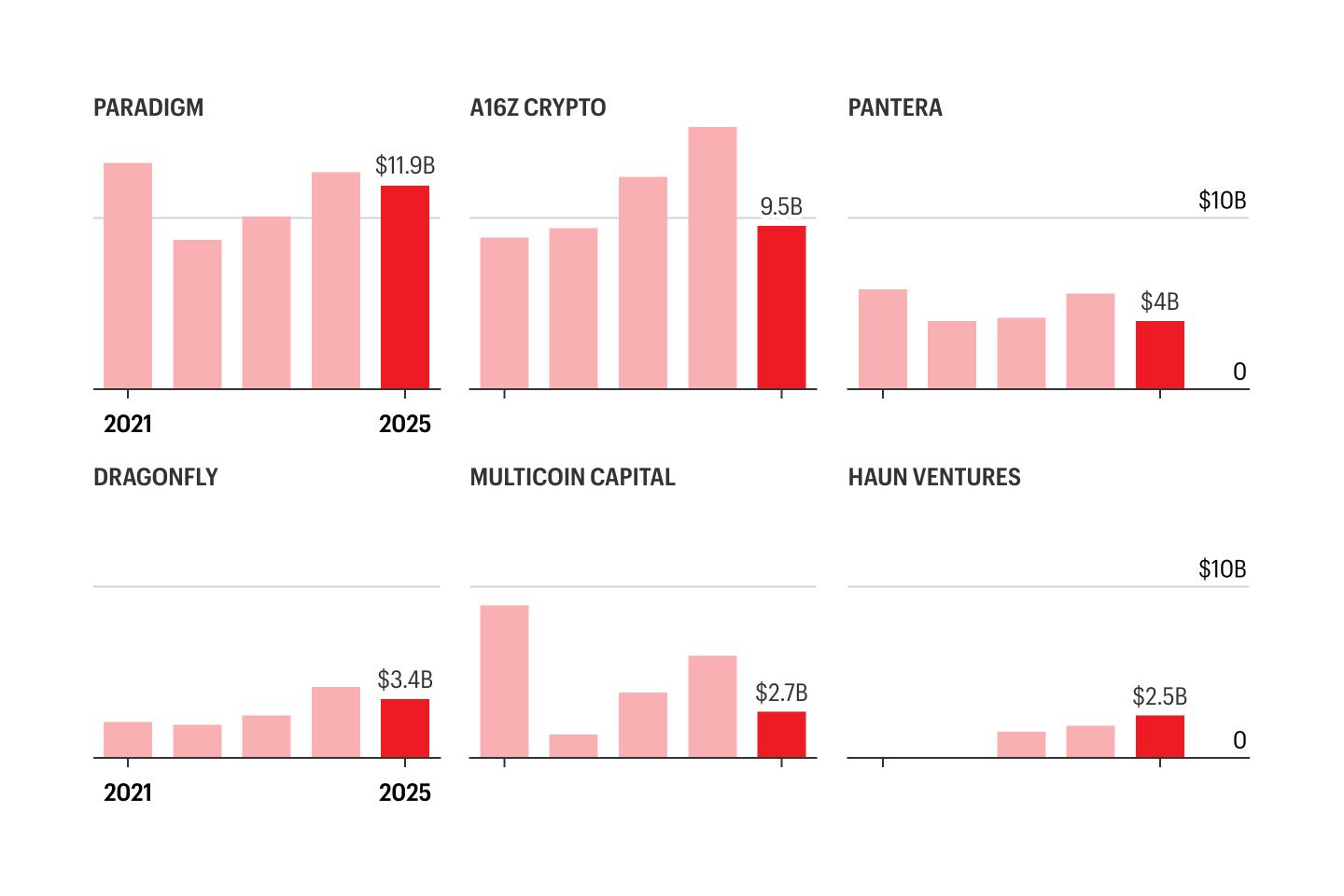
The biggest names in crypto venture weren’t immune to the sudden collapse in the digital asset market in 2025. Top outfits like Paradigm and Pantera Capital saw their assets under management shrink amid the downturn, according to previously unreported filings I obtained from the Securities and Exchange Commission.
Cryptocurrencies are volatile, sometimes rocketing up in price with one tweet from one volatile man. (Elon Musk, President Donald Trump, or Binance cofounder Changpeng Zhao… take your pick.) And veteran crypto venture capitalists have weathered their fair share of bear and bull markets, watching their holdings soar in value during the NFT hype cycle of 2021 to only see their portfolios plummet in the ensuing “crypto winter.”
In other words, short-term changes in the value of a crypto venture fund’s portfolio aren’t usually a sign of performance. And assets under management are poor barometers of a venture fund’s success, generally. Ultimately, top-notch investors are supposed to exit companies and give money back to their limited partners.
Behind the curtain
Still, digging into crypto VCs’ holdings provides a glimpse into their funds’ inner workings.
Take, for example, a16z crypto. The total assets under management for its four crypto funds plummeted almost 40% between 2024 and 2025 to $9.5 billion—even as its parent Andreessen Horowitz saw its holdings balloon past $100 billion, according to data from the SEC.
That decrease is partly because the venture giant began to distribute capital back to investors from its first three funds, according to sources familiar with the matter, who spoke anonymously to discuss private business dealings. One source told me that a16z crypto timed the distributions to coincide with the 2025 crypto market’s highs. In fact, the net DPI, or distributions to paid-in capital, for a16z’s first crypto fund was 5.4, according to Newcomer. Those returns are stellar compared to those from other VCs who raised in 2018, per data from Carta.
Pantera Capital also distributed capital back to investors in 2025 on the back of five portfolio companies that went public, including Circle and BitGo, said another source familiar with the venture’s operations.
Other crypto investors likely saw their holdings fall because the markets turned sour. Multicoin, especially, has been at the whims of crypto’s booms and busts. The VC also runs a hedge fund, and when digital assets were all the rage in 2021, it saw its assets under management almost triple to nearly $9 billion from the year prior. After the collapse of crypto exchange FTX in 2022, the investor’s portfolio plummeted and then rebounded in the following two years. It has now plunged again: From 2024 to 2025, its assets under management more than halved to nearly $2.7 billion as cryptocurrencies like Bitcoin nosedived beginning in October.
And only one top investor saw its stockpile grow. Haun Ventures, the outfit founded by former a16z partner Katie Haun, saw its assets under management jump more than 30% year-over-year to almost $2.5 billion. While the venture investor has made some well-timed bets (including on the stablecoin startup BVNK that Mastercard agreed to acquire for up to $1.8 billion), Haun Ventures was also raising a new $1 billion fund in 2025, my former colleague Leo reported last year. (We will miss you, Leo!)
Other peers are also seeking capital. Paradigm is looking to drum up as much as $1.5 billion, a16z crypto is raising up to $2 billion, and Dragonfly just closed a $650 million fund. And, perhaps next year, the portfolios of these other crypto venture investors will grow—if the crypto markets revive themselves after a dreary winter.
Spokespeople for Paradigm, Pantera, a16z crypto, Multicoin, and Haun Ventures all declined to comment.
‘We’re actively deploying capital,” said a spokesperson for Dragonfly.
See you tomorrow,
Ben Weiss
X: @bdanweiss
Email: benjamin.weiss@fortune.com
Submit a deal for the Term Sheet newsletter here.
Correction, April, 16, 2026: A previous version of this article said Dragonfly declined to comment. A spokesperson did comment when contacted and said the numbers provided were “accurate.”
Joey Abrams curated the deals section of today’s newsletter. Subscribe here.
VENTURE DEALS
- Beeline Medicines, a Boston, Mass.-based developer of therapies designed to target autoimmune and inflammatory diseases, raised $300 million in Series A funding. Bain Capital led the round.
- Glydways, a South San Francisco-based developer of autonomous vehicle networks, raised $170 million in Series C funding. Suzuki Motor Corporation, ACS Group, and Khosla Ventures led the round.
- Mintlify, a San Francisco-based developer of AI for the documentation lifecycle, raised $45 million in Series B funding. a16z and Salesforce Ventures led the round and was joined by Bain Capital Ventures, Y Combinator, MVP Ventures, Avra, HubSpot Ventures, TwentyTwo Ventures, and others.
- Alloy Therapeutics, a Waltham, Mass.-based antibody discovery services and technology company, raised $40 million in Series E funding from 8VC, JIC Venture Growth Investments, Echo Capital, and others.
- Synera, a Bremen, Germany-based agentic AI platform designed for engineering teams, raised $40 million in Series B funding. Revaia led the round and was joined by Capgemini and existing investors.
- Parasail, a San Francisco-based deployment network for AI agents, raised $32 million in Series A funding. Touring Capital and Kindred Ventures led the round and were joined by Samsung NEXT, Flume Ventures, Banyan Ventures, and existing investors.
- NanoTech Materials, a Houston, Texas-based developer of advanced materials designed for energy efficiency and wildfire resilience, raised $29.4 million in Series A funding. HPI Real Estate & Investments led the round and was joined by Goose Capital and Milliken & Company.
- Pillar, a New York City-based commodity risk automation platform, raised $20 million in seed funding. a16z led the round and was joined by Crucible Capital, Gallery Ventures, and others.
- Phonely, a San Francisco-based developer of AI voice agents for customer service, raised $16 million in Series A funding. Base10 Partners led the round and was joined by Y Combinator, Etech Global Services, TSA Group, and Engage CX.
- Gitar, a San Mateo, Calif.-based developer of AI agents designed for code review, raised $9 million in funding. Venrock led the round and was joined by Sierra Ventures.
- Capsule Security, a Tel Aviv, Israel-based trust layer for agentic AI, raised $7 million in seed funding. Lama Partners led the round and was joined by Forgepoint Capital International.
- Gravity, a Boulder, Colo.-based developer of an autonomous AI analyst designed to work like a consultant, raised $7 million in funding. Next Frontier Capital led the round and was joined by Foundry Group, K5 Global, and Denver Ventures.
- Traza, a New York City-based AI-powered procurement and supply chain operations automation platform, raised $2.1 million in pre-seed funding. Base10 Partners led the round and was joined by Kfund, a16z scouts, Clara Ventures, Masia Ventures, and others.
PRIVATE EQUITY
- American Industrial Partners agreed to acquire Avanos Medical, an Alpharetta, Ga.-based medical technology company, for $1.27 billion.
- H.I.G. Capital acquired Inventus Power, a Woodridge, Ill.-based provider of advanced battery and power systems. Financial terms were not disclosed.
- Midland Industries, a portfolio company of Gemspring Capital, acquired Trading Services International, a New York City-based pipe fittings, valves, and industrial products company. Financial terms were not disclosed.
FUNDS + FUNDS OF FUNDS
- Topspin Consumer Partners, a Mamaroneck, N.Y.-based private equity firm, raised $328 million for its third fund focused on consumer sectors, including health & wellness, personal care, and beauty.