If you’d never heard of the Strait of Hormuz before, you probably have by now. Iran’s effective closure of the waterway, which usually carries about 20% of the world’s oil and gas, has put severe pressure on the global economy.
Now, some analysts are warning a new flashpoint could emerge: the Bab el-Mandeb Strait.
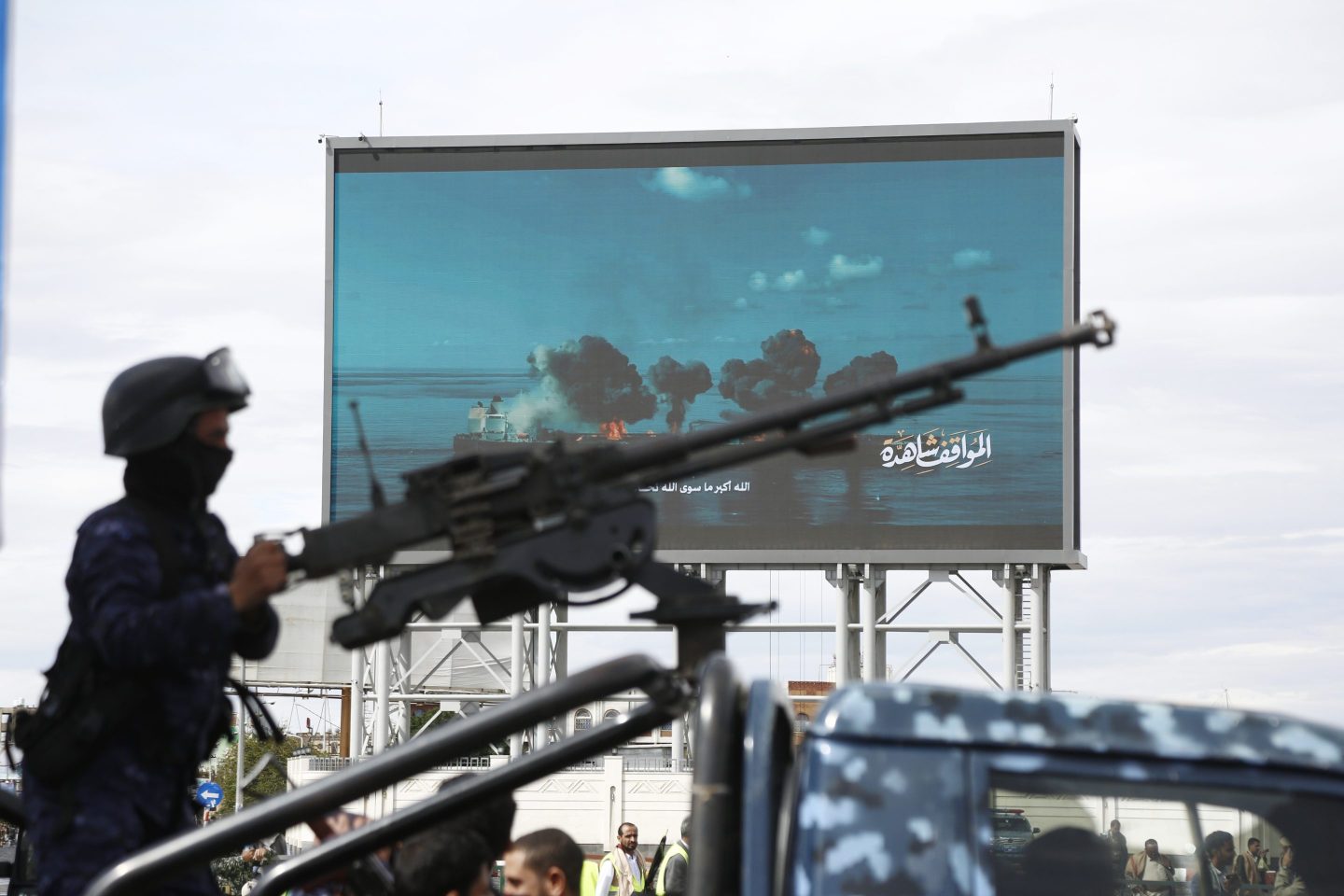
That’s because on March 28, the Houthis, a military group that controls large parts of northern Yemen and is aligned with Iran, entered the war, launching missiles towards Israel for the first time since the war with Iran began.
Yemen is situated on one side of the strait, and the Houthis have previously attacked shipping in the Red Sea, causing major disruption in late 2023 and 2024.
Bloomberg now reports Iran has approached the Houthis to prepare for a similar campaign.
Here’s why all eyes will be back on the Houthis, Bab el-Mandeb and the Red Sea, and what disruption of a second major chokepoint could mean for the world economy.
What is the Bab el-Mandeb Strait?
The Bab el-Mandeb Strait is about 30 kilometres wide at its narrowest point. It is situated between Yemen on the Arabian Peninsula to the northeast and Eritrea and Djibouti in Africa on the west.
Its name literally means “Gate of Tears” in Arabic, after its famously treacherous sailing conditions.
It has become so important because, along with the Suez Canal in Egypt, it allows ships to transit directly between the Mediterranean Sea and the Indian Ocean by passing through the Red Sea and the Gulf of Aden.
Before the Suez Canal’s opening in the 19th century, ships had to travel all the way around the southern tip of Africa to join these two points.
An oil tanker leaving Saudi Arabia to go to the Netherlands, for example, only has to travel 12,000 kilometres if it goes via the Red Sea, compared with more than 20,000 kilometres going south around Africa.
As you’d expect, that’s much faster too. According to the US Energy Information Administration (EIA), a trip between the Arabian Sea and the Netherlands that takes 34 days the long way around is shortened to just 19 days.
What passes through it?
In normal times, as much as 14% of global maritime trade goes through the Bab el-Mandeb Strait.
Detailed data on what passes through the Bab el-Mandeb Strait is somewhat limited. But fossil fuels are a major component.
The International Energy Agency (IEA) estimates that in 2025 about 4.2 million barrels of crude oil and petroleum liquids crossed the Bab al-Mandeb Strait per day. That’s about 5% of global production.
Given most ships use the Suez Canal as well, official data from the Suez Canal Authority allow us to paint a detailed picture of Red Sea shipping.
In the final quarter of 2025, about 40% of the 3,426 ships passing through the Suez Canal transported fossil fuels: (1,330 oil tankers, 88 liquefied natural gas (LNG) ships).
Bulk and general cargo made up another 40% (1,339 ships), typically transporting agricultural commodities such as corn, wheat and soybeans, and also coal and iron ore. Container ships made about 13% of the traffic (459 ships).
Notably, total traffic through the Red Sea has declined considerably since Houthi attacks on shipping in late 2023 and 2024, even though these attacks have largely stopped.
Can the strait be closed?
The Bab el-Mandeb Strait can’t be “closed” entirely. Its narrowest point is still a considerably wide waterway. And unlike the Strait of Hormuz, the Bab el-Mandeb Strait is not a “cul-de-sac”, where the passage is closed at one end with only one way out. Ships can still exit to the Mediterranean via the Suez Canal.
That’s little comfort for those bound for Asia, which would then have to round Africa to do so, adding weeks to the journey.
Notably, Saudi Arabia had already built a “Plan B” to avoid the Strait of Hormuz, called the East-West pipeline. This pipeline connects Abqaiq in the north with Yanbu on the Red Sea, and had already begun pumping oil at almost full capacity in response to the conflict.
But oil bound for Asia from this new exit point still has to pass through Bab el-Mandeb to avoid the long way around, meaning it could be disrupted.
We’ve been here before
To get a sense of how the Houthis could disrupt shipping again, we can look to the most recent Red Sea crisis.
According to the International Maritime Organization (IMO), 67 incidents were recorded between November 2023 and September 2024. Some ships only suffered minor equipment damage. But others faced severe fires, flooding and structural damage after being hit by missiles or drones.
However, there have been relatively few attacks since 2024. And the strait was never totally “closed” per se: some ships continued to pass through throughout the crisis.
The mere threat of attacks
These same tactics would probably apply today. But for shipping companies, the mere threat of attacks may be enough to slow or restrict shipping. There are significant risks to civilian crew, who face a threat to life.
Adding to this, insurance costs could become prohibitive enough to close the route in practical terms. Back in 2024, insurance costs were about 0.6% of the value of the cargo on a ship. After the Red Sea crisis, this rose as high as 2%.
The effective closure of both the Strait of Hormuz and Bab el-Mandeb at the same time would be severely disruptive to global supply chains and the global economy.
Flavio Macau, Associate Dean – School of Business and Law, Edith Cowan University
This article is republished from The Conversation under a Creative Commons license. Read the original article.