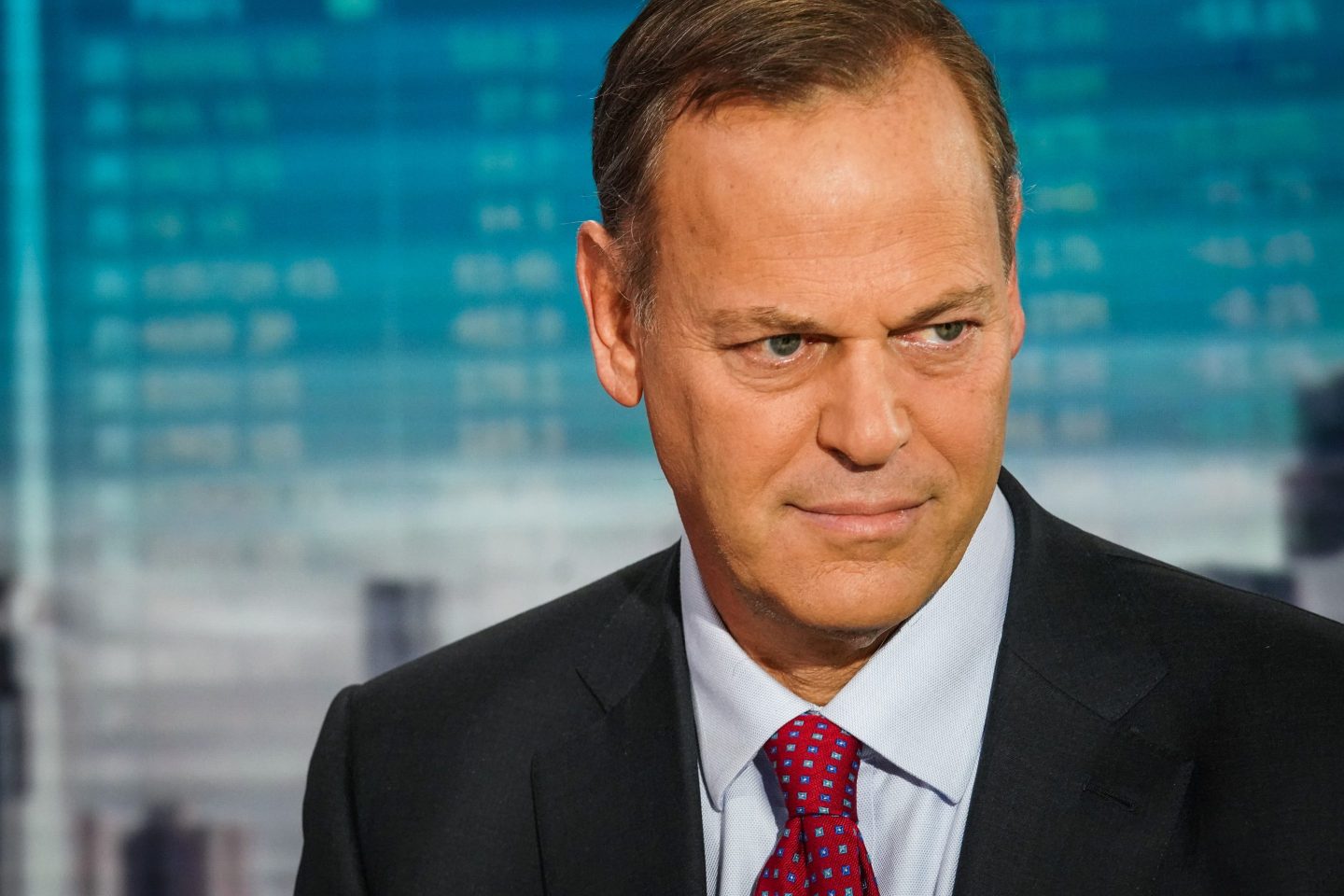
Steve Klinsky has spent 25 years building New Mountain Capital into one of private equity’s most respected firms, with $60 billion in assets under management across hundreds of portfolio companies. His investment record speaks for itself: a supply chain software company he bought for $600 million sold for over $8 billion. A life sciences firm he backed went public at a $3 billion gain. The firm often says that it has never had a portfolio company go bankrupt.
But ask Klinsky what he’s most excited about right now, and he’ll tell you about a website.
ModernStates.org—the online home of his Modern States Education Alliance—has quietly reached 800,000 people and given away the equivalent of 25,000 free years of college credit, all without spending a dollar on advertising. And Klinsky says that’s just the start.
“It’s just getting started,” he said in a recent interview on Goldman Sachs’ Great Investors podcast, noting that it’s all happened without a single dollar spent on advertising.
“There’s $1.7 trillion dollars of student debt,” Klinsky said when speaking about what motivates him, a notable philanthropist. “It’s an unreal number.”
The Idea Is Elegantly Simple
Modern States didn’t invent anything new, Klinsky explained to Alison Mass, Goldman’s chair of Investment Banking, Global Banking and Markets. It built on a little-known but decades-old program called CLEP exams—College-Level Examination Program tests administered by the College Board, the same organization behind the SAT. The exams cover dozens of subjects, from college algebra to American literature, and have existed for 50 years. Pass one, and most U.S. colleges and universities will award you the credit—no tuition required.
The problem was that almost nobody knew about them, and even fewer could afford to prepare for them properly.
Klinsky’s solution: hire the best professor in each of the 32 subjects, build a free online course for every one, and post them at ModernStates.org. Students get free coursework, free readings, and free practice questions. If they pass, Modern States even picks up the $100 CLEP exam fee.
The math is striking.
“If you’re Abe Lincoln and you’re totally impoverished but you’re ambitious, you can get a year of college this way and save a year of time and $30 grand of money,” Klinsky said.
Why a Billionaire PE Founder Is Doing This
Klinsky, whose net worth Forbes estimates at $4.9 billion, didn’t arrive at education philanthropy through guilt or optics. His path there is personal.
Growing up in Detroit, his older brother Gary—seven years his senior—tutored him relentlessly after school. “It was incredibly meaningful in my life,” Klinsky said. Gary died of a genetic illness while Klinsky was just in graduate school at Harvard. And in 1987, when Klinsky made partner at his first major PE firm, Forstmann Little, in New York City, one of his first acts was to create afterschool centers in the most crime-ridden neighborhoods nearby, named in Gary’s memory. They’re still running today.
That hands-on experience in East New York—a neighborhood that at the time had more murders than the entire state of Nebraska—convinced him the problem with America’s most underserved students wasn’t the kids. It was the system. “When I would go visit the school,” he said, “the kids were fantastic. The teachers were fantastic.”
Charter schools came next. Then a deeper focus on higher education. Then Modern States.
Redemption of an Industry
Klinsky’s philanthropy is harder to dismiss when you consider where he came from. He is, by his own acknowledgment, a character in Barbarians at the Gate—the classic business book that became the defining indictment of 1980s private equity excess, chronicling the savage $25 billion RJR Nabisco buyout (then the largest in history) and the era of debt-fueled, fee-gorged dealmaking that made Wall Street a cultural villain for a generation.
He was there. He saw it up close. And he spent the next 40 years building something deliberately different.
New Mountain Capital was founded on a explicit rejection of the old model—less debt, no financial engineering, only non-cyclical industries, and a relentless focus on actually improving the businesses it buys. Klinsky has made the case publicly for years, including as chairman of the American Investment Council, the trade group representing all 5,000 U.S. private equity firms, and in a Harvard Business Review piece laying out how his firm grew a sleepy supply chain software company from $600 million to over $8 billion in value.
“Private equity has gone from a form of finance into a form of business,” he told Mass on the Goldman Sachs podcast. His free-college initiative, in that light, isn’t a detour from Klinsky’s Wall Street identity but another expression of what he’s always done: find something broken, rolled up his sleeves, and built something better.
Just Getting Started
Despite its scale, Modern States remains one of philanthropy’s best-kept secrets. Klinsky attributes its growth entirely to word of mouth—800,000 users found it organically, proof of concept for a model he believes can grow far larger.
At a moment when student debt has become one of the defining anxieties of a generation, the program’s timing couldn’t be more relevant. Even in-state tuition at universities trying to hold costs down—like Purdue in Indiana—runs roughly $33,000 a year, Klinsky noted.
Modern States won’t solve the student debt crisis alone. But for 800,000 people who’ve already used it, it may be the most practical solution anyone has actually delivered.
For this story, Fortune journalists used generative AI as a research tool. An editor verified the accuracy of the information before publishing.