
• Home
  • Latest
  • Fortune 500
  • Finance
  • Tech
  • Leadership
  • Lifestyle
  • Rankings
  • Multimedia
InvestingDebt

300 years of wars show they are ‘always disaster times’ for holders of government debt because of inflation and financial repression

Jason Ma
By
Jason Ma
Jason Ma
Weekend Editor
Down Arrow Button Icon
Jason Ma
By
Jason Ma
Jason Ma
Weekend Editor
Down Arrow Button Icon
March 20, 2026, 12:06 PM ET
The USS Delbert D. Black (DDG 119) fires a Tomahawk Land Attack Missile (TLAM) in support of Operation Epic Fury on February 28, 2026 in the Mediterranean Sea.
The USS Delbert D. Black (DDG 119) fires a Tomahawk Land Attack Missile (TLAM) in support of Operation Epic Fury on February 28, 2026 in the Mediterranean Sea. U.S. Navy via Getty Images

Government bonds, especially Treasuries, have long been seen as a safe haven during recessions, geopolitical calamities, and other market-moving disasters that create uncertainty.

Recommended Video

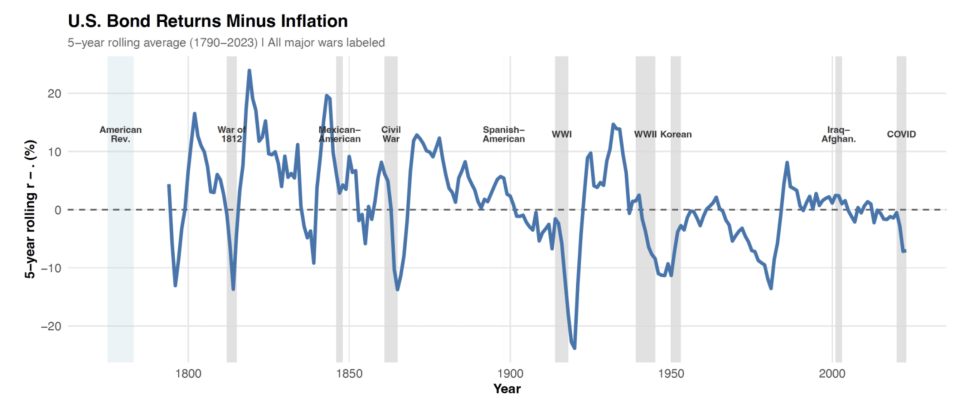
But after looking at 300 years of U.S. and U.K. history, the Center for Economic Policy Research found that wars and pandemic-scale emergencies have pummeled holders of debt.

“The historical evidence reveals a striking pattern: government bonds have repeatedly generated substantial real losses during these extreme episodes,” authors Zhengyang Jiang, Hanno Lustig, Stijn Van Nieuwerburgh, and Mindy Xiaolan wrote. “They have even underperformed equities and real estates which are traditionally regarded as risky assets.”

That’s because wars typically triggered large increases in government spending, averaging about 7% of GDP annually during the first four years, and tax hikes alone were rarely sufficient for financing needs, they added.

The finding comes as the U.S. is waging war on Iran while the national debt has exploded to $39 trillion. The Pentagon is seeking more than $200 billion in a budget request for the conflict, sources told the Washington Post.

Across their dataset, the CEPR authors calculated that bondholders suffered average real losses of roughly 14% during the first four years of conflicts. The losses were so steep that they reduced the real value of government debt outstanding.

To add insult to injury, cumulative bond returns were more than 20% below the cumulative returns on stocks and real estate, the opposite of how those assets perform during financial crises or recessions.

“Whenever there is a major war, we observe a sharp decline in the bond performance — wars are always disaster times for bondholders,” they warned. “Similarly, the bondholders also suffered large losses during the ‘war on Covid-19.'”
Center for Economic Policy Research

A key factor in bond losses is inflation, according to CEPR, which said the cumulative rate averaged about 20% in the first four years of wars.

In fact, during the current U.S.-Israel war on Iran, Treasuries and government debt from other countries have sold off sharply as surging oil prices have raised expectations for elevated inflation while budget deficits are also seen worsening. Since the war began three weeks ago, the U.S. 10-year yield has soared more than 40 basis points.

But profligate spending wasn’t the only way inflation weighed on bonds. The think tank said it was often the result of policy choices to reduce debt burdens without explicitly defaulting, such as by suspending gold standard commitments.

Another reason bonds perform so poorly during wars is so-called financial repression, or government policies that curb borrowing costs by influencing financial markets. That prevents bond yields from keeping pace with inflation.

For example, the Federal Reserve implemented yield-curve control, capped Treasury rates, and launched massive bond buying during World War II.

CEPR’s findings have particular relevance for U.S. debt as Treasuries continue to form the foundation of the global financial system with the dollar serving as the world’s reserve currency.

That status has allowed the U.S. to borrow more cheaply than investors would otherwise allow. Meanwhile, the interest on U.S. debt is now the fastest-growing budget item and is already at $1 trillion a year. CEPR said its report presents governments with an important tradeoff.

“Protecting taxpayers from large spending shocks may require shifting part of the burden onto bondholders through inflation or financial repression,” it said. “Economic theory suggests that such policies may be optimal when taxation is highly distortionary. However, they also reduce the safety of government debt and may raise borrowing costs over time if investors anticipate these risks.”


The Fortune 500 Innovation Forum will convene Fortune 500 executives, U.S. policy officials, top founders, and thought leaders to help define what’s next for the American economy, Nov. 16-17 in Detroit. Apply here.
About the Author
Jason Ma
By Jason MaWeekend Editor

Jason Ma is the weekend editor at Fortune, where he covers markets, the economy, finance, and housing.

See full bioRight Arrow Button Icon

Latest in Investing

Finance
Lorem ipsum dolor sit amet, consectetur adipiscing elit, sed do eiusmod tempor incididunt ut labore et dolore magna aliqua. Ut enim ad minim veniam
By Fortune Editors
October 20, 2025
Finance
Lorem ipsum dolor sit amet, consectetur adipiscing elit, sed do eiusmod tempor incididunt ut labore et dolore magna aliqua. Ut enim ad minim veniam
By Fortune Editors
October 20, 2025
Finance
Lorem ipsum dolor sit amet, consectetur adipiscing elit, sed do eiusmod tempor incididunt ut labore et dolore magna aliqua. Ut enim ad minim veniam
By Fortune Editors
October 20, 2025
Finance
Lorem ipsum dolor sit amet, consectetur adipiscing elit, sed do eiusmod tempor incididunt ut labore et dolore magna aliqua. Ut enim ad minim veniam
By Fortune Editors
October 20, 2025
Finance
Lorem ipsum dolor sit amet, consectetur adipiscing elit, sed do eiusmod tempor incididunt ut labore et dolore magna aliqua. Ut enim ad minim veniam
By Fortune Editors
October 20, 2025
Finance
Lorem ipsum dolor sit amet, consectetur adipiscing elit, sed do eiusmod tempor incididunt ut labore et dolore magna aliqua. Ut enim ad minim veniam
By Fortune Editors
October 20, 2025

Most Popular

Finance
Lorem ipsum dolor sit amet, consectetur adipiscing elit, sed do eiusmod tempor incididunt ut labore et dolore magna aliqua. Ut enim ad minim veniam
By Fortune Editors
October 20, 2025
Finance
Lorem ipsum dolor sit amet, consectetur adipiscing elit, sed do eiusmod tempor incididunt ut labore et dolore magna aliqua. Ut enim ad minim veniam
By Fortune Editors
October 20, 2025
Finance
Lorem ipsum dolor sit amet, consectetur adipiscing elit, sed do eiusmod tempor incididunt ut labore et dolore magna aliqua. Ut enim ad minim veniam
By Fortune Editors
October 20, 2025
Finance
Lorem ipsum dolor sit amet, consectetur adipiscing elit, sed do eiusmod tempor incididunt ut labore et dolore magna aliqua. Ut enim ad minim veniam
By Fortune Editors
October 20, 2025
Finance
Lorem ipsum dolor sit amet, consectetur adipiscing elit, sed do eiusmod tempor incididunt ut labore et dolore magna aliqua. Ut enim ad minim veniam
By Fortune Editors
October 20, 2025
Finance
Lorem ipsum dolor sit amet, consectetur adipiscing elit, sed do eiusmod tempor incididunt ut labore et dolore magna aliqua. Ut enim ad minim veniam
By Fortune Editors
October 20, 2025
Fortune Secondary Logo
Rankings
  • 100 Best Companies
  • Fortune 500
  • Global 500
  • Fortune 500 Europe
  • Most Powerful Women
  • Future 50
  • World’s Most Admired Companies
  • See All Rankings
Sections
  • Finance
  • Fortune Crypto
  • Features
  • Leadership
  • Health
  • Commentary
  • Success
  • Retail
  • Mpw
  • Tech
  • Lifestyle
  • CEO Initiative
  • Asia
  • Politics
  • Conferences
  • Europe
  • Newsletters
  • Personal Finance
  • Environment
  • Magazine
  • Education
Customer Support
  • Frequently Asked Questions
  • Customer Service Portal
  • Privacy Policy
  • Terms Of Use
  • Single Issues For Purchase
  • International Print
Commercial Services
  • Advertising
  • Fortune Brand Studio
  • Fortune Analytics
  • Fortune Conferences
  • Business Development
  • Group Subscriptions
About Us
  • About Us
  • Editorial Calendar
  • Press Center
  • Work At Fortune
  • Diversity And Inclusion
  • Terms And Conditions
  • Site Map
  • About Us
  • Editorial Calendar
  • Press Center
  • Work At Fortune
  • Diversity And Inclusion
  • Terms And Conditions
  • Site Map
  • Facebook icon
  • Twitter icon
  • LinkedIn icon
  • Instagram icon
  • Pinterest icon

Latest in Investing

Personal FinanceGold
Should you invest in physical gold or a gold ETF?
By Joseph HostetlerMarch 20, 2026
8 seconds ago
InvestingDebt
300 years of wars show they are ‘always disaster times’ for holders of government debt because of inflation and financial repression
By Jason MaMarch 20, 2026
1 hour ago
Jerome Powell, wearing a suit, looks ahead with his brow furrowed.
EconomyEconomics
Economists agree: You’re not crazy for feeling like the rich get richer, and the poor are doing worse. Welcome to the ‘K-shaped economy’
By Sasha Rogelberg, Eva Roytburg and Nick LichtenbergMarch 20, 2026
2 hours ago
Current price of Ethereum for March 20, 2026
Personal FinanceEthereum
Current price of Ethereum for March 20, 2026
By Joseph HostetlerMarch 20, 2026
5 hours ago
Current price of Bitcoin for March 20, 2026
Personal FinanceCryptocurrency
Current price of Bitcoin for March 20, 2026
By Joseph HostetlerMarch 20, 2026
5 hours ago
Photo: A-10 Thunderbolt Warthog.
BankingMarkets
As the U.S. gears up for a potential ground war in Iran, $100-plus oil threatens ‘demand destruction’ — starting in Asia
By Jim EdwardsMarch 20, 2026
6 hours ago

© 2026 Fortune Media IP Limited. All Rights Reserved. Use of this site constitutes acceptance of our Terms of Use and Privacy Policy | CA Notice at Collection and Privacy Notice | Do Not Sell/Share My Personal Information
FORTUNE is a trademark of Fortune Media IP Limited, registered in the U.S. and other countries. FORTUNE may receive compensation for some links to products and services on this website. Offers may be subject to change without notice.