
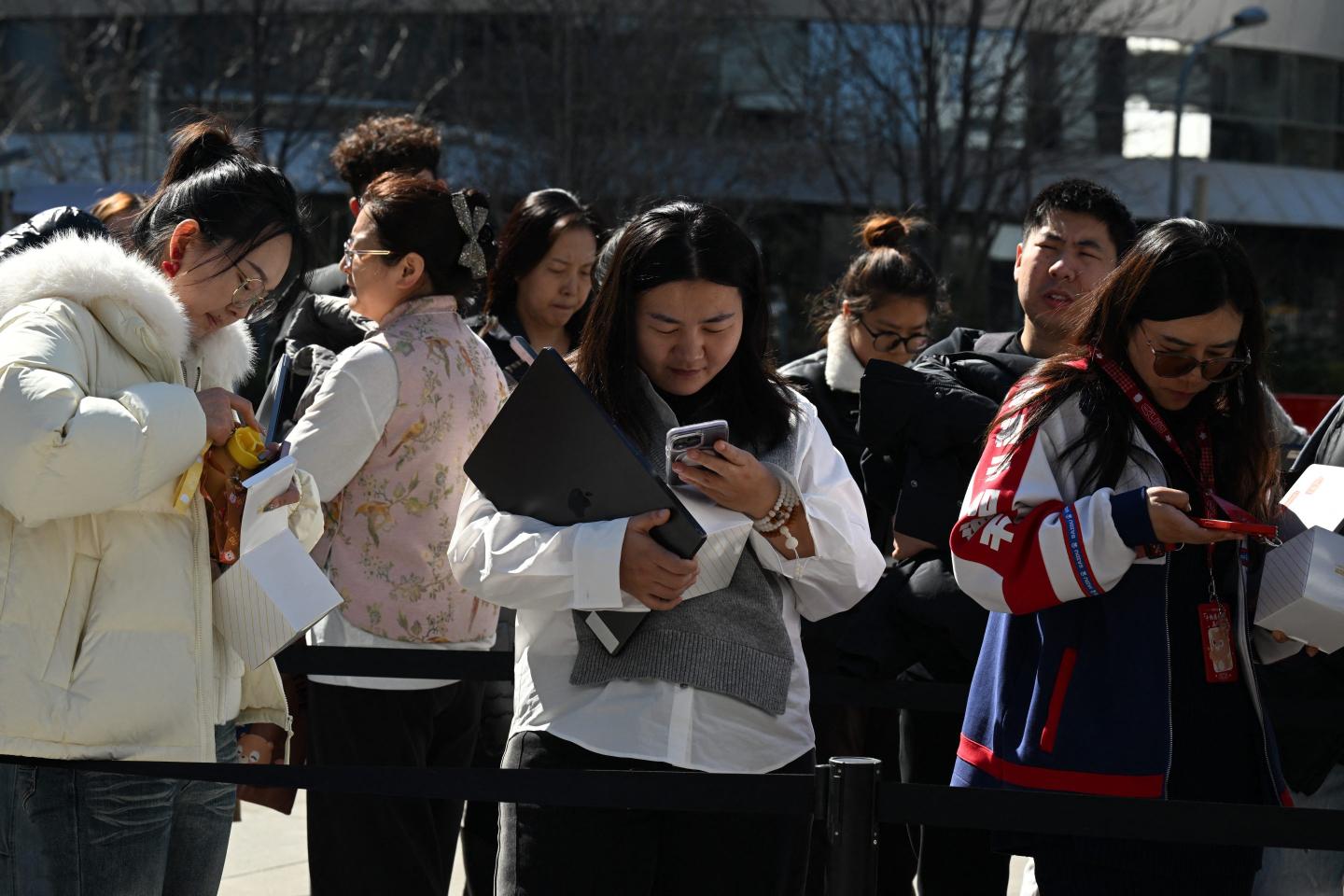
On a Friday afternoon in March, nearly 1,000 people lined up outside Tencent’s headquarters in Shenzhen to get a piece of software installed on their laptops. Engineers from the company’s cloud unit helped students, retirees, and office workers deploy OpenClaw, an open-source AI agent built by Austrian programmer Peter Steinberger.
Over the past month, major Chinese cloud providers debuted their own version of OpenClaw, local governments dangled grants to startups that build OpenClaw apps, and a cottage industry sprung up helping users install the open-source framework.
China’s users are now trying a “raise a lobster”, a phrase referring OpenClaw’s red lobster logo. It’s proved to be a shot in the arm for China’s AI startups, which could now see a surge of usage. In early February, Chinese AI models for the first time surpassed U.S. models in share of tokens—units of data processed by AI—among the top nine models on AI marketplace OpenRouter, according to HSBC.
The OpenClaw craze also aligns with China’s embrace of open-source AI, a strategy that has helped build labs’ reputation among the developer community and slowly helped models work their way into global business.
What is OpenClaw?
Steinberger released OpenClaw on GitHub last November, where it quickly caught on among AI developers and hobbyists. OpenClaw is what is called “an agentic harness.” It isn’t an AI model itself—a user has to pick a model from an AI company to serve as the agent’s brain. But OpenClaw consists of a set of instructions for how an AI agent should deconstruct a goal into a series of subtasks, protocols that allow a user to connect various software tools for the AI agent to use, and also a memory function that means the AI agent won’t forget what it has done so far.
An OpenClaw agent runs locally on a user’s machine and connects to tools like messaging apps, email, calendars and other systems, making it easy for users to ask an AI agent to do useful things for them, like regularly check their email and automatically reply to certain messages, or make reservations on their behalf. Steinberger, who has a long history as an entrepreneur, has since been hired by OpenAI.
Over the past several weeks, China’s biggest cloud providers—Alibaba Cloud, Tencent Cloud, ByteDance’s Volcano Engine, JD.com, and Baidu—have all embraced OpenClaw, or some spinoff of it. A flood of startups and big tech companies also released their own “Claw” frameworks: Tencent’s WorkBuddy, Minimax’s MaxClaw, MoonShot’s Kimi Claw, among others.
Local governments joined in. Shenzhen’s Longgang district offered grants of up to 10 million yuan ($1.4 million) for “one-person companies,” or firms where the founder acts as sole shareholder. Wuxi, a city close to Shanghai, dangled up to 5 million yuan ($730,000) for OpenClaw-powered breakthroughs in robotics and industrial applications.
Those subsidies are landing in a market where users are eager to experiment with new AI. “Younger generations in Asia, and especially in China, are part of a high-tech adoption culture,” Jan Wuppermann, the head of service assurance, data and AI for NTT Data, said to Fortune. “There’s a mindset I often hear from everyday Chinese friends: It’s there anyway, I may as well use it.”
In the West, OpenClaw’s popularity has been tempered by security concerns. AI agents can be vulnerable to “prompt injection” attacks, where a bad actor can plant malicious instructions on a website. OpenClaw agents have been tricked into uploading sensitive data, including financial information and crypto wallet keys; in other cases, agents have deleted emails and code libraries.
OpenClaw is building upon a strong 2026 for China’s AI sector. Nearly every major Chinese AI lab has released updates to their open-source models, including Moonshot’s Kimi 2.5, Minimax’s M2.5 and Zhipu’s GLM-5. ByteDance’s new AI video-generation model, Seedance 2.0, also went viral after debuting at the 2026 Spring Festival Gala, one of China’s most widely-watched TV events.
The shift to agentic AI is giving some Big Tech companies the opportunity to catch up with the nimble AI labs. Tencent is now working on a new AI agent that can be integrated with the company’s ubiquitous WeChat superapp, The Information reported on March 10, citing unnamed sources. Tencent’s AI efforts have currently proved less successful than its rivals Alibaba and ByteDance; Tencent’s chatbot, Yuanbao has just 109 million users, much smaller than ByteDance’s Doubao and its 315 million users, according to The Information.
The OpenClaw craze has helped the stock market fortunes of some Chinese AI companies. Tencent’s stock is up by 8.9% over the past week. MiniMax is up by 27.4% since the weekend; shares are now up by more than 600% from its IPO earlier this year.
Still, China’s AI startups have a long road to profitability. MiniMax released its 2025 earnings on March 2, giving investors the first look at what the financials of an AI lab look like.
The answer? Expensive.
The AI startup reported total revenue of $79 million, an increase of 159%. Over 70% of this revenue came from overseas markets, showing that MiniMax is finding traction outside of China. Yet the company still posted a net loss of $1.8 billion, in part thanks to research and development costs totaling $252 million.
Still, investors don’t seem to care. At one point last week, MiniMax was worth more than tech giant Baidu, despite the latter generating $18.5 billion in 2025 revenue, more than 230 times more than MiniMax.
China’s open-source goes global
Chinese open-source models have quietly—and not so quietly—started to spread among global business. Airbnb CEO Brian Chesky raised eyebrows last year when he admitted that the company used Alibaba’s open-source Qwen model to power its customer service agent. “It’s very good. It’s also fast and cheap,” he said.
Last November, AI Singapore, the city-state’s national AI programme, adopted Qwen to build Qwen-SEA-LION-v4, a large language model optimized for Southeast Asian languages. Alibaba now claims the Qwen family of models has been downloaded over one billion times, and used by over 200,000 developers.
“You can see the attraction of open-weights models,” says Jeff Walters, who leads the Asia-Pacific tech practice for the Boston Consulting Group. “There may be a slight lag to how the latest frontier models might perform but, in a lot of situations, you don’t always need the best. ‘Good enough and cheap’ is sometimes the right tool to pull out of the toolbox”.
Using open-source also gives companies options, and doesn’t lock them into one particular provider—which may be useful for startups trying to navigate a constantly-changing world of regulations, export controls, and shifting alliances.
Still, open-source models shift the burden of running compute onto the user. “You can get narrowly excited about cost-per-token comparisons between a commercial model and an open-source model, but that’s only one part of the cost,” Walters cautions.
Companies need to pay for their own processors, but there are hidden costs too. Wuppermann notes that “hidden costs, like security breaches and complexity, often aren’t measured, and instead show up in other dimensions, like extra headcount or longer time-to-market”.
For Wuppermann, the decision to go open-source is mostly philosophical. “Those who have converted to open-source will always advocate open-source.”
China’s AI challenges
Even as OpenClaw and Chinese open-source models gain momentum, China’s AI ecosystem faces rising scrutiny over data security, intellectual property and Beijing’s own shifting priorities.
In February, Anthropic accused three Chinese firms—DeepSeek, Moonshot AI, and MiniMax—of trying to extract knowledge from its Claude model. OpenAI has also accused Chinese labs of conducting distillation attacks, or using U.S. models to help train Chinese ones.
Oddly enough, the complaints may have ended up reinforcing the reputation of Chinese labs. Reaction to Anthropic’s accusations on social media were mixed, with some users noting that even if DeepSeek and others were engaging in “illicit” distillation, they were at least sharing their work—unlike Anthropic, which has kept its AI models closed-source.
China’s own commitment to open source might also be fraying at the edges. On March 3, Lin Junyang—the technical lead of Alibaba’s Qwen model and a driving force behind the company’s open-source strategy—suddenly announced his resignation.
Lin’s exit exposed tensions between Alibaba’s open-source ambitions and its push to commercialize flagship models. Local media reported the Qwen team disagreed with the goals of Alibaba leadership, and expressed frustration that cloud customers sometimes got access to compute before they did. (Alibaba has affirmed that it isn’t abandoning its open-source strategy)
Beijing might also try to dampen enthusiasm over OpenClaw. On Wednesday, Bloomberg reported that both government agencies and state-owned enterprises were warned against installing OpenClaw on work devices, citing security risks.
Still, Chinese companies keep on releasing their own versions of OpenClaw. On March 12, Sensetime, once one of China’s most prominent AI firms, announced that it had integrated its office assistant “Office Raccoon” with OpenClaw.
And local Chinese are finding ways to capitalize on the craze. Engineers have found a new business: Charging 500 yuan ($72) to install OpenClaw on-site. And if someone ends up getting cold feet over giving an AI agent access to their entire lives? They’ll charge you to uninstall it too.