Welcome to Eye on AI, with AI reporter Sharon Goldman. In this edition: a preview of Nvidia GTC…the end of computer programming as we know it…Atlassian cuts 10% of its workforce in AI drive…AI money floods into the U.S. midterms...McKinsey rushes to fix AI system after hacker exposes flaws.
As basketball fans gear up for March Madness next week, AI industry watchers turn to their own late-winter frenzy: Nvidia GTC, the annual developer conference of what is now the world’s most valuable company.
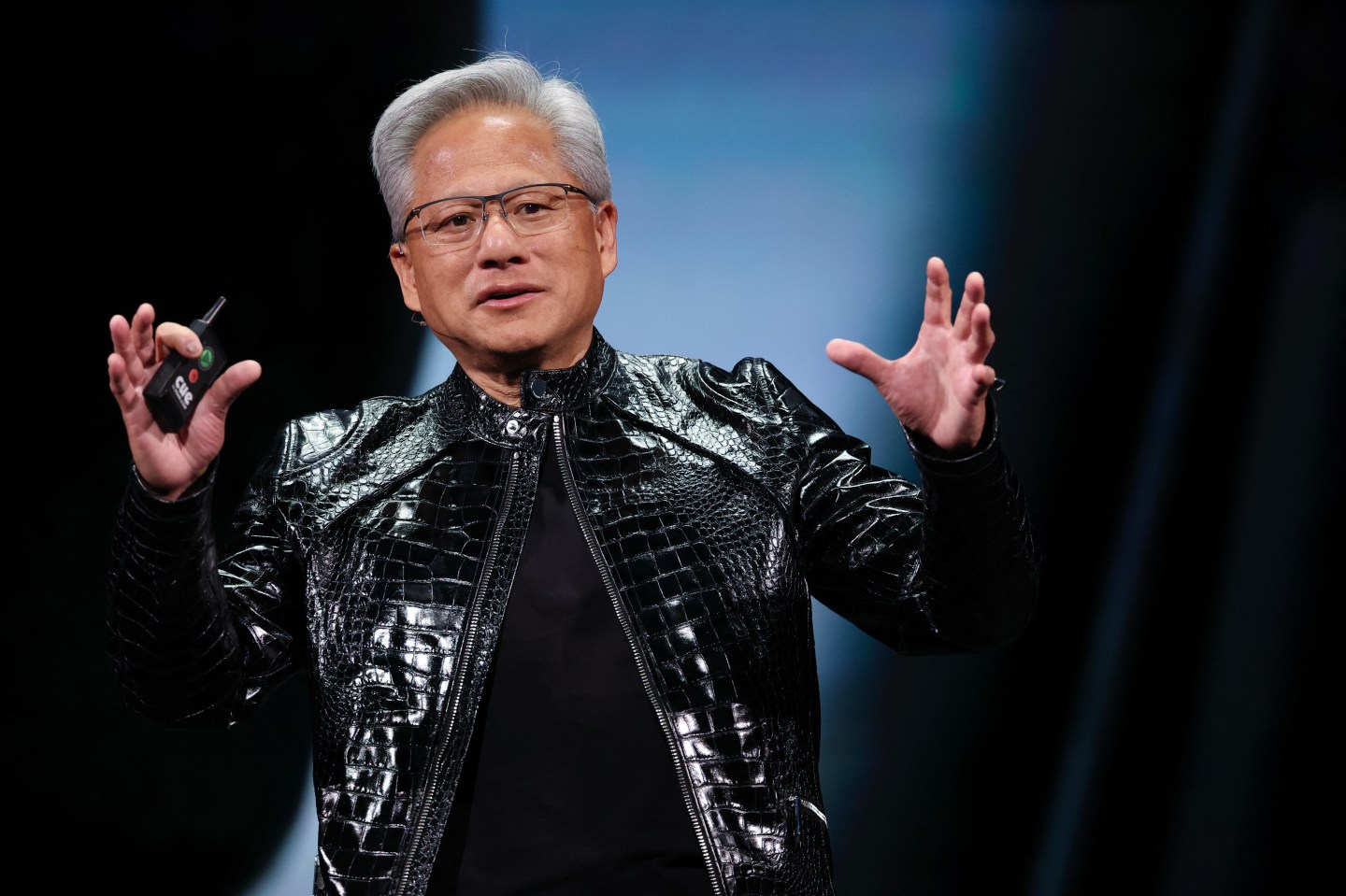
For the past two years, I’ve headed to San Jose for what has become far more than a gathering of the Nvidia faithful. It has evolved into a highly-anticipated moment for CEO Jensen Huang to step on stage before nearly 20,000 attendees at the packed SAP Center and hit the equivalent of dozens of three-pointers in his keynote—with loud cheers at every “swish” of Nvidia news. There’s even a three-hour “pre-game” show, which this year features the CEOs of several Nvidia partners.
And that’s just the first day. The event has grown so popular that last year I struggled to find space to meet people, or even to sit down for a minute.
While I won’t be able to attend in person this year, I’ll be watching the announcements—as well as playing what has become a game of “Which black leather jacket will Jensen wear?”
There has already been a stream of previews, strong hints and rumors about what will be shared at GTC. Here’s a sampling:
- AI as a “5 layer cake.” On Tuesday, Nvidia released a blog post by Huang called “AI is a 5 Layer Cake.” In the blog, Huang argues that AI depends on five layers—energy, chips, infrastructure, models, and applications—and that all five need to scale together to enable the massive buildout of AI across the economy. Nvidia, not coincidentally, sits squarely in the middle of that stack, and connects most of the layers together.
- More investments and partnerships. Nvidia has invested in dozens of AI companies since last year, deploying billions of dollars across the ecosystem. This week, in advance of GTC, the company announced it has invested $2 billion in AI cloud firm Nebius and is also backing former OpenAI CTO Mira Murati’s new startup, Thinking Machines with over 1 GW in Nvidia chips.
- Open-source models—with a strategic goal. In the wake of an announcement this week of a new open source model, Nvidia is reportedly investing up to $26 billion in open-source models and it is rumored that the company will unveil something called NemoClaw, an open-source AI agent platform for enterprises, at GTC. The strategy is less about competing with frontier AI labs and more about keeping developers building inside Nvidia’s software ecosystem—and ultimately driving demand for more chips.
- Autonomous driving ambitions. Nvidia is also continuing to expand its push into autonomous vehicles, where its chips and software platforms are increasingly being used by carmakers building self-driving systems. Yesterday, the company released a video showing Huang taking a 2.5-hour ride across San Francisco in a Mercedes using its Alpamayo autonomous driving system.
With that, here’s more AI news.
Sharon Goldman
sharon.goldman@fortune.com
@sharongoldman
FORTUNE ON AI
Microsoft launches Copilot Health, a dedicated space for personal health data and AI-driven insights – by Beatrice Nolan
AI is capable of remarkable feats. And has the power to kill. Meet one woman warning about the dangers ahead – by Kamal Ahmed
Exclusive: Oro Labs, which uses AI to streamline corporate procurement, raises $100 million – by Jeremy Kahn
This startup is helping tech giants and real estate developers find land for data centers—and using its own GPU cluster to do it – by Jessica Mathews
Google and OpenAI employees back Anthropic in a legal fight that could redefine military use of AI – by Beatrice Nolan
‘AI brain fry’ is real — and it’s making workers more exhausted, not more productive, new study finds – by Sasha Rogelberg
AI IN THE NEWS
The end of computer programming as we know it. In a new New York Times Magazine article, author Clive Thompson interviewed more than 70 software developers at Google, Amazon, Microsoft and small start-ups to explore how rapidly improving AI coding tools such as ChatGPT and Claude are reshaping the software development profession. Some developers say these tools make them dramatically more productive, shifting their role from writing code line by line to directing, reviewing, and debugging AI-generated output. At the same time, the technology is raising concerns about the future of programming jobs—particularly entry-level roles that have traditionally been a pathway into the industry. While many experts believe human engineers will remain essential for oversight, architecture, and problem-solving, the article argues that AI is already beginning to redefine what it means to be a programmer.
Atlassian slashes 10% of workforce to ‘self-fund’ investments in AI and enterprise sales. Cloud-based software company Atlassian announced it will cut about 10% of its workforce, roughly 1,600 employees, as it restructures amid pressure from the rapid rise of AI tools and a sharp decline in its stock price. According to CNBC, CEO Mike Cannon-Brookes said the layoffs are intended to help the company redirect resources toward AI development and enterprise sales while improving its financial position. Atlassian’s stock has fallen more than half this year—and about 84% from its 2021 peak—as investors worry about competition from generative AI tools such as Claude and other coding assistants. The company has been pushing its own AI products, including its Rovo platform, which now has about 5 million monthly users, but Cannon-Brookes acknowledged that AI is reshaping the kinds of skills and roles the company needs. The move reflects a broader trend across the tech industry, where companies are cutting staff while ramping up investment in artificial intelligence.
EYE ON AI NUMBERS
80%
That's how many physicians now use AI professionally, doubling since 2023, according to new research from the American Medical Association’s Center for Digital Health and AI . The average number of use cases per physician is 2.3 in 2026, up from 1.1 in 2023, while the most common physician uses of AI are centered on medical research summarization and clinical care documentation.
Also from the study:
- Physicians are growing more confident in AI: In 2026, more than three-quarters of physicians believe AI improves their ability to care for patients, up from 65 percent in 2023. The greatest expected advantages are in diagnostic accuracy and work efficiency.
- Many physicians are cautiously optimistic: Forty percent of physicians have balanced attitudes that are equally excited and concerned about AI, citing patient privacy and the integrity of the patient-physician relationship as top concerns.
- The majority of physicians are concerned about skill loss: Seventy percent of physicians see AI as a tool to automate tasks that contribute to work-related burnout. However, 88 percent are concerned about potential skill loss, particularly among those with 10 years or less in practice.
AI CALENDAR
March 12-18: South by Southwest, Austin, Texas.
March 16-19: Nvidia GTC, San Jose, Calif.
April 6-9: HumanX, San Francisco.
June 8-10: Fortune Brainstorm Tech, Aspen, Colorado. Apply to attend here.
July 7-10: AI for Good Summit, Geneva, Switzerland.