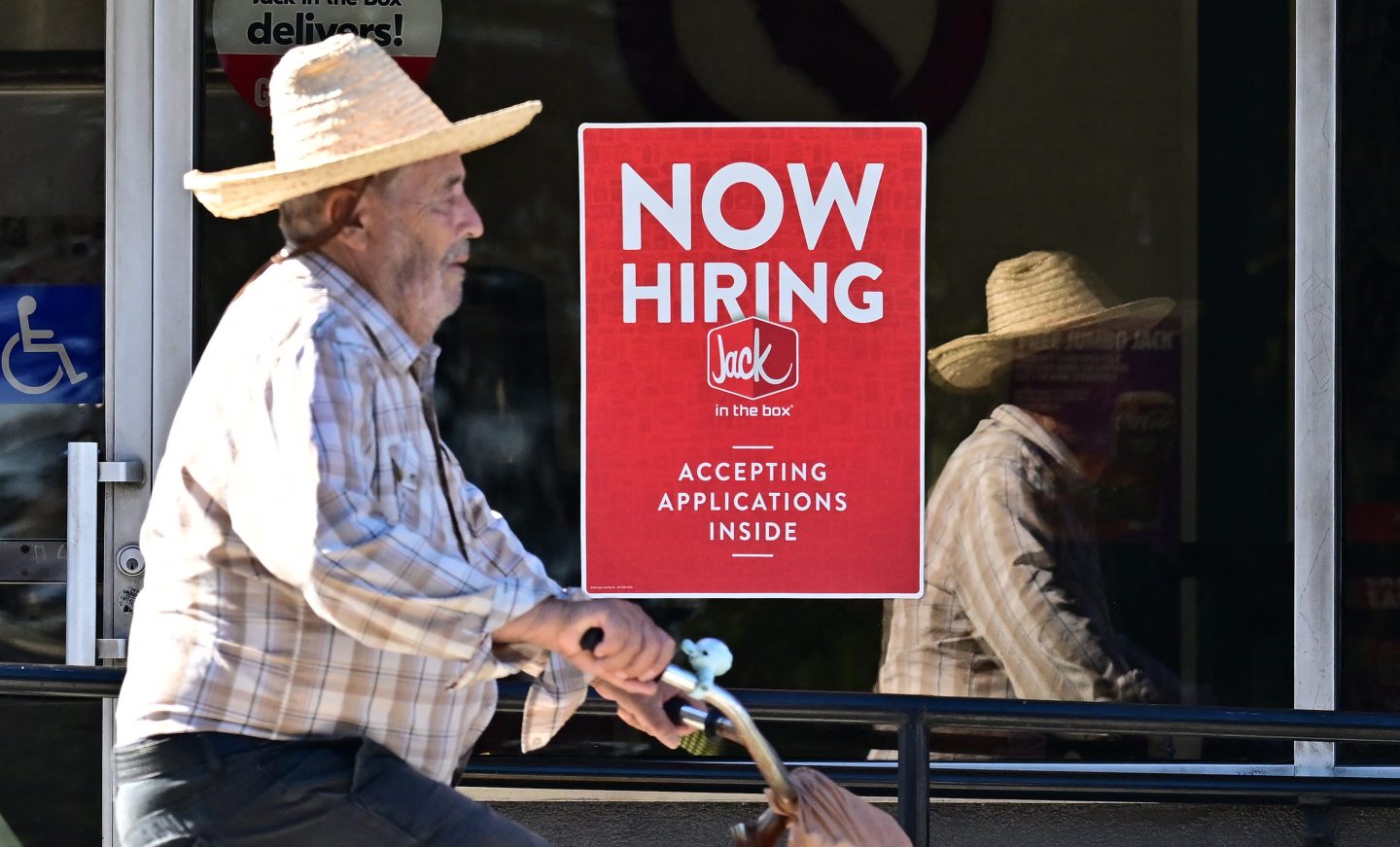

More than one year into the Trump administration’s immigration crackdown, there’s little to suggest White House Deputy Chief of Staff Stephen Miller has achieved his goal of boosting the U.S.-born workforce by closing borders.
A National Foundation for American Policy (NFAP) policy brief published this month noted from February 2025 to February 2026, labor force participation for U.S.-born workers age 16 and older actually fell from 61.4% to 61%, citing jobs data from the Bureau of Labor Statistics.
That dip in the U.S.-born labor force—part of a larger labor market slowdown that saw just 181,000 jobs added to the U.S. economy in 2025—coincided with a swath of actions meant to curb immigration. This included roughly $170 billion in immigration enforcement funding, counting $75 billion to Immigration and Customs Enforcement through 2029, outlined in President Donald Trump’s One Big Beautiful Bill (OBBB).
The crackdown appears to have had its intended effect in driving out immigrants and those considering coming to the U.S. The Brookings Institution estimated the U.S. saw between 10,000 and 295,000 people leave the country in 2025, reaching negative net migration for the first time in about half a century. NFAP’s analysis found a decline of 596,000 foreign-born workers in the U.S. since January 2026 and a total of 1.01 million workers since the number of foreign-born workers in the U.S. peaked in March 2025.
While efforts to slash the foreign-born workforce were efficacious, they did not succeed in bolstering jobs for U.S.-born workers, according to labor economist and NFAP senior fellow Mark Regets.
“Most economic research shows that immigration increases employment opportunities for the U.S.-born, so it would not be surprising if reducing immigration harms American workers,” Regets said in the report.
Regets previously told Fortune an immigrant workforce can help boost productivity and justify hiring more workers, as well as encourage U.S. firms to take advantage of a domestic workforce instead of offshoring jobs. Greater immigration can also encourage consumer spending to stimulate economic activity.
“A company unable to find the workers it needs for some roles could shut down operations rather than continuing,” Regets said.
He suggested efforts to stifle immigration for the sake of boosting opportunities for workers in the name of growing the U.S. economy has, instead, backfired completely.
“The data is raising huge red flags that we are losing immigrants of all types that otherwise would be advancing America’s economy,” he added.
How closed borders will impact the U.S. economy
Economists have warned the writing has been on the wall on how negative net migration—which the Trump administration has touted as a win—could shrink the U.S. economy.
A working paper published last year from the American Enterprise Institute (AEI), a conservative economics policy center, found negative net migration could shrink the U.S. GDP growth by between 0.3% and 0.4%. With U.S. real GDP at about $23.5 trillion, the tradeoff of fewer immigrants could be between $70.5 billion to $94 billion in lost economic output annually, a result of not only fewer workers, but also a decrease in consumer spending.
NFAP previously projected Trump’s immigration policies would slash the number of U.S. workers by 6.8 million by 2028 and 15.7 million by 2035.
“Our workforce is disproportionately made up of immigrants relative to their share of the population, and because of that we…really can’t sustain a high level of job growth with the U.S.-born population alone, because there just aren’t enough bodies, essentially, to do that,” report coauthor Tara Watson, a Brookings economist and professor of economics at Williams College, told Fortune in July 2025.
Research published last month by the Cato Institute, a libertarian think tank, indicates U.S. immigration has helped keep the U.S. from a debt crisis as its charges balloon to $39 trillion. From 1994 to 2023, immigrants (both documented and undocumented) contributed more in taxes than they received in local, state, or federal benefits, totaling a fiscal surplus of $14.5 trillion over the 30-year period. Without the economic contribution, the analysis indicated, public debt would be above 200% of the U.S. GDP, the threshold some economists could consider a crisis.
Immigrants made up 14.7% of the U.S. population in 2023, but paid 17.3% of the share of taxes and made up 17.4% of the share of income, making higher income and paying more in taxes per capita than their U.S.-born counterparts, according to the report. Many immigrants come to the U.S. in their twenties, requiring less schooling and therefore education costs than those born in the U.S. Similarly, many temporary or undocumented immigrants do not qualify for Social Security, and cost the government about $74,000 less per capita in old-age benefits.
“For years, nativists in Congress and the administration have wrongly claimed that immigrants are behind the growth in debt and that the U.S. immigration system allowed foreigners to take advantage of Americans’ generosity,” David Bier, report coauthor and Cato Institute director of immigration studies, wrote in a Substack post in February about the report. “Our data completely repudiates this view. Immigrants are subsidizing the U.S. government.”