• Home
  • Latest
  • Fortune 500
  • Finance
  • Tech
  • Leadership
  • Lifestyle
  • Rankings
  • Multimedia
InvestingMedia

3 things we will never know after Netflix pulled out of the Warner Bros. bidding, handing it to Paramount

Nick Lichtenberg
By
Nick Lichtenberg
Nick Lichtenberg
Business Editor
Down Arrow Button Icon
Nick Lichtenberg
By
Nick Lichtenberg
Nick Lichtenberg
Business Editor
Down Arrow Button Icon
February 28, 2026, 10:56 AM ET
sarandos
Ted Sarandos, chief executive officer of Netflix Inc., departs following meetings at the White House in Washington, DC, US, on Thursday, Feb. 26, 2026. Warner Bros. Discovery Inc. said a new $111 billion offer from Paramount Skydance Corp. is a better deal for shareholders than the one it agreed to earlier with Netflix Inc. Stefani Reynolds/Bloomberg via Getty Images

When the credits finally rolled on the Warner Bros. Discovery bidding war this week, it wasn’t the world’s largest streamer standing on the lot. It was Paramount Skydance, another legacy Hollywood studio with a subscale streaming business struggling under a massive debt load.

Recommended Video

Netflix formally withdrew its bid on Thursday after Warner’s board deemed Paramount’s latest offer “superior,” ending months of brinksmanship that played out as a throwback, even a sequel of sorts, to the great takeover battles of the 1980s and ’90s, many of them involving Warner and Paramount. Like so many of those battles of yore, particularly Barry Diller losing out to Sumner Redstone in the contest to acquire Paramount in 1994, this becomes yet another “what if” in a Hollywood history littered with them.​

Three major questions about the future of the entertainment sector would have been settled in one fashion or another in the event of a successful Netflix bid, but now we’ll always be asking: what if? Here are the questions about the future of Hollywood that remain unresolved.

1. The theatrical windowing question, or getting people to go to the movies

From the start, the Netflix bid was a test of whether the company that had trained consumers to “binge-watch” or “Netflix and chill,” consuming mass quantities of content from the comfort of their couches, could tolerate old‑school theatrical discipline. Buying Warner Bros. didn’t just mean owning DC Comics, Harry Potter, and HBO. It meant inheriting a global distribution machine, multiplex relationships, and a release ecosystem still built around a roughly 45‑day exclusive theatrical window for major films.

Netflix Co-CEO Ted Sarandos, who rose from video-store clerk to maybe the single most influential man in Hollywood, was closely watched for his public statements on theatrical release, or “windowing.” He famously said at the Time100 Summit in April 2025 that movie theaters were an “outdated concept” and the 45-day window was much too long for most consumers. (He later stressed that he was only talking about some consumers, not ruling out the entire theatrical industry as outdated.)

Once Netflix went in for Warner, though, Sarandos repeatedly insisted that he didn’t want to buy a business with a string of nine straight box office number ones, only to destroy it. After dancing around the 45-day window commitment, he told The New York Times in January that he would commit to exactly that, repeating the pledge in congressional testimony and then, maybe under harsher questioning, with Matt Belloni of The Town. On paper, that would have completed Netflix’s transformation from insurgent to studio, putting it in the same category as the legacy players its rise helped destabilize.

Now we won’t see that transformation take place. We’ll never know if Netflix would have stuck to 45 days once a $200 million tentpole stumbled on opening weekend—or whether it would have turned its vast data advantage into pressure to shrink windows in real time. Paramount Skydance, which famously trotted out a video from Tom Cruise before the premiere of Top Gun: Maverick thanking viewers for taking the time to actually go to theaters, already lives comfortably in the theatrical tradition and is unlikely to put that question to such a stark test. (Cruise released a follow-up thank-you message which featured him skydiving.) Netflix’s metamorphosis into a fully traditional movie studio, complete with all the frictions of theatrical, remains incomplete, and may stay that way.

2. What is television, anyway, these days?

The bidding war also teed up a potential blockbuster antitrust case. A Netflix–Warner combination would have forced regulators to answer a deceptively simple question with trillion‑dollar implications: What market is Netflix actually in?

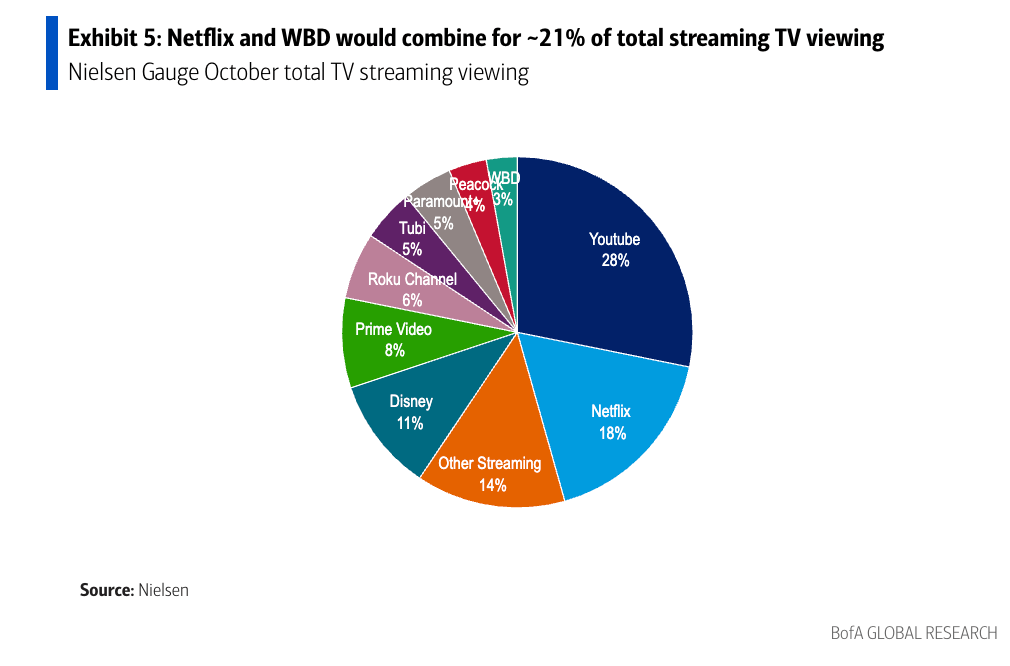
If Netflix acquired Warner Bros., including a complementary prestige streaming asset in the form of HBO Max, the largest streaming company in the world would have added roughly 100 million customers to its 325 million global customer base, surely a concern for regulators. Yet Co-CEO Greg Peters argued that, by total TV viewing time in the U.S. as measured by Nielsen, a combined Netflix-Warner (at 9%) still would have trailed behind the quiet giant in the space: YouTube, at 13%

In November 2025, Bank of America Research had also analyzed Nielsen data to calculate that total streaming TV viewing favored YouTube at 28% versus a combined Netflix-Warner at 21%.
With Paramount as the buyer instead, that showdown disappears. A legacy media company rolling up another legacy media portfolio may face regulatory scrutiny anyway, but it will be a simpler question of whether the combination of two hobbled Hollywood legacy studios would be too large. Everyone—from bankers to studio chiefs—will keep guessing what counts as market power when the biggest player in streaming never had to test its limits in court.

3. What Wall Street really thinks about Hollywood

The third unknown is about the rivalry between New York and California. As the bidding escalated, Wall Street traders turned Netflix stock into a live‑fire focus group on how investors feel about a pure‑play tech platform strapping itself to an old‑line studio. Since the Warner bidding began, Netflix shares fell nearly 40%, wiping out over $100 billion in value at one point, as investors modeled a future in which Netflix suddenly owned soundstages and the cyclical economics of theatrical releases.
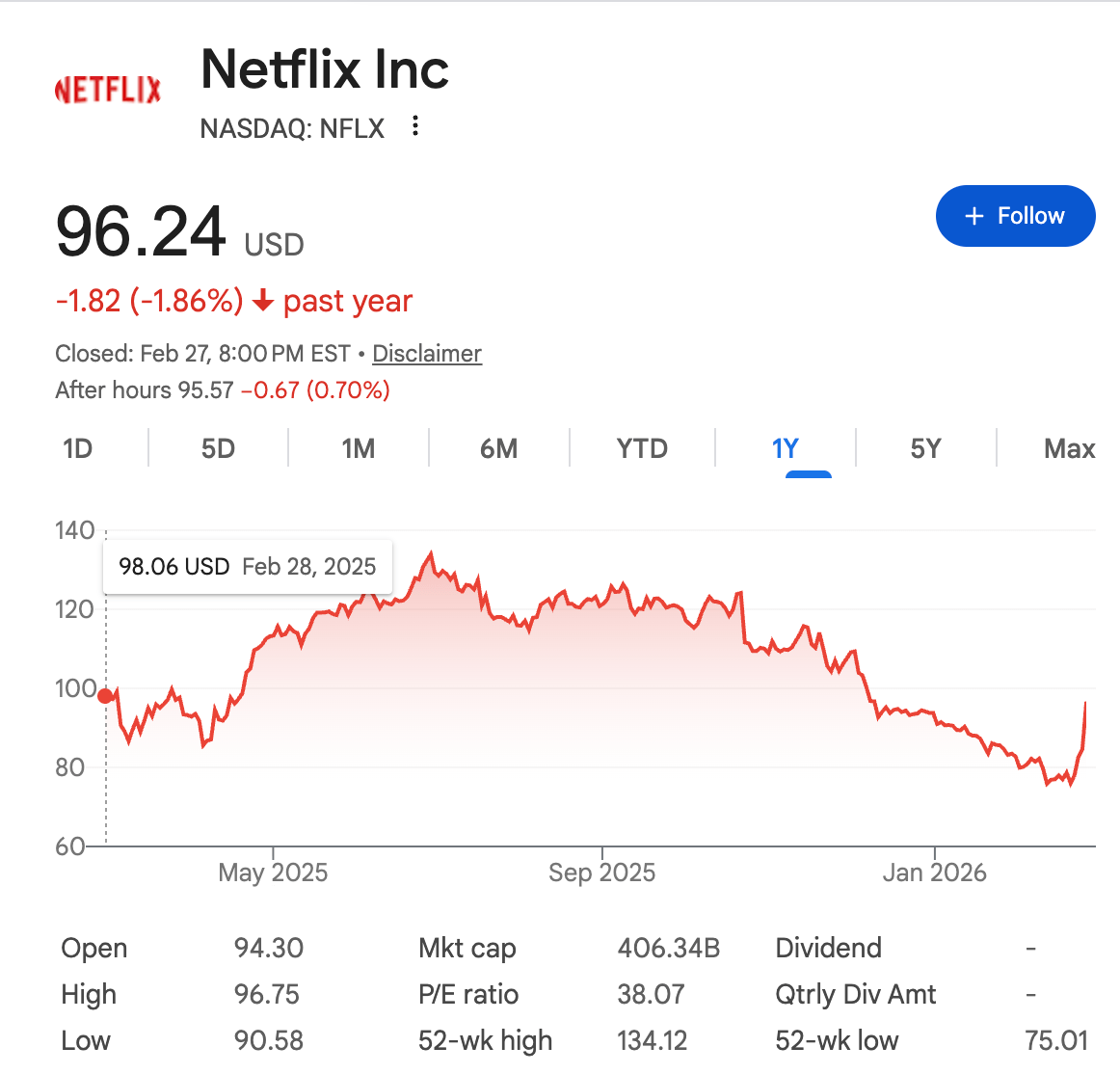
Now that Warner has chosen Paramount, that counterfactual vanishes. Netflix’s stock bounced nearly double digits after it walked away and secured an estimated $2.8 billion breakup fee. The market breathed a sigh of relief that Netflix was no longer a “deal stock,” sending the stock up 26%. With the market cap now only down $60 billion since its pursuit of Warner was revealed, a clear verdict on this specific deal emerged: investors prefer the clean streaming story to a debt‑heavy Hollywood empire. But what we still don’t know—and now may not learn for years—is whether the market would have ultimately rewarded Netflix for controlling DC, HBO, and one of the industry’s most storied lots, or punished it for embracing the very legacy structures it once disrupted.
Join us at the Fortune Workplace Innovation Summit May 19–20, 2026, in Atlanta. The next era of workplace innovation is here—and the old playbook is being rewritten. At this exclusive, high-energy event, the world’s most innovative leaders will convene to explore how AI, humanity, and strategy converge to redefine, again, the future of work. Register now.
About the Author
Nick Lichtenberg
By Nick LichtenbergBusiness Editor
LinkedIn icon

Nick Lichtenberg is business editor and was formerly Fortune's executive editor of global news.

See full bioRight Arrow Button Icon

Latest in Investing

Finance
Lorem ipsum dolor sit amet, consectetur adipiscing elit, sed do eiusmod tempor incididunt ut labore et dolore magna aliqua. Ut enim ad minim veniam
By Fortune Editors
October 20, 2025
Finance
Lorem ipsum dolor sit amet, consectetur adipiscing elit, sed do eiusmod tempor incididunt ut labore et dolore magna aliqua. Ut enim ad minim veniam
By Fortune Editors
October 20, 2025
Finance
Lorem ipsum dolor sit amet, consectetur adipiscing elit, sed do eiusmod tempor incididunt ut labore et dolore magna aliqua. Ut enim ad minim veniam
By Fortune Editors
October 20, 2025
Finance
Lorem ipsum dolor sit amet, consectetur adipiscing elit, sed do eiusmod tempor incididunt ut labore et dolore magna aliqua. Ut enim ad minim veniam
By Fortune Editors
October 20, 2025
Finance
Lorem ipsum dolor sit amet, consectetur adipiscing elit, sed do eiusmod tempor incididunt ut labore et dolore magna aliqua. Ut enim ad minim veniam
By Fortune Editors
October 20, 2025
Finance
Lorem ipsum dolor sit amet, consectetur adipiscing elit, sed do eiusmod tempor incididunt ut labore et dolore magna aliqua. Ut enim ad minim veniam
By Fortune Editors
October 20, 2025

Most Popular

Finance
Lorem ipsum dolor sit amet, consectetur adipiscing elit, sed do eiusmod tempor incididunt ut labore et dolore magna aliqua. Ut enim ad minim veniam
By Fortune Editors
October 20, 2025
Finance
Lorem ipsum dolor sit amet, consectetur adipiscing elit, sed do eiusmod tempor incididunt ut labore et dolore magna aliqua. Ut enim ad minim veniam
By Fortune Editors
October 20, 2025
Finance
Lorem ipsum dolor sit amet, consectetur adipiscing elit, sed do eiusmod tempor incididunt ut labore et dolore magna aliqua. Ut enim ad minim veniam
By Fortune Editors
October 20, 2025
Finance
Lorem ipsum dolor sit amet, consectetur adipiscing elit, sed do eiusmod tempor incididunt ut labore et dolore magna aliqua. Ut enim ad minim veniam
By Fortune Editors
October 20, 2025
Finance
Lorem ipsum dolor sit amet, consectetur adipiscing elit, sed do eiusmod tempor incididunt ut labore et dolore magna aliqua. Ut enim ad minim veniam
By Fortune Editors
October 20, 2025
Finance
Lorem ipsum dolor sit amet, consectetur adipiscing elit, sed do eiusmod tempor incididunt ut labore et dolore magna aliqua. Ut enim ad minim veniam
By Fortune Editors
October 20, 2025
Fortune Secondary Logo
Rankings
  • 100 Best Companies
  • Fortune 500
  • Global 500
  • Fortune 500 Europe
  • Most Powerful Women
  • Future 50
  • World’s Most Admired Companies
  • See All Rankings
Sections
  • Finance
  • Fortune Crypto
  • Features
  • Leadership
  • Health
  • Commentary
  • Success
  • Retail
  • Mpw
  • Tech
  • Lifestyle
  • CEO Initiative
  • Asia
  • Politics
  • Conferences
  • Europe
  • Newsletters
  • Personal Finance
  • Environment
  • Magazine
  • Education
Customer Support
  • Frequently Asked Questions
  • Customer Service Portal
  • Privacy Policy
  • Terms Of Use
  • Single Issues For Purchase
  • International Print
Commercial Services
  • Advertising
  • Fortune Brand Studio
  • Fortune Analytics
  • Fortune Conferences
  • Business Development
About Us
  • About Us
  • Editorial Calendar
  • Press Center
  • Work At Fortune
  • Diversity And Inclusion
  • Terms And Conditions
  • Site Map
Fortune Secondary Logo
  • About Us
  • Editorial Calendar
  • Press Center
  • Work At Fortune
  • Diversity And Inclusion
  • Terms And Conditions
  • Site Map
  • Facebook icon
  • Twitter icon
  • LinkedIn icon
  • Instagram icon
  • Pinterest icon

Latest in Investing

warren
InvestingBerkshire Hathaway
Berkshire Hathaway shareholders just woke up to a letter by someone other than Warren Buffett
By Josh Funk and The Associated PressFebruary 28, 2026
3 hours ago
sarandos
InvestingMedia
3 things we will never know after Netflix pulled out of the Warner Bros. bidding, handing it to Paramount
By Nick LichtenbergFebruary 28, 2026
3 hours ago
A man wearing a red hat shakes Trump's hand in a crows
Personal FinanceRetirement
Trump’s universal 401(k) architect on why lower-income people distrust retirement accounts: ‘they want to know what the catch is’
By Jacqueline MunisFebruary 28, 2026
8 hours ago
Aerial view of a data center under construction in Ohio.
EconomyEconomics
Before AI gains materialize, governments will have to deal with a ‘policy tradeoff,’ Moody’s says: How to handle the massive spending and debt risk
By Tristan BoveFebruary 27, 2026
23 hours ago
Personal Financewealth management
The Great Wealth Transfer is already happening as millennials hitting their ‘Peak 35’ are richer than ever
By Catherina GioinoFebruary 27, 2026
1 day ago
Nvidia CEO Jensen Huang during the Nvidia GTC keynote address at the SAP Center
InvestingMarkets
U.S. stocks are being battered by ‘AI derangement syndrome,’ and CEOs are learning not to talk about it
By Jim EdwardsFebruary 27, 2026
1 day ago

Most Popular

placeholder alt text
Success
Japanese companies are paying older workers to sit by a window and do nothing—while Western CEOs demand super-AI productivity just to keep your job
By Orianna Rosa RoyleFebruary 27, 2026
1 day ago
placeholder alt text
Success
Walmart exec says U.S. workforces needs to take inspiration from China where ‘5 year-olds are learning DeepSeek’
By Preston ForeFebruary 27, 2026
1 day ago
placeholder alt text
Law
China's government intervenes to show Michigan scientists were carrying worms, not biological materials
By Ed White and The Associated PressFebruary 26, 2026
2 days ago
placeholder alt text
Personal Finance
Current price of gold as of February 27, 2026
By Danny BakstFebruary 27, 2026
1 day ago
placeholder alt text
Commentary
'The Pitt': a masterclass display of DEI in action 
By Robert RabenFebruary 26, 2026
2 days ago
placeholder alt text
Economy
Come 2030, the U.S. deficit will be worth 5.9% of GDP—more than spending on Social Security, and equal to major health programs
By Eleanor PringleFebruary 26, 2026
2 days ago

© 2026 Fortune Media IP Limited. All Rights Reserved. Use of this site constitutes acceptance of our Terms of Use and Privacy Policy | CA Notice at Collection and Privacy Notice | Do Not Sell/Share My Personal Information
FORTUNE is a trademark of Fortune Media IP Limited, registered in the U.S. and other countries. FORTUNE may receive compensation for some links to products and services on this website. Offers may be subject to change without notice.