• Home
  • Latest
  • Fortune 500
  • Finance
  • Tech
  • Leadership
  • Lifestyle
  • Rankings
  • Multimedia
AIChatbots

We studied chatbots and language and saw a huge problem: They mean 80% when they say ‘likely’ but humans hear 65%

By
Mayank Kejriwal
Mayank Kejriwal
and
The Conversation
The Conversation
Down Arrow Button Icon
By
Mayank Kejriwal
Mayank Kejriwal
and
The Conversation
The Conversation
Down Arrow Button Icon
February 25, 2026, 2:30 AM ET
gen z
What does this chatbot mean, really.Getty Images

When a human says an event is “probable” or “likely,” people generally have a shared, if fuzzy, understanding of what that means. But when an AI chatbot like ChatGPT uses the same word, it’s not assessing the odds the way we do, my colleagues and I found.

Recommended Video

We recently published a study in the journal NPJ Complexity that suggests that, while large language model AIs excel at conversation, they often fail to align with humans when communicating uncertainty. The research focused on words of estimative probability, which include terms like “maybe,” “probably” and “almost certain.”

By comparing how AI models and humans map these words to numerical percentages, we uncovered significant gaps between humans and large language models. While the models do tend to agree with humans on extremes like “impossible,” they diverge sharply on hedge words like “maybe.” For example, a model might use the word “likely” to represent an 80% probability, while a human reader assumes it means closer to 65%.

This could be because humans can interpret words such as “likely” and “probable” based more on contextual cues and personal experiences. In contrast, large language models may be averaging over conflicting usages of those words in their training data, leading to divergences with human interpretations.

Our study also found that large language models are sensitive to gendered language and the specific language used for prompting. When a prompt changed from “he” to “she,” the AI’s probability estimates often became more rigid, reflecting biases embedded in its training data. When a prompt changed from English to Chinese, the AI’s probability estimates often shifted, possibly due to differences between English and Chinese in how people express and understand uncertainty.
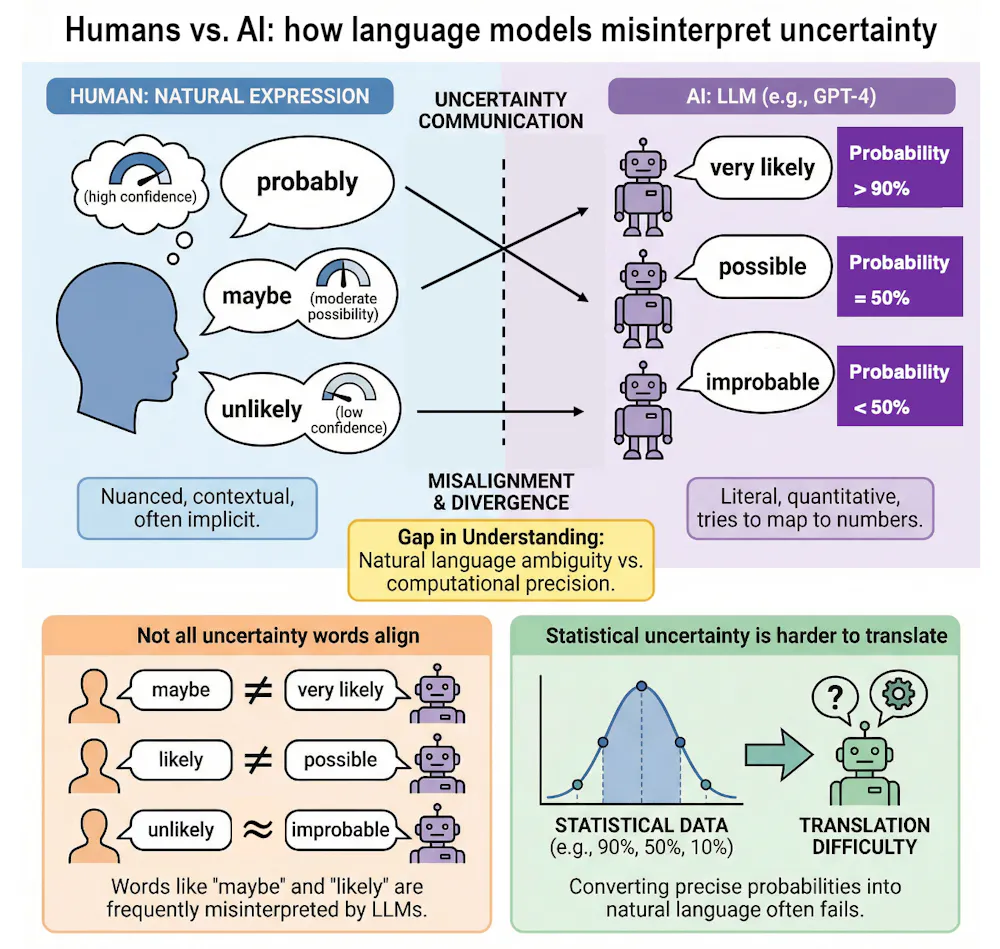
a multicolor three-pane graphic with icons representing humans and robots, and text and arrows
AI chatbots don’t interpret ‘probably’ and ‘maybe’ the same way you do. Mayank Kejriwal

Why it matters

Far from being a linguistic quirk, this misalignment is a fundamental challenge for AI safety and human-AI interaction. As large language models are increasingly used in high-stakes fields like health care, government policy and scientific reporting, the way they communicate risk becomes a matter of public trust.

If an AI assistant helping a doctor, for instance, describes a side effect as “unlikely,” but the model’s internal calculation of “unlikely” is much higher than the doctor’s interpretation, the resulting decision could be flawed.

What other research is being done

Scientists have studied how humans quantify uncertainty since the 1960s, a field pioneered by CIA analysts to improve intelligence reporting. More recently, there has been an explosion in large language model literature seeking to look under the hood of neural networks to better understand their “behaviors” and linguistic patterns.

Our study adds a layer of complexity by treating the interaction between humans and artificial intelligence as a biological-like system where meaning can degrade. It moves beyond simply measuring if an AI is “smart” and instead asks if it is aligned.

Other researchers are currently exploring whether so-called chain-of-thought prompting – asking the AI to show its work – can fix these errors. However, our study found that even advanced reasoning doesn’t always bridge the gap between statistical data and verbal labels.

What’s next

A goal for future AI development is to create models that don’t just predict the next likely word but actually understand the weight of the uncertainty they are conveying. Researchers are calling for more robust consistency metrics to ensure that if a model sees a 10% chance in the data, it chooses the same word every time.

As we move toward a world where AI summarizes scientific papers and manages people’s schedules, making sure that “probably” means “probably” is a vital step in making these systems reliable partners rather than just sophisticated parrots.

The Research Brief is a short take on interesting academic work.

Mayank Kejriwal, Research Assistant Professor of Industrial & Systems Engineering, University of Southern California

This article is republished from The Conversation under a Creative Commons license. Read the original article.

The Conversation
Join us at the Fortune Workplace Innovation Summit May 19–20, 2026, in Atlanta. The next era of workplace innovation is here—and the old playbook is being rewritten. At this exclusive, high-energy event, the world’s most innovative leaders will convene to explore how AI, humanity, and strategy converge to redefine, again, the future of work. Register now.
About the Authors
By Mayank Kejriwal
See full bioRight Arrow Button Icon
By The Conversation
See full bioRight Arrow Button Icon

Latest in AI

Finance
Lorem ipsum dolor sit amet, consectetur adipiscing elit, sed do eiusmod tempor incididunt ut labore et dolore magna aliqua. Ut enim ad minim veniam
By Fortune Editors
October 20, 2025
Finance
Lorem ipsum dolor sit amet, consectetur adipiscing elit, sed do eiusmod tempor incididunt ut labore et dolore magna aliqua. Ut enim ad minim veniam
By Fortune Editors
October 20, 2025
Finance
Lorem ipsum dolor sit amet, consectetur adipiscing elit, sed do eiusmod tempor incididunt ut labore et dolore magna aliqua. Ut enim ad minim veniam
By Fortune Editors
October 20, 2025
Finance
Lorem ipsum dolor sit amet, consectetur adipiscing elit, sed do eiusmod tempor incididunt ut labore et dolore magna aliqua. Ut enim ad minim veniam
By Fortune Editors
October 20, 2025
Finance
Lorem ipsum dolor sit amet, consectetur adipiscing elit, sed do eiusmod tempor incididunt ut labore et dolore magna aliqua. Ut enim ad minim veniam
By Fortune Editors
October 20, 2025
Finance
Lorem ipsum dolor sit amet, consectetur adipiscing elit, sed do eiusmod tempor incididunt ut labore et dolore magna aliqua. Ut enim ad minim veniam
By Fortune Editors
October 20, 2025

Most Popular

Finance
Lorem ipsum dolor sit amet, consectetur adipiscing elit, sed do eiusmod tempor incididunt ut labore et dolore magna aliqua. Ut enim ad minim veniam
By Fortune Editors
October 20, 2025
Finance
Lorem ipsum dolor sit amet, consectetur adipiscing elit, sed do eiusmod tempor incididunt ut labore et dolore magna aliqua. Ut enim ad minim veniam
By Fortune Editors
October 20, 2025
Finance
Lorem ipsum dolor sit amet, consectetur adipiscing elit, sed do eiusmod tempor incididunt ut labore et dolore magna aliqua. Ut enim ad minim veniam
By Fortune Editors
October 20, 2025
Finance
Lorem ipsum dolor sit amet, consectetur adipiscing elit, sed do eiusmod tempor incididunt ut labore et dolore magna aliqua. Ut enim ad minim veniam
By Fortune Editors
October 20, 2025
Finance
Lorem ipsum dolor sit amet, consectetur adipiscing elit, sed do eiusmod tempor incididunt ut labore et dolore magna aliqua. Ut enim ad minim veniam
By Fortune Editors
October 20, 2025
Finance
Lorem ipsum dolor sit amet, consectetur adipiscing elit, sed do eiusmod tempor incididunt ut labore et dolore magna aliqua. Ut enim ad minim veniam
By Fortune Editors
October 20, 2025
Fortune Secondary Logo
Rankings
  • 100 Best Companies
  • Fortune 500
  • Global 500
  • Fortune 500 Europe
  • Most Powerful Women
  • Future 50
  • World’s Most Admired Companies
  • See All Rankings
Sections
  • Finance
  • Fortune Crypto
  • Features
  • Leadership
  • Health
  • Commentary
  • Success
  • Retail
  • Mpw
  • Tech
  • Lifestyle
  • CEO Initiative
  • Asia
  • Politics
  • Conferences
  • Europe
  • Newsletters
  • Personal Finance
  • Environment
  • Magazine
  • Education
Customer Support
  • Frequently Asked Questions
  • Customer Service Portal
  • Privacy Policy
  • Terms Of Use
  • Single Issues For Purchase
  • International Print
Commercial Services
  • Advertising
  • Fortune Brand Studio
  • Fortune Analytics
  • Fortune Conferences
  • Business Development
About Us
  • About Us
  • Editorial Calendar
  • Press Center
  • Work At Fortune
  • Diversity And Inclusion
  • Terms And Conditions
  • Site Map
Fortune Secondary Logo
  • About Us
  • Editorial Calendar
  • Press Center
  • Work At Fortune
  • Diversity And Inclusion
  • Terms And Conditions
  • Site Map
  • Facebook icon
  • Twitter icon
  • LinkedIn icon
  • Instagram icon
  • Pinterest icon

Latest in AI

AIMcDonald's
McDonald’s CEO is a ‘supersubscriber’ of AI tools—and even used it to photoshop all his kids into a Christmas card
By Sydney LakeFebruary 25, 2026
30 minutes ago
students work on computers
AIEducation
More than half of teens are using AI for schoolwork—and many parents don’t know it
By Jake AngeloFebruary 25, 2026
41 minutes ago
data center
AIData centers
Moody’s flags $662 billion risk at the heart of the data-center buildout by just 5 companies
By Nick LichtenbergFebruary 25, 2026
49 minutes ago
gen z
AIChatbots
We studied chatbots and language and saw a huge problem: They mean 80% when they say ‘likely’ but humans hear 65%
By Mayank Kejriwal and The ConversationFebruary 25, 2026
1 hour ago
Traders stand at the New York Stock Exchange
InvestingNew York Stock Exchange
The AI love-hate trade roars as Meta-AMD $100 billion deal cheers traders’ spirits after doom spiral
By Stan Choe and The Associated PressFebruary 24, 2026
11 hours ago
meta
InvestingChips
Meta signs AI chips deal that could go up to $100 billion, option for 10% stake in AMD
By Michelle Chapman and The Associated PressFebruary 24, 2026
11 hours ago

Most Popular

placeholder alt text
Economy
Scott Bessent has ’got a feeling’ that $175 billion raised under the IEEPA is lost to the American people for good
By Eleanor PringleFebruary 23, 2026
2 days ago
placeholder alt text
Cybersecurity
Discord cuts ties with Peter Thiel–backed verification software after its code was found tied to U.S. surveillance efforts
By Catherina GioinoFebruary 24, 2026
1 day ago
placeholder alt text
Economy
In less than a year, Trump erased 12 years of solvency for the trust fund that pays for Medicare Part A
By Nick LichtenbergFebruary 23, 2026
2 days ago
placeholder alt text
Economy
The record gap between corporate profits and worker pay has an ‘undercurrent of betrayal,’ top economist warns 
By Jason MaFebruary 23, 2026
2 days ago
placeholder alt text
Economy
A two-child household must earn $400,000 a year for childcare to be affordable, study says. 'It’s easy to see why birth rates are falling'
By Jason MaFebruary 22, 2026
3 days ago
placeholder alt text
Success
While Nvidia CEO Jensen Huang enjoys an over $150 billion net worth, his fellow cofounder Curtis Priem sold out in 2006—and missed out on $600 billion
By Preston ForeFebruary 23, 2026
2 days ago

© 2026 Fortune Media IP Limited. All Rights Reserved. Use of this site constitutes acceptance of our Terms of Use and Privacy Policy | CA Notice at Collection and Privacy Notice | Do Not Sell/Share My Personal Information
FORTUNE is a trademark of Fortune Media IP Limited, registered in the U.S. and other countries. FORTUNE may receive compensation for some links to products and services on this website. Offers may be subject to change without notice.