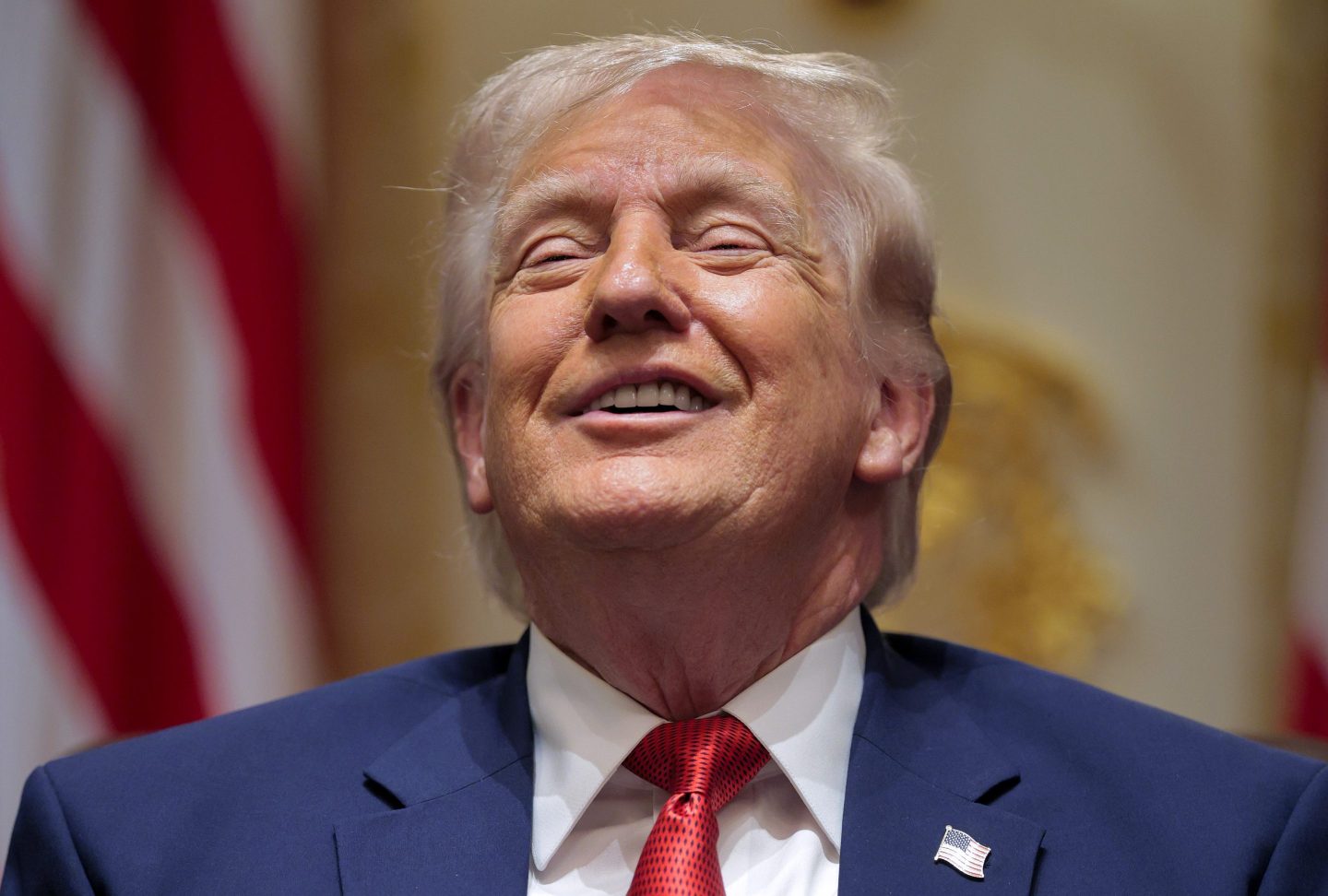
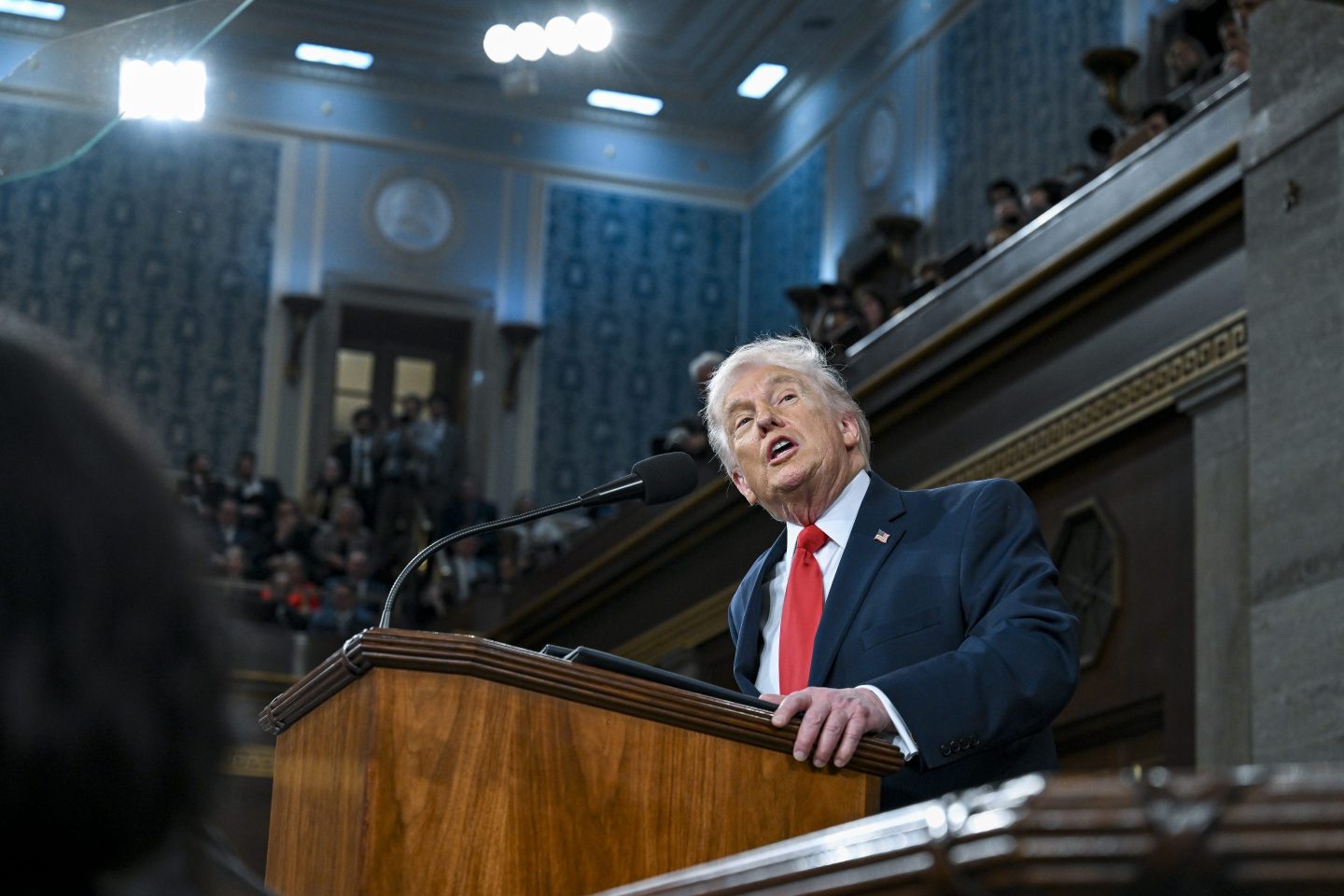
President Donald Trump delivered the longest State of the Union address in history on Feb. 24, 2026, celebrating a nation he claims is “bigger, better, richer, and stronger than ever before,” as “affordability” concerns among voters continue to rise. With the national debt standing at nearly $38.8 trillion and accelerating rapidly toward the $39 trillion mark, the president did not utter the phrase “national debt” once during his economy-focused speech.
In a sprawling speech that clocked in at 10,887 words and lasted for an hour and 47 minutes, Trump championed his administration’s economic achievements, highlighting rising incomes, plummeting core inflation, and a stock market that has hit 53 record highs since his election. And yet, despite the expansive run time, the word “debt” crossed the president’s lips only once—and that was when he spoke metaphorically of “the debt we owe to the heroes who came before us.”
While Trump sidestepped talking about the national debt, he did briefly touch on the federal budget. He officially announced a “war on fraud” to be led by Vice President JD Vance, claiming that if the administration is able to find enough fraud in the system, “we will actually have a balanced budget overnight.”
But according to fiscal responsibility groups, any gains that would be recuperated in the “war on fraud” wouldn’t even make a dent in the national debt.
In a statement to Fortune responding to the speech, Carolyn Bourdeaux, executive director of Concord Action, said her organization appreciated the nod to the idea of a balanced budget, but Trump’s proposals would not move the U.S. closer to that goal. “While eliminating fraud in federal programs is a very important goal, it’s not going to balance the federal budget.” The first-ever report from the Government Accountability Office that attempted to estimate the size of government-wide fraud losses, published in 2024, produced a figure of $233 billion to $521 billion, based on data from fiscal years 2018 through 2022. The deficit for the 2025 fiscal year, for comparison, was $1.78 trillion.
Trump’s remarks here seemed to come mainly in the context of his political enemies in the Democratic Party, as he mentioned former Speaker Nancy Pelosi next to a potential ban on insider trading by members of Congress, as well as “the Somali pirates who ransacked Minnesota.” Pelosi’s husband, who was attacked in his home by a deranged Trump supporter with a hammer in 2022, has long been criticized for his stock trades, while the Minnesota situation is related to a YouTube amateur journalist’s investigation of allegedly fraudulent day-care centers that preceded the deadly crackdown by ICE in Minneapolis in which two American citizens were shot to death.
Trump also heavily promoted his tariff regime, asserting that the tariffs have “taken in hundreds of billions of dollars” from foreign countries and will eventually “substantially replace the modern-day system of income tax.” Some analysts note the tariffs do generate significant revenue, with the Congressional Budget Office finding they could cut deficits by $4 trillion over the next decade.
The glaring omission of the national debt stands in stark contrast to the rapidly deteriorating fiscal reality facing the United States. In October 2025, the U.S. Treasury Department reported that the national debt had surged past the $38 trillion mark, having climbed by $1 trillion in a little over two months. According to the Peter G. Peterson Foundation, a nonpartisan fiscal watchdog, that represented the fastest rate of growth outside the COVID-19 pandemic, twice the rate seen since 2000.
The consequences of this rapid borrowing are already rippling through the economy. Interest payments on the national debt have become the fastest-growing category in the federal budget, currently totaling roughly $1 trillion annually. Over the next decade, these interest costs are projected to balloon to $14 trillion, threatening to crowd out vital public and private investments. A Yale Budget Lab report in March 2025 highlighted that ballooning federal debt exerts upward pressure on inflation and interest rates. Furthermore, the U.S. Treasury’s Bureau of the Fiscal Service has explicitly warned that current policy places the nation on an “unsustainable fiscal path.”
Trump’s silence on the national debt also ignores a rare point of bipartisan consensus among the American public. According to a January 2026 index sponsored by the Peterson Foundation, an overwhelming 82% of voters agree that lawmakers must spend more time addressing the national debt. Across the political spectrum, voters said they viewed debt reduction as a pressing issue, with 89% of Republicans, 75% of Democrats, and 70% of independents classifying it as a “top-three priority” for the president and Congress. Voters remain deeply concerned about the country’s fiscal direction, especially following a tumultuous 2025 marked by record spending, the highest interest costs ever, and a historic government shutdown.
However, fiscal experts maintain that current policies and political gridlock are severely compounding the issue. The ongoing government shutdown, which recently entered its third week, adds billions to federal expenses and postpones necessary budgetary reforms. With the U.S. no longer holding a top credit rating from any of the three major agencies, the pressure is mounting. Even as the president declares that “the golden age of America is upon us,” the looming $39 trillion debt remains an unavoidable, if unspoken, shadow over the nation’s finances.