• Home
  • Latest
  • Fortune 500
  • Finance
  • Tech
  • Leadership
  • Lifestyle
  • Rankings
  • Multimedia
EconomyTariffs and trade

Trump has already hit peak tariff, Morgan Stanley says. His new 15% levy might not even be legal

Nick Lichtenberg
By
Nick Lichtenberg
Nick Lichtenberg
Business Editor
Down Arrow Button Icon
Nick Lichtenberg
By
Nick Lichtenberg
Nick Lichtenberg
Business Editor
Down Arrow Button Icon
February 23, 2026, 11:55 AM ET
trump
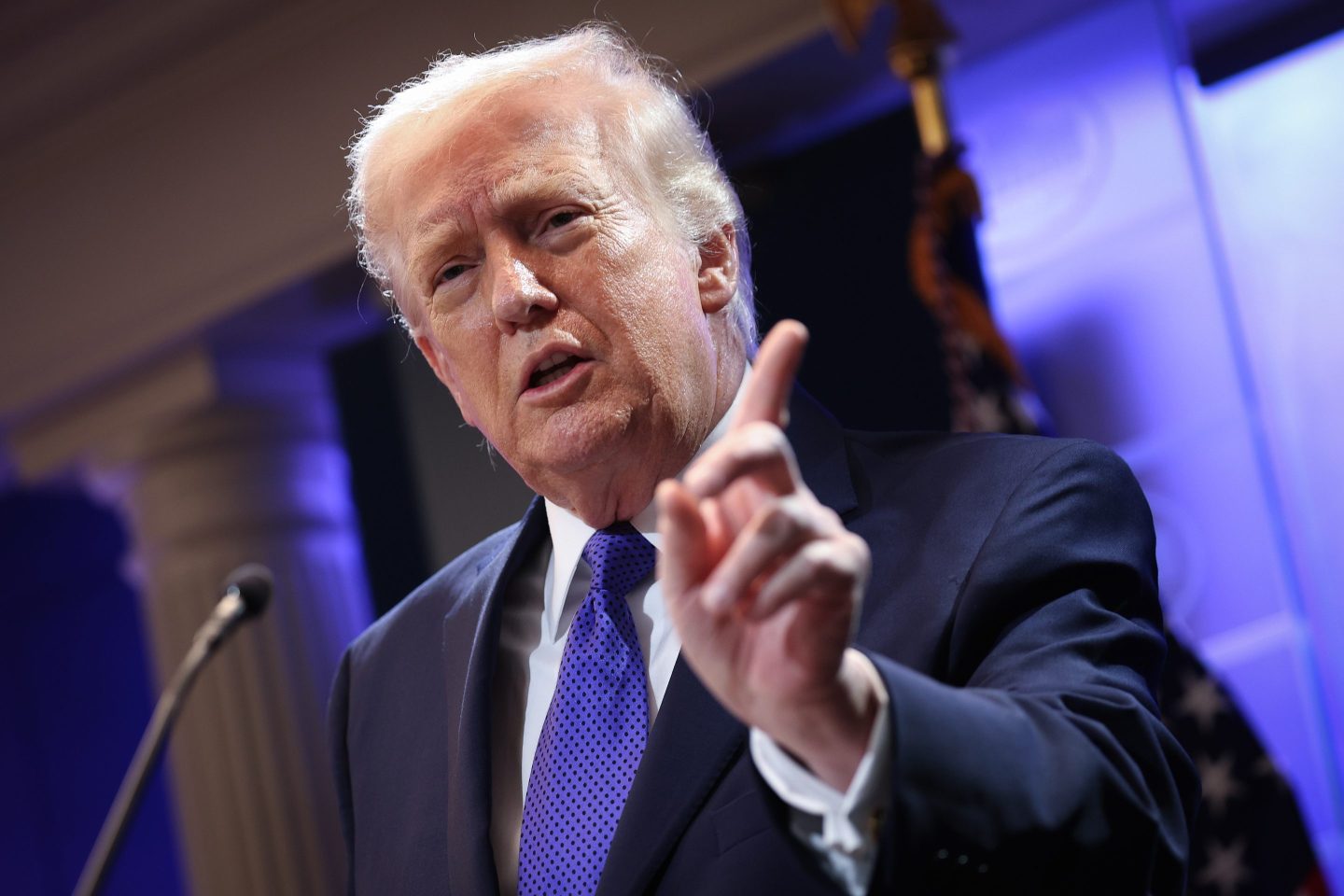
U.S. President Donald Trump during a press briefing held at the White House, Feb. 20, 2026. Kevin Dietsch—Getty Images

For businesses and consumers bracing for a relentless era of global trade wars, Morgan Stanley is offering a striking reality check: Peak tariffs have likely already come and gone.

Recommended Video

The bank’s global economic briefing on Monday, the latest in a series of “tariff diaries” by senior economists including Rajeev Sibal and Michael Gapen, found President Donald Trump is very unlikely to draw any greater revenue from tariffs than he already has, following the recent Supreme Court ruling striking down the administration’s use of the International Emergency Economic Powers Act (IEEPA). Although it didn’t cite Treasury Secretary Scott Bessent by name, the note lent credence to his description, before the Supreme Court ruling, of tariffs as a “shrinking ice cube.”

While Trump quickly pivoted to Section 122 of the Trade Act of 1974 as a stopgap measure, Morgan Stanley economists argued any new trade framework will be legally vulnerable and mathematically weaker, and a return to last year’s aggressive “Liberation Day” tariff levels would be “quite complicated.”

The flawed foundation of Section 122

The administration’s fallback plan relies on Section 122, a statute that allows the president to impose an across-the-board temporary import surcharge of up to 15% for 150 days. However, Morgan Stanley warns Section 122 could face legal challenges similar to those versus the IEEPA, especially given that it has never actually been used since its creation.

The act provides the president authority to impose temporary import measures of up to 15%, limited to 150 days unless extended by Congress, with no formal investigative process required. But more important, Gapen writes, the statutory trigger is framed around a “balance of payments disequilibrium” rather than a goods trade deficit.

In the 1970s context in which this law was written, Gapen explains, this had a concrete meaning related to the Bretton Woods regime in place since the end of World War II. In the 1970s era of fixed exchange rates, a payments problem meant severe reserve loss and forced currency adjustments. Today, under a regime of floating exchange rates and monetary sovereignty, Morgan Stanley economists said, “we would not view a persistent trade deficit as constituting a classic balance of payments ‘crisis’ or solvency constraint.“ Because of this mismatch, relying on Section 122 leaves the new tariff framework wide open to inevitable legal challenges.

Beyond this legal fragility, Section 122 mechanically caps the administration’s trade ambitions. Replacing IEEPA with Section 122 would mechanically lower baseline headline tariffs from approximately 13% down to 11%, Morgan Stanley estimates. And if Congress fails to renew these tariffs by roughly August, the bank calculates nominal tariff levels would plummet to the mid-single digits, around 6% to 7%.

The refund question

A major lingering question following the Supreme Court’s decision to strike down the administration’s use of the IEEPA is the status of the tens of billions in tariff revenue already collected. However, because the Supreme Court ruling did not explicitly mandate whether the Treasury must pay back the collected tariff revenue, the path to recovering those funds remains legally ambiguous. Morgan Stanley expects the issue to be heavily litigated in lower courts. The timeline for this process is expected to be extensive, mirroring comments made by Trump, who said during a press briefing: “We’ll end up being in court for the next five years” over the matter.

Given this lack of clarity and the anticipated legal battles, any potential refunds are expected to take a significant amount of time to actually reach the broader economy. When they do arrive, Morgan Stanley forecasts a “midpoint scenario” of partial and delayed refunds totaling approximately $84 billion to $85 billion. Alternatively, a “limited/minimal” scenario projects the refunds could be as low as roughly $56 billion.

Because of the relatively limited size and the extended, complicated timeline, economists predict these refunds will ultimately result in very little change to their broader macroeconomic and supply outlooks. Should the administration eventually need to fund these refund issuances, Morgan Stanley expects it will likely do so using Treasury bills, and any resulting rise in yields is expected to be short-lived.

“Given the lack of clarity by the Supreme Court, refunds are likely to take a while to reach the economy,” the bank wrote—and these refunds would be for companies, not consumers.

The complicated picture

Because of the strict 15% cap, the temporary nature of the authority, and the legally untested “balance of payments” trigger, raising tariffs back to the extreme “risk” scenarios seen around last year’s “Liberation Day” would be “quite complicated,” Morgan Stanley said. To rebuild those sweeping tariff walls, the administration would have to rely on slow-moving, sector-specific Section 232 or Section 301 investigations, which can take months or even years to fully implement.

For the broader U.S. economy, the unraveling of the administration’s primary tariff tool is a distinct positive, and if the Section 122 tariffs ultimately expire after 150 days without a legislative replacement, the macroeconomic picture would brighten further. A material drop in tariff rates in the third quarter of 2026 could provide a significant uplift to domestic demand, supporting corporate margins, labor demand, and household spending. For now, the Supreme Court ruling has effectively installed a strict near-term ceiling on trade barriers, substantially neutralizing the threat of runaway tariff escalation. What’s unknown, of course, is whether Trump will accept it.

For this story, Fortune journalists used generative AI as a research tool. An editor verified the accuracy of the information before publishing.

Join us at the Fortune Workplace Innovation Summit May 19–20, 2026, in Atlanta. The next era of workplace innovation is here—and the old playbook is being rewritten. At this exclusive, high-energy event, the world’s most innovative leaders will convene to explore how AI, humanity, and strategy converge to redefine, again, the future of work. Register now.
About the Author
Nick Lichtenberg
By Nick LichtenbergBusiness Editor
LinkedIn icon

Nick Lichtenberg is business editor and was formerly Fortune's executive editor of global news.

See full bioRight Arrow Button Icon

Latest in Economy

Finance
Lorem ipsum dolor sit amet, consectetur adipiscing elit, sed do eiusmod tempor incididunt ut labore et dolore magna aliqua. Ut enim ad minim veniam
By Fortune Editors
October 20, 2025
Finance
Lorem ipsum dolor sit amet, consectetur adipiscing elit, sed do eiusmod tempor incididunt ut labore et dolore magna aliqua. Ut enim ad minim veniam
By Fortune Editors
October 20, 2025
Finance
Lorem ipsum dolor sit amet, consectetur adipiscing elit, sed do eiusmod tempor incididunt ut labore et dolore magna aliqua. Ut enim ad minim veniam
By Fortune Editors
October 20, 2025
Finance
Lorem ipsum dolor sit amet, consectetur adipiscing elit, sed do eiusmod tempor incididunt ut labore et dolore magna aliqua. Ut enim ad minim veniam
By Fortune Editors
October 20, 2025
Finance
Lorem ipsum dolor sit amet, consectetur adipiscing elit, sed do eiusmod tempor incididunt ut labore et dolore magna aliqua. Ut enim ad minim veniam
By Fortune Editors
October 20, 2025
Finance
Lorem ipsum dolor sit amet, consectetur adipiscing elit, sed do eiusmod tempor incididunt ut labore et dolore magna aliqua. Ut enim ad minim veniam
By Fortune Editors
October 20, 2025

Most Popular

Finance
Lorem ipsum dolor sit amet, consectetur adipiscing elit, sed do eiusmod tempor incididunt ut labore et dolore magna aliqua. Ut enim ad minim veniam
By Fortune Editors
October 20, 2025
Finance
Lorem ipsum dolor sit amet, consectetur adipiscing elit, sed do eiusmod tempor incididunt ut labore et dolore magna aliqua. Ut enim ad minim veniam
By Fortune Editors
October 20, 2025
Finance
Lorem ipsum dolor sit amet, consectetur adipiscing elit, sed do eiusmod tempor incididunt ut labore et dolore magna aliqua. Ut enim ad minim veniam
By Fortune Editors
October 20, 2025
Finance
Lorem ipsum dolor sit amet, consectetur adipiscing elit, sed do eiusmod tempor incididunt ut labore et dolore magna aliqua. Ut enim ad minim veniam
By Fortune Editors
October 20, 2025
Finance
Lorem ipsum dolor sit amet, consectetur adipiscing elit, sed do eiusmod tempor incididunt ut labore et dolore magna aliqua. Ut enim ad minim veniam
By Fortune Editors
October 20, 2025
Finance
Lorem ipsum dolor sit amet, consectetur adipiscing elit, sed do eiusmod tempor incididunt ut labore et dolore magna aliqua. Ut enim ad minim veniam
By Fortune Editors
October 20, 2025
Fortune Secondary Logo
Rankings
  • 100 Best Companies
  • Fortune 500
  • Global 500
  • Fortune 500 Europe
  • Most Powerful Women
  • Future 50
  • World’s Most Admired Companies
  • See All Rankings
Sections
  • Finance
  • Fortune Crypto
  • Features
  • Leadership
  • Health
  • Commentary
  • Success
  • Retail
  • Mpw
  • Tech
  • Lifestyle
  • CEO Initiative
  • Asia
  • Politics
  • Conferences
  • Europe
  • Newsletters
  • Personal Finance
  • Environment
  • Magazine
  • Education
Customer Support
  • Frequently Asked Questions
  • Customer Service Portal
  • Privacy Policy
  • Terms Of Use
  • Single Issues For Purchase
  • International Print
Commercial Services
  • Advertising
  • Fortune Brand Studio
  • Fortune Analytics
  • Fortune Conferences
  • Business Development
About Us
  • About Us
  • Editorial Calendar
  • Press Center
  • Work At Fortune
  • Diversity And Inclusion
  • Terms And Conditions
  • Site Map
Fortune Secondary Logo
  • About Us
  • Editorial Calendar
  • Press Center
  • Work At Fortune
  • Diversity And Inclusion
  • Terms And Conditions
  • Site Map
  • Facebook icon
  • Twitter icon
  • LinkedIn icon
  • Instagram icon
  • Pinterest icon

Latest in Economy

Scott Bessent sits during a testimony with both hands raised beside him.
EconomyTariffs and trade
Goldman Sachs says U.S. consumers are stuck with higher prices even after Supreme Court ruling opens door to $180 billion in tariff refunds
By Sasha RogelbergFebruary 23, 2026
18 minutes ago
A convoy of National Guard vehicles in Mexico City
EconomyDrugs
Drug use is on the rise as U.S. spend on the War on Drugs tops $1 trillion and cartel leaders drive violent eruptions in Mexico
By Tristan BoveFebruary 23, 2026
24 minutes ago
broker
InvestingMarkets
Morgan Stanley hails rare ‘reindustrialization renaissance’ of AI economy—but it’s better for computers than humans
By Nick LichtenbergFebruary 23, 2026
2 hours ago
trump
EconomyTariffs and trade
Trump has already hit peak tariff, Morgan Stanley says. His new 15% levy might not even be legal
By Nick LichtenbergFebruary 23, 2026
2 hours ago
Photo: Inside a data center.
AIEconomics
Without AI spending, U.S. corporate investment in equipment would be negative, a decline that’s ‘worryingly broad-based,’ Pantheon analyst says 
By Jim EdwardsFebruary 23, 2026
2 hours ago
broker at the stock exchange
InvestingMarkets
The stock market bubble will burst in 2027, and the current rotation is a ‘warning of trouble ahead,’ Capital Economics says
By Nick LichtenbergFebruary 23, 2026
2 hours ago

Most Popular

placeholder alt text
Innovation
The U.S. spent $30 billion to ditch textbooks for laptops and tablets: The result is the first generation less cognitively capable than their parents
By Sasha RogelbergFebruary 21, 2026
2 days ago
placeholder alt text
Economy
A two-child household must earn $400,000 a year for childcare to be affordable, study says. 'It’s easy to see why birth rates are falling'
By Jason MaFebruary 22, 2026
23 hours ago
placeholder alt text
Economy
Stocks sell off as traders wake up to the realization that Trump has 'highly punitive' options for new trade tariffs
By Jim EdwardsFebruary 23, 2026
7 hours ago
placeholder alt text
Startups & Venture
'I have a chip on my shoulder.' Phoebe Gates wants her $185 million AI startup Phia to succeed with 'no ties to my privilege or my last name'
By Sydney LakeFebruary 21, 2026
2 days ago
placeholder alt text
Economy
New Fed report proves Milton Friedman and Joe Biden understood something vital about immigration—and explains why growth may sputter under Trump
By Shawn TullyFebruary 22, 2026
1 day ago
placeholder alt text
Economy
Scott Bessent has ’got a feeling’ that $175 billion raised under the IEEPA is lost to the American people for good
By Eleanor PringleFebruary 23, 2026
7 hours ago

© 2026 Fortune Media IP Limited. All Rights Reserved. Use of this site constitutes acceptance of our Terms of Use and Privacy Policy | CA Notice at Collection and Privacy Notice | Do Not Sell/Share My Personal Information
FORTUNE is a trademark of Fortune Media IP Limited, registered in the U.S. and other countries. FORTUNE may receive compensation for some links to products and services on this website. Offers may be subject to change without notice.