The U.S. economy is bracing for a substantial fiscal injection this tax season, with Bank of America Global Research analysts projecting a massive surge in tax refunds driven by the One Big Beautiful Bill Act (OBBBA). While the legislation is poised to give the economy a $65 billion shot in the arm compared with last year, analysts suggest the benefits will be unevenly distributed, potentially exacerbating the nation’s “K-shaped” economic divide.
According to BofA Global Research, tax refunds in 2026 are expected to be approximately $65 billion higher than in 2025—an 18% year-over-year increase. The bank estimates the total consumer stimulus from the OBBBA will range from $135 billion to $140 billion. However, the structure of these tax breaks, particularly changes to the state and local tax (SALT) deduction caps, suggests that middle- and higher-income households will reap most of the benefits.
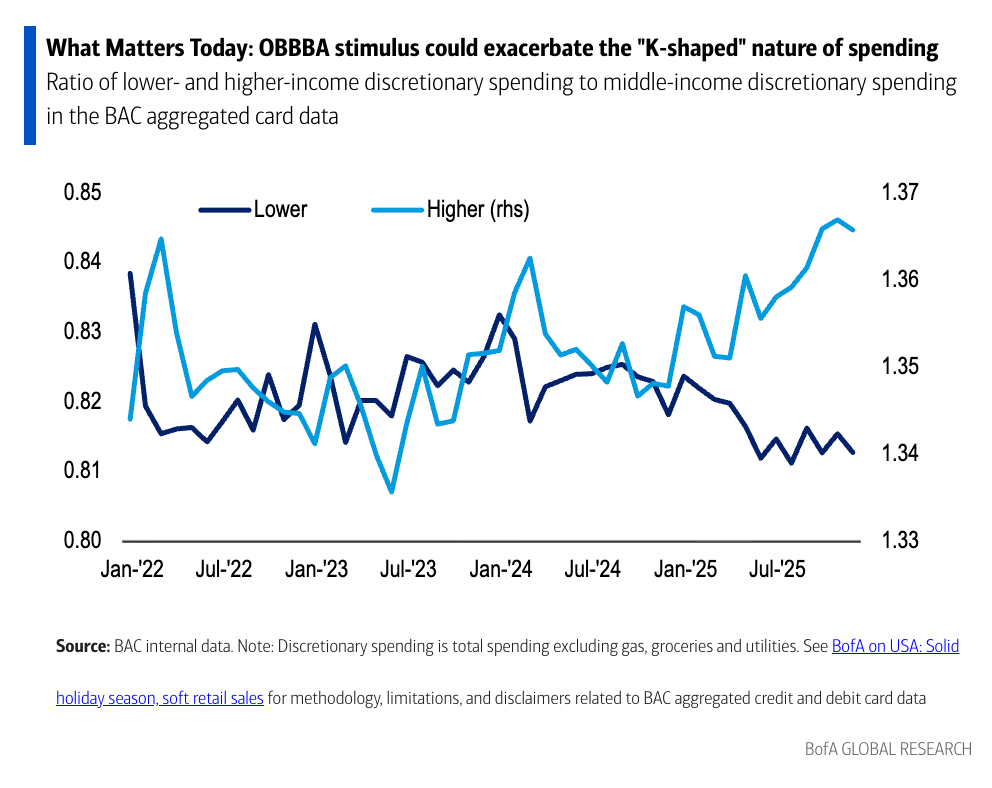
The widening ‘K’
BofA’s analysis highlights a persistent “K-shaped” dynamic in the post-2025 economy, where the financial fortunes of the wealthy diverge sharply from those of lower-income Americans. In late 2025 and early 2026, spending by higher-income households rose by 2.4%, while lower-income households saw just 0.4% growth.
Middle- and higher-income households should be the biggest beneficiaries of this policy, according to senior U.S. economist Aditya Bhave, who predicted that “K-shaped” spending dynamics could become “more pronounced.” The economist’s note follows a finding earlier this week from the New York Federal Reserve that evidence of the K-shaped economy now stretches back three years. “The consumer divide is about to get deeper,” Bhave added.
While the bill includes deductions for tip and overtime income—which benefits service workers—it also raises the SALT deduction cap, a policy that disproportionately favors higher earners. The nonpartisan Tax Policy Center has estimated that the legislation’s largest cash impacts will accrue to those with the highest incomes.
Treasury and independent estimates now project that the typical 2026 refund could be roughly $300 to $1,000 higher than last year, with some estimates centering around about $3,800 on average.
Wall Street vs. Main Street
The distribution of this stimulus has significant implications for how money circulates through the economy. BofA notes that higher-income households are more likely to save than spend. Consequently, about half of this new stimulus might never reach the retail economy. Instead, unspent funds from wealthy recipients are “more likely to be used to buy stocks than pay down debt.”
This trend is already visible in consumer behavior. Throughout 2025, wealthy consumers maintained spending on services, while the broader consumer base became increasingly price-conscious, prioritizing smaller-ticket items and cutting back on big-ticket purchases such as electronics and furniture.
Lifeline for lower incomes
Despite the skew toward the wealthy, the OBBBA does offer a crucial lifeline to lower-income households. BofA data indicate that for these families, tax refunds represent a much larger share of their average monthly spending than for wealthier peers, meaning that much of the boost to the economy will come from this cohort.
“Even if the growth in refunds was fairly uniform… it could still boost lower-income household spending—and take some pressure off their discretionary ‘nice-to-have’ spending budgets,” noted a separate analysis by the Bank of America Institute. Historically, lower-income households utilize tax refunds to increase spending on goods, travel, and leisure by nearly 40% in the weeks following receipt.
The stimulus arrives at a critical moment. Fourth-quarter GDP tracking for 2025 has declined to 2.4%, and the economy has seen a “choppy” start to 2026, the institute said. While the $65 billion increase in refunds will provide a temporary boost to discretionary spending between February and April, BofA cautions that longer-term economic momentum remains dependent on the labor market.
For this story, Fortune journalists used generative AI as a research tool. An editor verified the accuracy of the information before publishing.