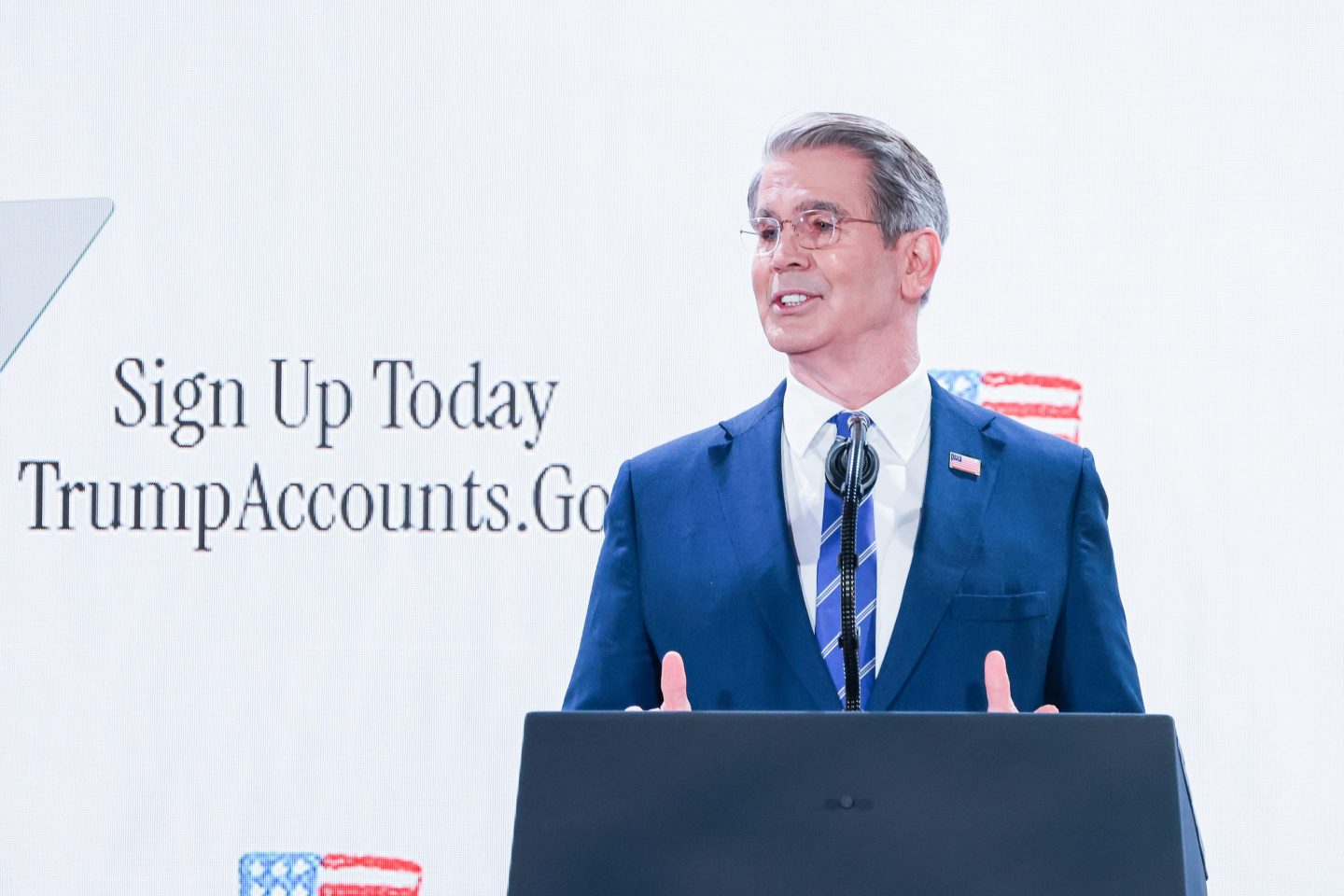
U.S. Treasury Secretary Scott Bessent is drawing a sharp line between young Americans’ skepticism of capitalism and their lack of market participation, arguing that attitudes toward socialism are inseparable from whether people actually own stocks.
In a wide-ranging interview with CNBC’s Squawk on the Street anchor Sara Eisen on the sidelines of the Treasury Department’s Trump Accounts Summit in Washington, Bessent was asked about a Gallup poll finding that 39% of Americans have a favorable view of socialism, while just over half view capitalism positively. He immediately connected that sentiment to another statistic: about 38% of American households have no exposure to equities.
“I think that dovetails somewhat—that 38% of American households have no exposure to equities,” Bessent said, suggesting that those who don’t participate in the stock market are more likely to be dissatisfied with the existing economic model. He framed the administration’s push for investment accounts for children as a way to “mint a new generation of capitalists” by giving young people a direct stake in corporate America’s growth.
The Philadelphia Fed reported in September 2025 that about 57.2% of American households do not invest in the stock market.
Trump Accounts as an antidote
The new “Trump Accounts” initiative, a federally supported investment program for children, sits at the center of Bessent’s effort to change those numbers. The accounts, he said, are designed to channel contributions into a broad-based index fund, with the goal of exposing millions of future adults to the long-term compounding power of equity markets.
Bessent cast the program as part of President Donald Trump’s “enduring legacy,” alongside peace deals, trade agreements, and tax cuts. Children born between 2025 and 2028 would see their Trump Accounts compounding for 18 years, he noted, arguing that such long-term exposure will create both wealth and financial literacy for the next generation. “This is a real-time learning experiment,” he said. “We’re going to shoot to get everyone a stake in the great innovation in our country, in the economic engine, and I bet if we do this survey in five, 10 years, we’ll have drastically different results.”
Markets, policy, and the political stakes
Bessent’s comments came against the backdrop of an S&P 500 index he pointed out is hitting new highs “every day,” after three straight years of double-digit gains and a level of 7,000. He insisted that those returns reflect “good policies for sound economic growth,” including deregulation, tax changes, and a pro-investment environment that he credits with attracting “trillions of dollars of investment” back to the United States.
At the same time, he acknowledged that markets fluctuate and that past performance does not guarantee future returns, emphasizing that “events and policy” will determine what comes next. Still, the administration is clearly betting that if more young Americans have money in the market, they will see volatility as a feature of a system that ultimately benefits them, rather than as proof that capitalism is failing.
To be sure, correlation is not causation, and surveys can and have shown that young adults can like “free enterprise” in theory while souring on capitalism and Big Business at the same time, suggesting their views are about how the system works in practice, not simply whether they own stocks. In other words, you can be a non‑investor because wages are low, debt is high, and housing is unaffordable, and those structural conditions may be what push you toward alternatives to the status quo.
And even when “America owns stocks,” the gains are highly concentrated, so more accounts do not automatically mean broad-based benefit, and analyses show the top 10% of households hold the vast majority of stock value, while lower‑income and younger households own far less in dollar terms. In other words, giving every child a small index-fund stake doesn’t change who really controls corporate America or who captures most of the upside. At the same time, the donations from billionaires Ray Dalio and Michael Dell into the Trump Accounts represents a remarkable moment of philanthropy.
Also, it’s unclear what people mean by “socialism.” Polling finds young Americans often use the term to signal support for stronger safety nets, public health care, and checks on corporate power, while still endorsing free enterprise and entrepreneurship. Perhaps the problem is not a lack of ideological commitment to capitalism, but barriers to participation: low incomes, student debt, lack of employer retirement plans, and thin emergency savings. If people are living paycheck to paycheck, they may rationally avoid stock risk, and their skepticism toward the system stems from feeling locked out, not from ignorance of compounding returns. Gen Z reportedly turns to prediction markets such as Polymarket and Kalshi, and are enthusiastic about crypto, because they feel locked out of the stock market, for instance.
For Bessent, the nearly one-to-one relationship between the share of Americans with favorable views of socialism and the share with no stock exposure is more than a polling coincidence. It is a political and economic problem he believes the Trump Accounts are designed to solve—by turning non-investors into shareholders, and, in his words, turning a generation that flirts with socialism into one that owns a piece of capitalism. It remains to be seen whether nudging more young Americans into index funds will be enough to overcome structural problems such as wage stagnation, high rents, or concentrated corporate power.
For this story, Fortune journalists used generative AI as a research tool. An editor verified the accuracy of the information before publishing.
Correction, Jan. 28, 2026: A previous version of this article misstated the Philadelphia Fed survey’s findings.