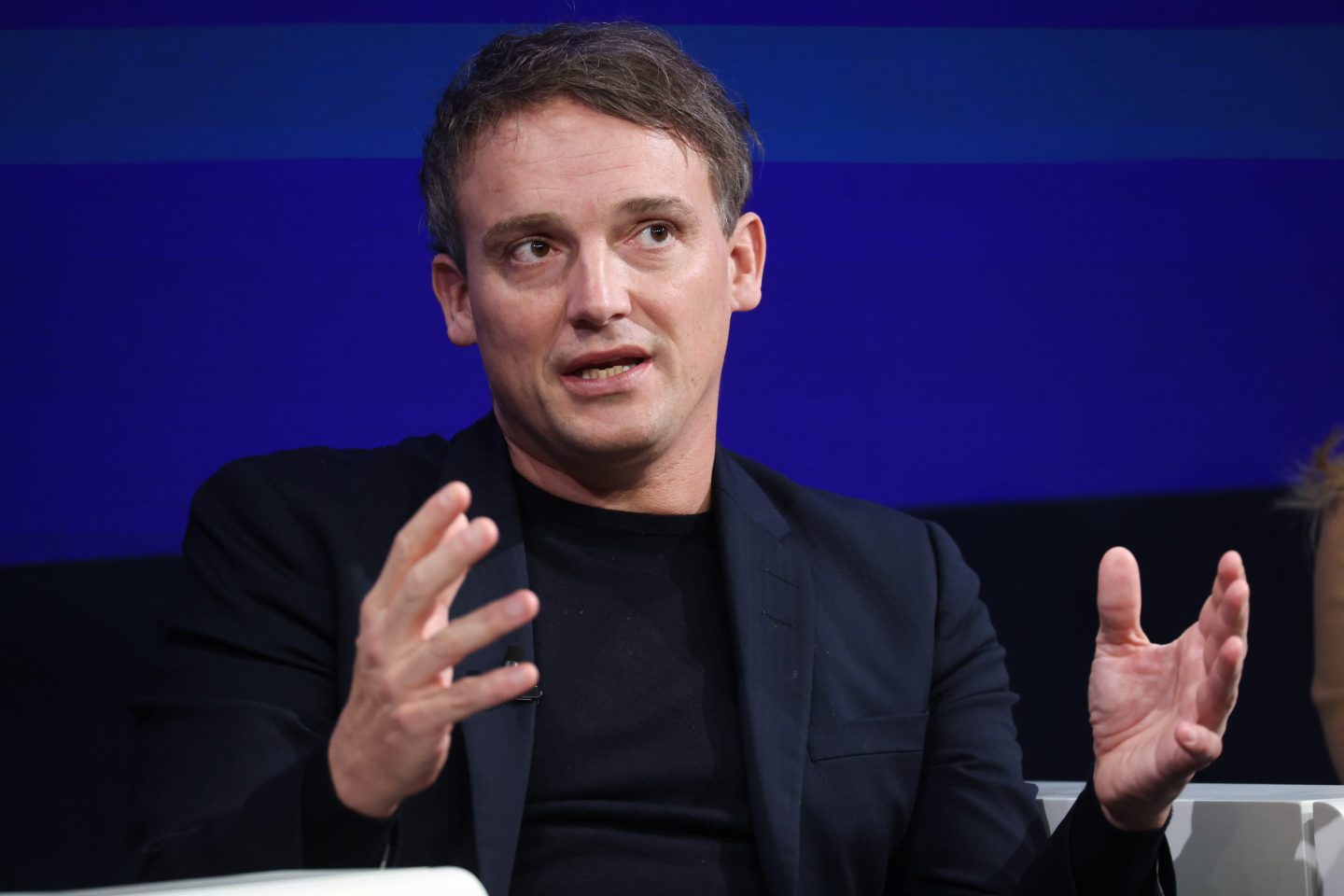
The English engineer, Henry Mill, submitted the first ever patent for a “machine transcribing letters” in 1714. It never actually went into production, but it was a forerunner of the typewriter and then the electronic keyboard. 312 years later, Christian Klein, CEO of software giant SAP, is calling the end of an era.
“The end of the keyboard is near,” he tells me. “When you encounter voice recognition from many of these large-language models, [it] is super strong. Now we have to do some work to translate voice into business language and business data.”
The deleterious effects of AI on the humble keyboard might not be top of the list of business leaders’ priorities when it comes to mapping out the technological future. But SAP’s prediction that ‘data-inputting’ via typing will end in the next two to three years at the firm has significance well beyond the death of QWERTY.
“We are now giving our co-worker tool more and more skills,” Klein says.
“The future will be, for sure, that you are not typing any data information into an SAP system. You can instead ask certain analytical questions with your voice. You can trigger operational task workflows. You can also make entries in the system with your voice—performance feedback, pipeline entries, etc. The technological capabilities are there, it really is now about the execution.”
Read more: The most honest prediction for 2026: nobody knows what’s next by Christian Klein
“Now about the execution” is the phrase most associated with artificial intelligence in 2026. We are beyond the theoretical discussions about what artificial intelligence might be able to do and into the zone of Applied AI. Software companies are creating billions of dollars in profitable revenue supplying the services of the future.
“The future will be, for sure, that you are not typing any data information into an SAP system. You can instead ask certain analytical questions with your voice…”
Christian Klein
SAP stands for Systemanalyse Programmentwicklung (which translates to System Analysis Program Development). The firm, headquartered in Walldorf, Germany, near where it was founded in 1972, provides cloud services to the largest companies in the world, as well as millions of SMEs. Klein, 44, is the youngest CEO of a major business listed on Germany’s DAX index.
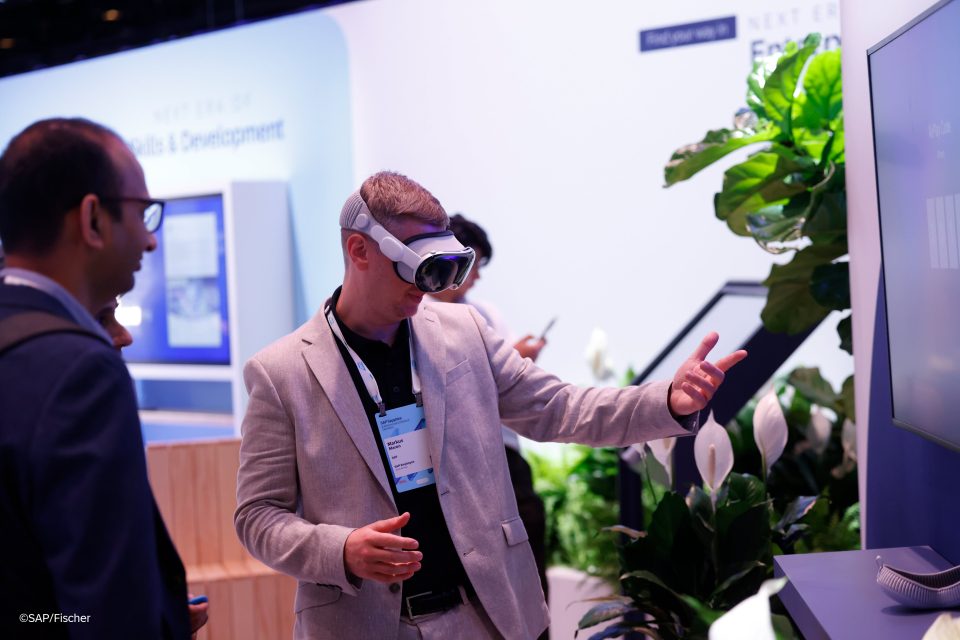
He argues that there are two broad categories of businesses when it comes to AI adoption. First, the company that says, “AI is really changing the way I run my business.” Then, the other that says, “I invested a tonne of money, but I see rather low value in it”. The latter might be viewing AI as an efficiency hack for one division or function. The issue here is that there is no reach across to other parts of the firm. Klein says that the “whole business” needs to be at the table. “AI is super powerful, but it needs to be applied in the right way.”
He gives an example of a large consumer goods company SAP is working with which is beginning to link customer-demand planning with company financial planning and then with inventory control—a laborious, often months-long process.
“They said, okay, this agent really is predicting the demand much more intelligently than all the human beings I had in planning,” he said. “But it still always takes months until I adjust the inventory—and the inventory is dependent on procurement and the manufacturing side. So, we are now building, with agents, an end-to-end planning scenario which helps them optimize inventory by 20%. This is real money.”
Read more: How CEO Christian Klein spearheaded SAP’s seismic shift to a cloud company by Peter Vanham
Applying AI horizontally throughout the business, rather than vertically in divisions, is key. Add in training of your employees and the transformational effects of AI can finally begin to be realised.
“An employee can say ‘hey, go into my PowerPoint presentations’,” Klein says. “They can give an AI model a million financial analysis PowerPoints. We then need to make sure, with our AI, that the business data is understood and that we can do the analysis right away. The employee can then say, ‘tell me, from the millions of documents we created in the financial department, what would be the right measures to tackle some of the challenges we see in the financial performance of the company?’”
“That is the future of work. And then, hopefully, they get it beautifully packaged up, with some nice graphs and commentaries, some nice analysis and recommended actions, and then they can go to their managers who say ‘Wow, this is a new way of steering this company. My God, what did you do? Which training did you attend?’” And they say, ‘No, there is no training’.”
Beyond the training in AI itself, of course.
The use of voice to create workflows within traditional environments is one challenge. There are also higher-order issues which Fortune 500 leaders must consider. Klein and I were speaking at the World Economic Forum in Davos, an event dominated by Donald Trump and his threat to annex Greenland and launch new tariff wars. ‘Spheres of influence’ and mercantilism are back, as the G4 (America, China, Europe, and India) approach global trade in very different ways.
“We are wanting companies who do global trade across borders, and no one wants to scale back on the cause and vision they have as a company,” Klein says of the increased geopolitical risk.
“There are two superpowers in the world and they’re using the power to have more influence. I don’t expect that this will change any time soon.”
“The world has changed a lot, because suddenly not everyone is saying: ‘Oh, I believe in globalization’. Now [it’s] ‘my country first’.”
Which means you have to position your business for the new reality.
“[Companies] are saying, ‘hey, Christian, it’s great your software helps [in] over 100 countries. But how do we do this in a world which is becoming more fragmented?’ There are lots of new sovereignty requirements. In this case, you need the cloud server to be located in the country. In another country, you need to protect the data in a different way. In another country, you need to cut it from the global network. That can be pretty expensive.”
“There are two superpowers in the world and they’re using the power to have more influence. I don’t expect that this will change any time soon.”
Christian Klein
“Business cannot just change the software. It’s mission-critical. Now, with AI, it’s even more mission-critical. What we have to make sure is, when it comes to geo-lock, we are [relying] on infrastructure. We want US infrastructure with the hyperscalers, in China we want Chinese infrastructure. And we want infrastructure provided by local providers here in Germany or in France or wherever. And we always need to make sure that, when something is happening in the world, such as geopolitical sanctions or export control—as we have seen in Iran or in Russia—we can port our platform over to another type of cloud infrastructure in days or weeks.”
Talk now is of ‘kill-switches’ and geo-location autonomy—new entries on the list of leadership risks. Klein is not convinced Europe has got the memo.
“We talk about Europe as a superpower. I would say Europe is a superpower in regulation, but not in unity, because there is no banking union, there is no trade union, there is no digital union and, in a world like this, you need economic power. With economic power, you can influence certain things. You are listened to.”
“We are talking about digital taxes and so on. I would strongly advise both business and political leaders in Europe to spend more time on: ‘How can we innovate?’ How can we use the strengths we have to build something, to increase economic power?’”
Geography and the G4 are the new global reality in the era of Applied AI. Businesses must be agile in how they respond, as it is not always clear where the next political boulder is coming from. When Henry Mill patented the first typewriter there was no such entity as the United States of America. Now it is writ large on the decision tree of every global leader.