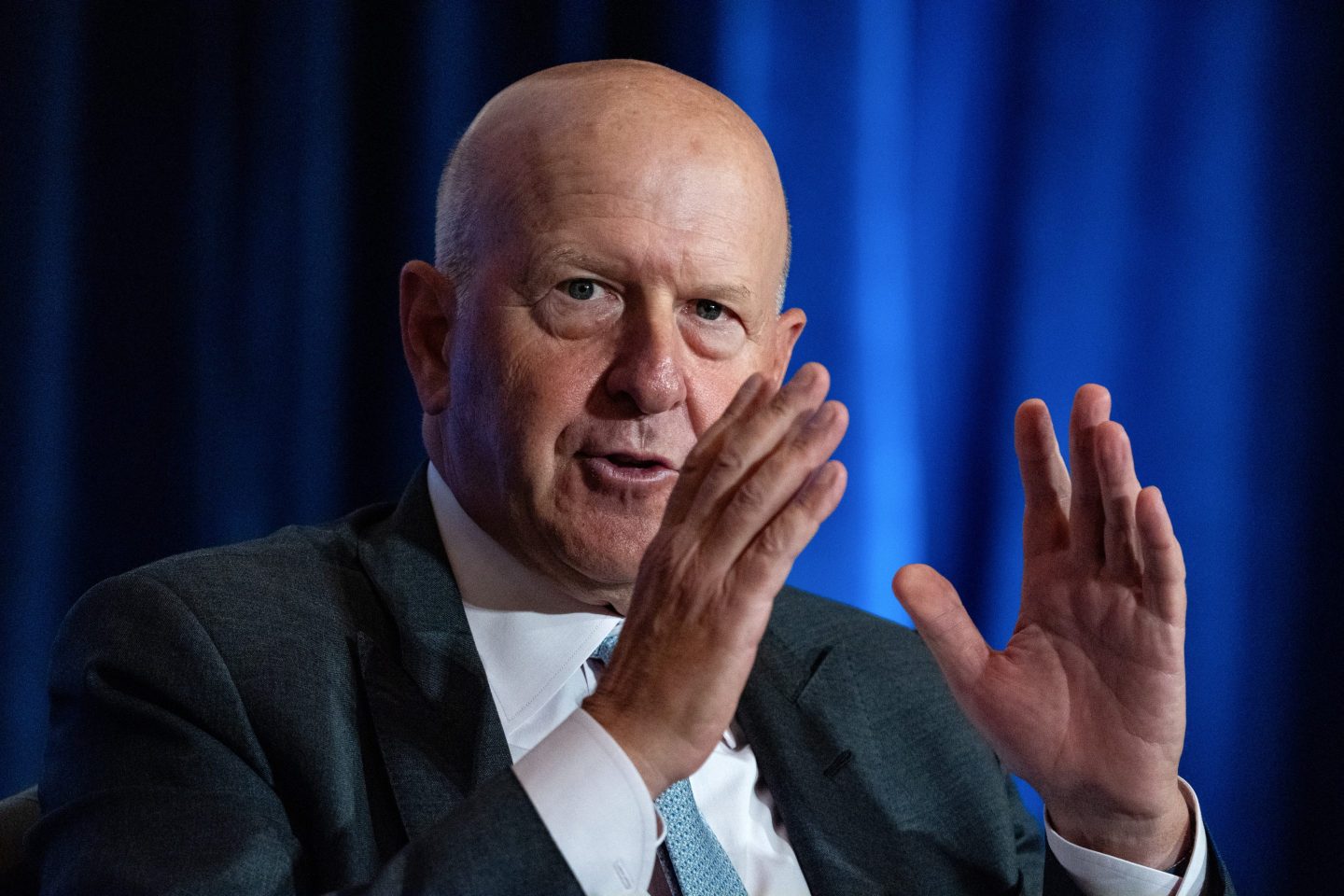
With the global business elite having descended on the Swiss Alps for the annual World Economic Forum meeting, Goldman Sachs chairman and CEO David Solomon has offered a stark readout on the current corporate mood: CEOs are ready to unleash record-breaking levels of investment, provided Washington can dampen the noise of what he terms a “shotgun approach” to policy.
Speaking on the Goldman Sachs Exchanges podcast on Jan. 20, ahead of his trip to Davos, Solomon described a business landscape defined by a sharp dichotomy. On one side, the macroeconomic setup for 2026 is “pretty good for risk assets and for markets,” fueled by a “confluence of very stimulative actions,” including monetary easing and a massive capital investment boom in AI infrastructure. On the other, executives are grappling with anxiety about inconsistent policymaking and geopolitical “noise.”
“They’re concerned about the amount of noise outside of Washington,” he said. “They’re concerned about, for lack of a better term, the kind of shotgun approach to policy that’s not as consistent as they’d like.” Allowing that it is consistent on deregulation, it’s not as consistent on other things. “Candidly,” he added, “I think they’d like to see less noise and more focus on opportunities for growth, because that’s what CEOs want.”
The return of the deal
Solomon’s most bullish forecast centers on a resurgence of mergers and acquisitions, driven by a radical shift in the regulatory climate. For the past four years, Solomon noted, when CEOs asked regulators if a deal was possible, “it didn’t matter what the question was. The answer was no.”
Now, in a deregulatory environment that Solomon describes as “quite stimulative for investment and growth,” corporate leaders are becoming more forward-thinking. “Unless there’s a big exogenous event that really significantly shifts sentiment,” Solomon predicted, “2026 could be one of the best M&A years ever.” His optimism extended to the IPO market, where private equity portfolios, marked up during the boom years of 2020 and 2021, are finally preparing to exit as public markets improve.
Solomon’s comments aligned with those of Kim Posnett, Goldman’s co-head of investment banking, who predicted an IPO “mega-cycle” in a Q&A with Fortune earlier this week. She also noted that how the M&A market has transitioned from 2025’s year of recovery to a “bold and strategic” state, with last year’s $5.1 trillion in volume a 44% increase from 2024.
The ‘shotgun’ anxiety
However, Solomon stressed CEO optimism is tempered by frustration with how the new administration is handling policy implementation. While CEOs welcome deregulation, they are rattled by the unpredictability of other government actions. Solomon highlighted concerns regarding a “shotgun approach to policy that’s not as consistent as they‘d like.” For those unfamiliar with the phrase, “shotgun approach” has to do with how shotguns fire many small pellets that spread out, increasing the chance of hitting a moving target compared with a single bullet, fired from a rifle at one target.
“If there’s stability, CEOs get very optimistic and very forward-looking,” Solomon observed. “When there’s noise and uncertainty, they’re more cautious.” He pointed specifically to recent headlines regarding “Greenland and tariffs in Europe” as the type of geopolitical friction that causes capital to pause. “Those kinds of things are going to create uncertainty. And when they create uncertainty, you’re going to see drawdowns or step backs or pauses.”
The widening transatlantic gap
Solomon was also flying to Davos with a sobering message for his European counterparts: The economic chasm between the United States and Europe is growing.
“Europe, I just think structurally, has much lower growth,” he said, noting much talk from European leaders about how they want to move forward with a more constructive regulatory regime, a more growth-oriented agenda, and a more capital-markets- and finance-friendly agenda, but “they’ve really been very slow in their ability to implement.” Just look at the growth data, he said.
“Europe trend growth is below 1%,” Solomon said, explaining that with roughly 450 million people, Europe has a roughly $20 trillion economy and less than 1% trend growth. The U.S., on the other hand, has roughly 330 million, a $30 trillion economy, and 2% trend growth.
“That gap between the U.S. and Europe will continue to widen,” he predicted, attributing the disparity to superior capital formation processes and tech infrastructure in the U.S. Days later, President Donald Trump would make similar points—along with many others, often off-topic—in a main stage Davos speech that was met with occasional groans and laughter.
Despite the bullish fundamentals, Solomon said he remains vigilant regarding risks that cannot be modeled in a spreadsheet. The primary threat to the 2026 trajectory, he warned, is an “exogenous event” originating from geopolitics, cyber threats, or idiosyncratic shocks.
“I think the big thing that risks stopping the economic trajectory … is some sort of exogenous event,” Solomon concluded. “They come from big, idiosyncratic events that we don’t see in advance.”