
• Home
  • Latest
  • Fortune 500
  • Finance
  • Tech
  • Leadership
  • Lifestyle
  • Rankings
  • Multimedia
EconomyWealth

How the middle class was hollowed out from 1979 to 2022, according to new federal data

Nick Lichtenberg
By
Nick Lichtenberg
Nick Lichtenberg
Business Editor
Down Arrow Button Icon
Nick Lichtenberg
By
Nick Lichtenberg
Nick Lichtenberg
Business Editor
Down Arrow Button Icon
January 22, 2026, 4:58 PM ET
reagan
President Ronald Reagan at Durenberger Republican convention Rally, 1982.Universal History Archive/Getty Images

A comprehensive new report released by the Congressional Budget Office (CBO) portrays a stark transformation of the American economy over the last four decades, revealing a deepening divide where the wealthiest households have dramatically expanded their economic footprint while the middle class has steadily lost ground.

Recommended Video

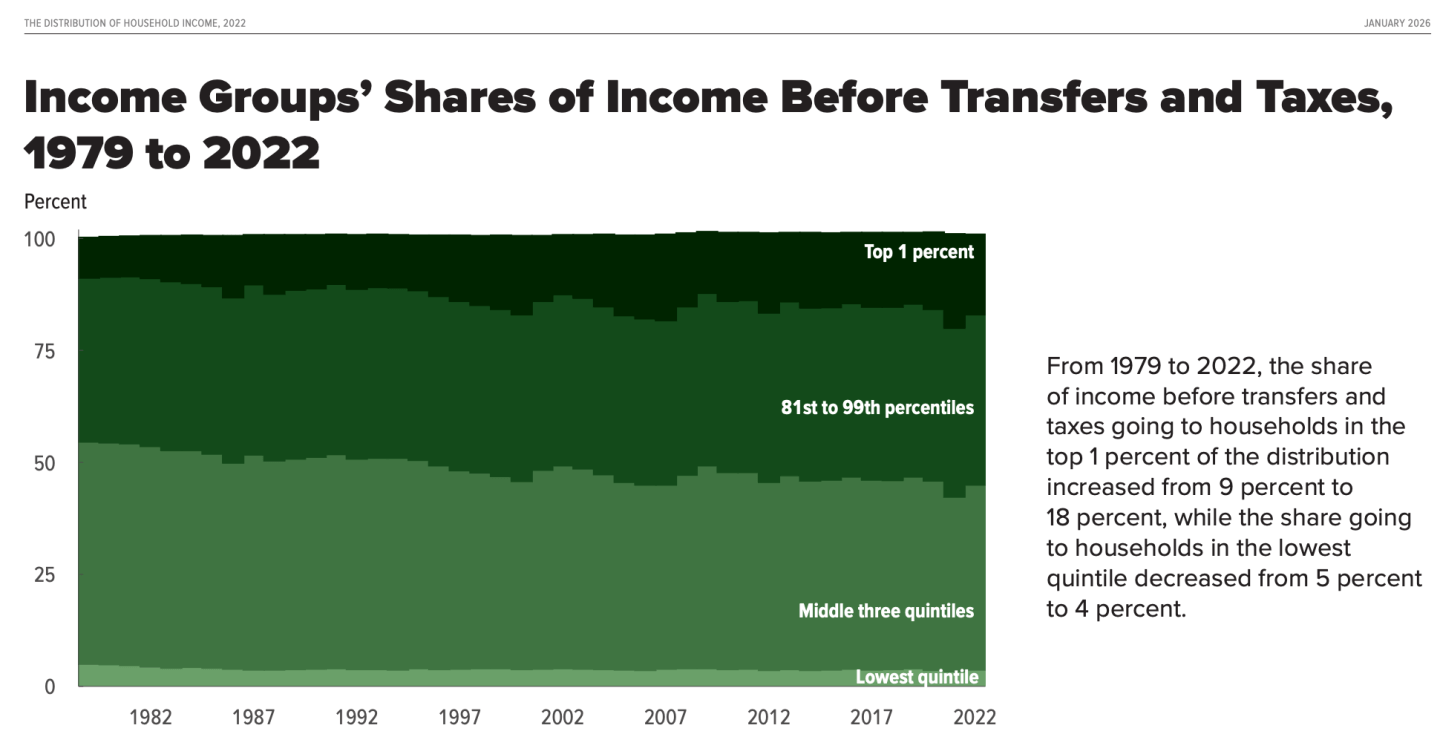
According to the data, which spans from 1979 through 2022, the distribution of national income has skewed heavily toward the very top. The report reveals the top 1% of households grew their share of income before transfers and taxes from 9% in 1979 to 18% in 2022, effectively doubling their slice of the economic pie.
A hollowing out of the middle

While the top tier prospered, the rest of the economic ladder struggled to maintain its standing. The CBO found as the top 1% seized a larger portion of market income, the share going to the lowest quintile dropped from 5% to 4%. This means most of the compression occurred in the middle.

Even after accounting for the stabilizing effects of the safety net and the tax code, the middle class has seen its relative status diminish. The share of income after transfers and taxes held by the “middle three” income quintiles decreased by 6 percentage points over the 43-year period. Conversely, the share of after-tax income going to the top 1% doubled from 7% to 14%.

The disparity in growth rates is even more pronounced when looking at the ultrawealthy. While average income grew for all groups since 1979, the acceleration at the summit was unmatched. Income for the highest quintile more than doubled, and for the top 0.01% of earners, average income after taxes and transfers grew more than sevenfold.

To be sure, the amount of wealth is greater overall, with the U.S. surging in the creation of more millionaires than ever before—a development so stark that UBS nicknamed it the “everyday millionaire.” While the wealthy own a greater share of household wealth, this is coming on the back of overall growth in the economy, with a rising tide arguably lifting all boats. The wealthy may have a greater share, in other words, but it’s a greater share of a larger pie.

Kent Smetters, the Wharton School professor and faculty director of the Penn Wharton Budget Model (PWBM), recently told Fortune that he thinks the behavioral economics phenomenon that is known as the “money illusion” is at play. This is where people don’t actually believe that they have gotten richer because of, well, sticker shock. “The reality is that, in fact, we have a much higher standard of living than we had even 20 or 30 years ago,” he said. “I’m not saying there’s no problems,” but just consider the family car, for example. He recalled his family having to budget for the car breaking down multiple times a year and that just doesn’t happen due to technological improvements.

Drivers of inequality

The report identifies market income—specifically capital gains—as a primary engine of this divergence. Realized capital gains constitute a much larger portion of income for households at the top of the distribution, leading to massive financial surges during boom years. Consequently, increases in market income at the top drove much of the overall rise in income inequality observed since the late 1970s.

The federal government has attempted to mitigate this widening gap through the tax and transfer system. The CBO notes the degree to which taxes and transfers reduce inequality has actually increased over the past four decades. However, the structure of federal revenue has shifted along with the income. Because the wealthy now command such a massive share of total earnings, they also pay a larger portion of the national tax bill; the top quintile paid 70% of all federal taxes in 2022, up from 55% in 1979.

Smetters also recently spoke to Fortune about misconceptions on the U.S. tax system. “What people don’t realize is just how progressive the United States income tax system is,” by far the most progressive in the OECD. With such a progressive tax system, he added, “it’s really hard to raise a lot of revenue,” because the wealthy are paying such a disproportionate share.

The CBO found over this 43-year period, the reliance on government assistance has grown for the poorest Americans. For the lowest income quintile, Medicaid and CHIP benefits ballooned from representing just 9% of their income in 1979 to 48% in 2022.

Post-pandemic volatility

The CBO also provided a snapshot of the volatile economy immediately following the COVID-19 pandemic. In 2022, average income after transfers and taxes actually fell for all income groups compared to the prior year.

For lower-income households, this decline was driven by the expiration of temporary pandemic-era policies, such as the expanded child tax credit and recovery rebate credits. For the wealthy, the 2022 dip was the result of a sharp decline in realized capital gains from a record high in 2021.

Despite the temporary fluctuation in 2022, the long-term trend remains clear. The Gini coefficient, a standard measure of income inequality, shows the gap between the rich and the rest of the country is significantly wider today than it was in 1979.

For this story, Fortune journalists used generative AI as a research tool. An editor verified the accuracy of the information before publishing.

[This report has been updated to add additional context on the growth of the economy since the 1970s and comments from UBS and Wharton professor Kent Smetters.]

Join us at the Fortune Workplace Innovation Summit May 19–20, 2026, in Atlanta. The next era of workplace innovation is here—and the old playbook is being rewritten. At this exclusive, high-energy event, the world’s most innovative leaders will convene to explore how AI, humanity, and strategy converge to redefine, again, the future of work. Register now.
About the Author
Nick Lichtenberg
By Nick LichtenbergBusiness Editor
LinkedIn icon

Nick Lichtenberg is business editor and was formerly Fortune's executive editor of global news.

See full bioRight Arrow Button Icon

Latest in Economy

Finance
Lorem ipsum dolor sit amet, consectetur adipiscing elit, sed do eiusmod tempor incididunt ut labore et dolore magna aliqua. Ut enim ad minim veniam
By Fortune Editors
October 20, 2025
Finance
Lorem ipsum dolor sit amet, consectetur adipiscing elit, sed do eiusmod tempor incididunt ut labore et dolore magna aliqua. Ut enim ad minim veniam
By Fortune Editors
October 20, 2025
Finance
Lorem ipsum dolor sit amet, consectetur adipiscing elit, sed do eiusmod tempor incididunt ut labore et dolore magna aliqua. Ut enim ad minim veniam
By Fortune Editors
October 20, 2025
Finance
Lorem ipsum dolor sit amet, consectetur adipiscing elit, sed do eiusmod tempor incididunt ut labore et dolore magna aliqua. Ut enim ad minim veniam
By Fortune Editors
October 20, 2025
Finance
Lorem ipsum dolor sit amet, consectetur adipiscing elit, sed do eiusmod tempor incididunt ut labore et dolore magna aliqua. Ut enim ad minim veniam
By Fortune Editors
October 20, 2025
Finance
Lorem ipsum dolor sit amet, consectetur adipiscing elit, sed do eiusmod tempor incididunt ut labore et dolore magna aliqua. Ut enim ad minim veniam
By Fortune Editors
October 20, 2025

Most Popular

Finance
Lorem ipsum dolor sit amet, consectetur adipiscing elit, sed do eiusmod tempor incididunt ut labore et dolore magna aliqua. Ut enim ad minim veniam
By Fortune Editors
October 20, 2025
Finance
Lorem ipsum dolor sit amet, consectetur adipiscing elit, sed do eiusmod tempor incididunt ut labore et dolore magna aliqua. Ut enim ad minim veniam
By Fortune Editors
October 20, 2025
Finance
Lorem ipsum dolor sit amet, consectetur adipiscing elit, sed do eiusmod tempor incididunt ut labore et dolore magna aliqua. Ut enim ad minim veniam
By Fortune Editors
October 20, 2025
Finance
Lorem ipsum dolor sit amet, consectetur adipiscing elit, sed do eiusmod tempor incididunt ut labore et dolore magna aliqua. Ut enim ad minim veniam
By Fortune Editors
October 20, 2025
Finance
Lorem ipsum dolor sit amet, consectetur adipiscing elit, sed do eiusmod tempor incididunt ut labore et dolore magna aliqua. Ut enim ad minim veniam
By Fortune Editors
October 20, 2025
Finance
Lorem ipsum dolor sit amet, consectetur adipiscing elit, sed do eiusmod tempor incididunt ut labore et dolore magna aliqua. Ut enim ad minim veniam
By Fortune Editors
October 20, 2025
Rankings
  • 100 Best Companies
  • Fortune 500
  • Global 500
  • Fortune 500 Europe
  • Most Powerful Women
  • Future 50
  • World’s Most Admired Companies
  • See All Rankings
Sections
  • Finance
  • Leadership
  • Success
  • Tech
  • Asia
  • Europe
  • Environment
  • Fortune Crypto
  • Health
  • Retail
  • Lifestyle
  • Politics
  • Newsletters
  • Magazine
  • Features
  • Commentary
  • Mpw
  • CEO Initiative
  • Conferences
  • Personal Finance
  • Education
Customer Support
  • Frequently Asked Questions
  • Customer Service Portal
  • Privacy Policy
  • Terms Of Use
  • Single Issues For Purchase
  • International Print
Commercial Services
  • Advertising
  • Fortune Brand Studio
  • Fortune Analytics
  • Fortune Conferences
  • Business Development
About Us
  • About Us
  • Editorial Calendar
  • Press Center
  • Work At Fortune
  • Diversity And Inclusion
  • Terms And Conditions
  • Site Map
  • Facebook icon
  • Twitter icon
  • LinkedIn icon
  • Instagram icon
  • Pinterest icon

Latest in Economy

(L-R) Canada's Prime Minister Mark Carney and US President Donald Trump attend the draw for the 2026 FIFA Football World Cup taking place in the US, Canada and Mexico, at the Kennedy Center, in Washington, DC, on December 5, 2025.
EconomyTariffs and trade
Trump’s Canada bridge meltdown dismissed by UBS as an unlikely TACO trade ‘in the post-Heated Rivalry environment’
By Eleanor PringleFebruary 10, 2026
23 minutes ago
zootopia
AsiaChina
Chinese shoppers can’t get enough of Disney’s Zootopia and Ralph Lauren’s ‘old money’ look despite nationalistic vibes
By Chan Ho-Him and The Associated PressFebruary 10, 2026
2 hours ago
chapman
CommentaryGender Issues
Sam Altman told me AI should be ‘an equalizing force in society.’ That’s why I’m working on the $1.6 trillion AI gender gap
By Valerie ChapmanFebruary 10, 2026
2 hours ago
women
Commentarynational debt
America is shorting one of its best assets as the $38 trillion national debt runs out of control 
By Katica RoyFebruary 10, 2026
3 hours ago
honda
EconomyTariffs and trade
Trump’s tariffs take a bit out of Honda with 42% drop in profits for past 9 months
By Yuri Kageyama and The Associated PressFebruary 10, 2026
3 hours ago
trump
PoliticsAmerican Dream
People really did have a kind of millennial optimism in 2016, Gallup finds, as hopes for the future fade
By Linley Sanders and The Associated PressFebruary 10, 2026
3 hours ago

Most Popular

placeholder alt text
C-Suite
Meet Jody Allen, the billionaire owner of the Seattle Seahawks, who plans to sell the team and donate the proceeds to charity
By Jake AngeloFebruary 9, 2026
22 hours ago
placeholder alt text
AI
As billionaires bail, Mark Zuckerberg doubles down on California with $50 million donation
By Sydney LakeFebruary 9, 2026
1 day ago
placeholder alt text
Economy
China might be beginning to back away from U.S. debt as investors get nervous about overexposure to American assets
By Eleanor PringleFebruary 9, 2026
1 day ago
placeholder alt text
Economy
Elon Musk warns the U.S. is '1,000% going to go bankrupt' unless AI and robotics save the economy from crushing debt
By Jason MaFebruary 7, 2026
3 days ago
placeholder alt text
Personal Finance
Current price of silver as of Monday, February 9, 2026
By Joseph HostetlerFebruary 9, 2026
1 day ago
placeholder alt text
Personal Finance
Current price of gold as of February 9, 2026
By Danny BakstFebruary 9, 2026
1 day ago

© 2026 Fortune Media IP Limited. All Rights Reserved. Use of this site constitutes acceptance of our Terms of Use and Privacy Policy | CA Notice at Collection and Privacy Notice | Do Not Sell/Share My Personal Information
FORTUNE is a trademark of Fortune Media IP Limited, registered in the U.S. and other countries. FORTUNE may receive compensation for some links to products and services on this website. Offers may be subject to change without notice.