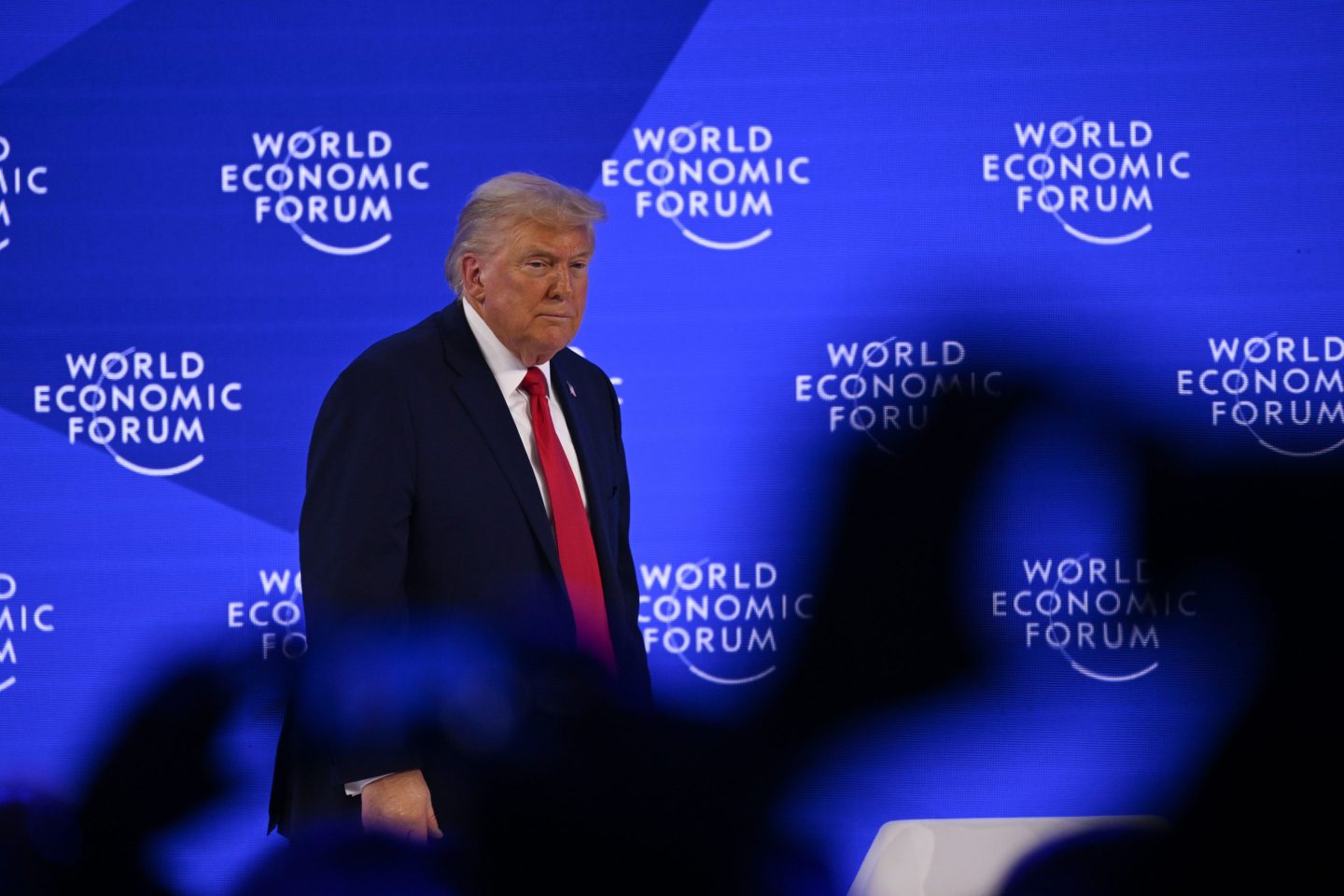
President Donald Trump’s pursuit of Greenland was at the center of his address to the World Economic Forum on Wednesday. The President, speaking in Davos, Switzerland, unleashed a sweeping history lesson about Greenland’s role in American security—lamenting that the United States was “stupid” to return the Arctic island to Denmark after World War II and insisting the time has come to reclaim the territory. He did clarify that acquiring the “big beautiful piece of ice” would not include military force.
Framing Greenland as both a misunderstood asset and an American birthright, he told the Davos audience that during World War II, the United States “was compelled” to send forces to Greenland after Denmark fell to Nazi Germany “after just six hours of fighting,” saying U.S. troops “saved Greenland and successfully prevented our enemies from gaining a foothold in our hemisphere.” After the war, he continued, recounting history in his own terms, Washington “gave Greenland back to Denmark,” a decision he castigated in blunt terms. “How stupid were we to do that?” he said. “But we did it, we gave it back. But how ungrateful are they now?”
Trump has repeatedly described Greenland as a core national security interest of the United States—a strategic bulwark between the U.S., Russia, and China that Washington, he claims, can uniquely defend. During his speech, he dismissed Greenland’s much-talked-about mineral wealth—including rare earths—as a secondary consideration behind strategic defenses, arguing that the island’s geographic position alone makes it indispensable to U.S. interests.
He tied his push to a centuries‑long U.S. doctrine of keeping outside threats out of the hemisphere and claimed “American presidents have sought to purchase Greenland for nearly two centuries.” Although there is evidence of late‑19th‑century U.S. interest in the Arctic and in expanding territory (for example, Alaska), and in 1946, President Truman offered Denmark $100 million in gold to buy Greenland, there has not been a continuous line of U.S. presidents “for nearly two centuries” formally trying to purchase the island.
Punctuating his case, Trump also derided 2019 Denmark’s pledge to boost Greenland’s defenses as hollow, noting that Copenhagen once promised more than $200 million but has “spent less than 1% of that amount. There’s no sign of Denmark there,” he claimed, while stressing that he has “tremendous respect” for both Danish and Greenlandic people.
While analysis from a Danish telecom and policy consultancy notes that by mid‑2024, only about 1% of that roughly $224 million Danish pledge has actually been spent—with investments delayed and some projects slow to materialize—Denmark has since committed much larger Arctic defense packages: in 2024 and 2025 Copenhagen approved additional multibillion‑kroner programs (in the low‑billions of dollars) for Arctic vessels, drones, satellites and personnel tied directly to Greenland and the broader Arctic.
Trump denies he’ll use military force
Aside from Denmark’s economic commitments, the nation remains an obvious presence on the island. Denmark operates the Joint Arctic Command, based in Greenland’s capital, Nuuk, and maintains patrol vessels, air surveillance, and military personnel in and around Greenland. And even before the new packages, Danish naval patrols, inspection vessels, and other assets routinely operated in Greenlandic waters; further ships, drones, and infrastructure upgrades have been funded or announced in recent years.
But perhaps the most striking moment came when Trump addressed lingering fears that his push might escalate into conflict. In an apparent effort to ease those anxieties, the president told the crowd he would not use military force to seize Greenland. “We never asked for anything, and we never got anything. We probably won’t get anything unless I decide to use excessive strength and force … but I won’t do that. I don’t want to use force. I won’t use force,” Trump said.
His statements clarified remaining questions about military force, which the White House had not yet fully ruled out, with senior administration officials telling reporters that the U.S. military was “always an option.” That ambiguity fueled concern among allies, global markets, and lawmakers alike.
Concern over Trump’s position on Greenland, however, is expected to continue. Danish Prime Minister Mette Frederiksen has repeatedly rejected any notion of selling Greenland and urged Washington to respect longstanding partnerships. European leaders, from Paris to London, issued reminders that territorial claims cannot be simply negotiated away under pressure.
Members of Congress from both parties also distanced themselves from Trump’s rhetoric, emphasizing that Greenland is a partner and that any discussion of territory must honor self-determination and international law.