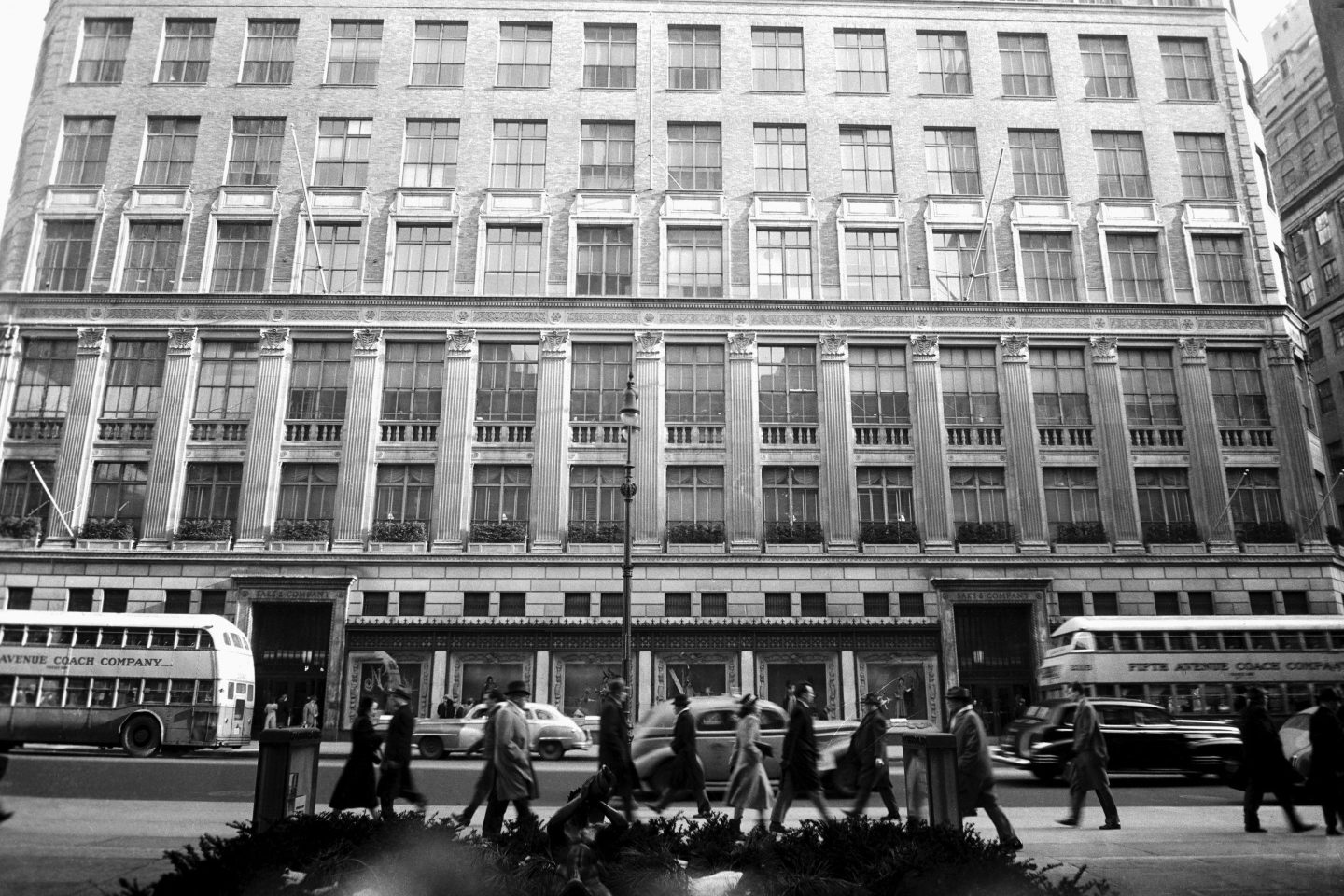
The new CEO of Saks Global, Geoffroy van Raemdonck, has said that his management philosophy when it comes to running luxury department stores is “leading with love,” Fortune’s Phil Wahba wrote this week. Van Raemdonck’s focus on the magic of a luxury shopping experience is reminiscent of one of his predecessors: Saks Fifth Avenue President Adam Gimbel was known, Fortune reported in 1938, for “the lighthearted way he runs the store,” and how he “honors merchandising axioms more often in the breach than in the observance.”
The grand department store on Manhattan’s Fifth Avenue was then a place of “hypnotism” and “spell-weaving,” in Fortune’s telling of it—a temple to luxury where “The customer who can escape from this seductive ambush without adding an unplanned $40 or $50 to her bill is a resolute woman.” It was also a place of startling excess, where a woman of means could procure herself “a $395 handbag or a $29,000 sable coat” (adjusted for inflation, about $9,000 and $670,000 in today’s dollars).
Gimbel—along with his wife, Sophie Gimbel, who selected and designed clothes for Saks’ exclusive Salon Moderne—had discovered a new and incredibly lucrative customer base, Fortune reported: “The woman of wealthy suburbia.” And in discovering how to sell to this tasteful, rather bored-sounding woman, the Gimbels pulled off a neat trick: They “put the luxury trade into mass production,” and “opened a field where elegance moves over the counter in amazing volume.”

This gave Gimbel enormous power, not just over these customers and their tastes, but also over the vendors whose products Saks stocked, Fortune explained: “Indeed, Adam Gimbel has remarked on occasion that a list of Saks manufacturers would be meaningless, because they change so often. If a manufacturer gets a Saks account, he knows that it will keep his plant humming, but he also knows that at the slightest dissatisfaction Saks will pull it away.”
Oh, how times have changed. Saks Global, having just declared bankruptcy after years of risky dealmaking and ill-advised expansions, has lost much of the magic that kept the customers streaming in during Gimbel’s time. And, robbed of its leverage over manufacturers in the era of e-commerce and direct-to-consumer sales, the department store faces an uphill battle to win back the trust of its vendors.
“Between sluggish business and heavy debt, Saks has in the last two years delayed payments to many vendors,” Wahba wrote. “Many of those vendors have stopped shipping to its stores, which has led to empty shelves and stale inventory, the antithesis of what a luxury department store should offer and certainly not a way to inspire a shopper’s love.”