• Home
  • Latest
  • Fortune 500
  • Finance
  • Tech
  • Leadership
  • Lifestyle
  • Rankings
  • Multimedia
EconomyU.S. economy

America’s $952 billion annual burden: Exploding interest on national debt is set to surpass Medicare spending within the decade

Shawn Tully
By
Shawn Tully
Shawn Tully
Senior Editor-at-Large
Down Arrow Button Icon
Shawn Tully
By
Shawn Tully
Shawn Tully
Senior Editor-at-Large
Down Arrow Button Icon
January 15, 2026, 4:33 AM ET
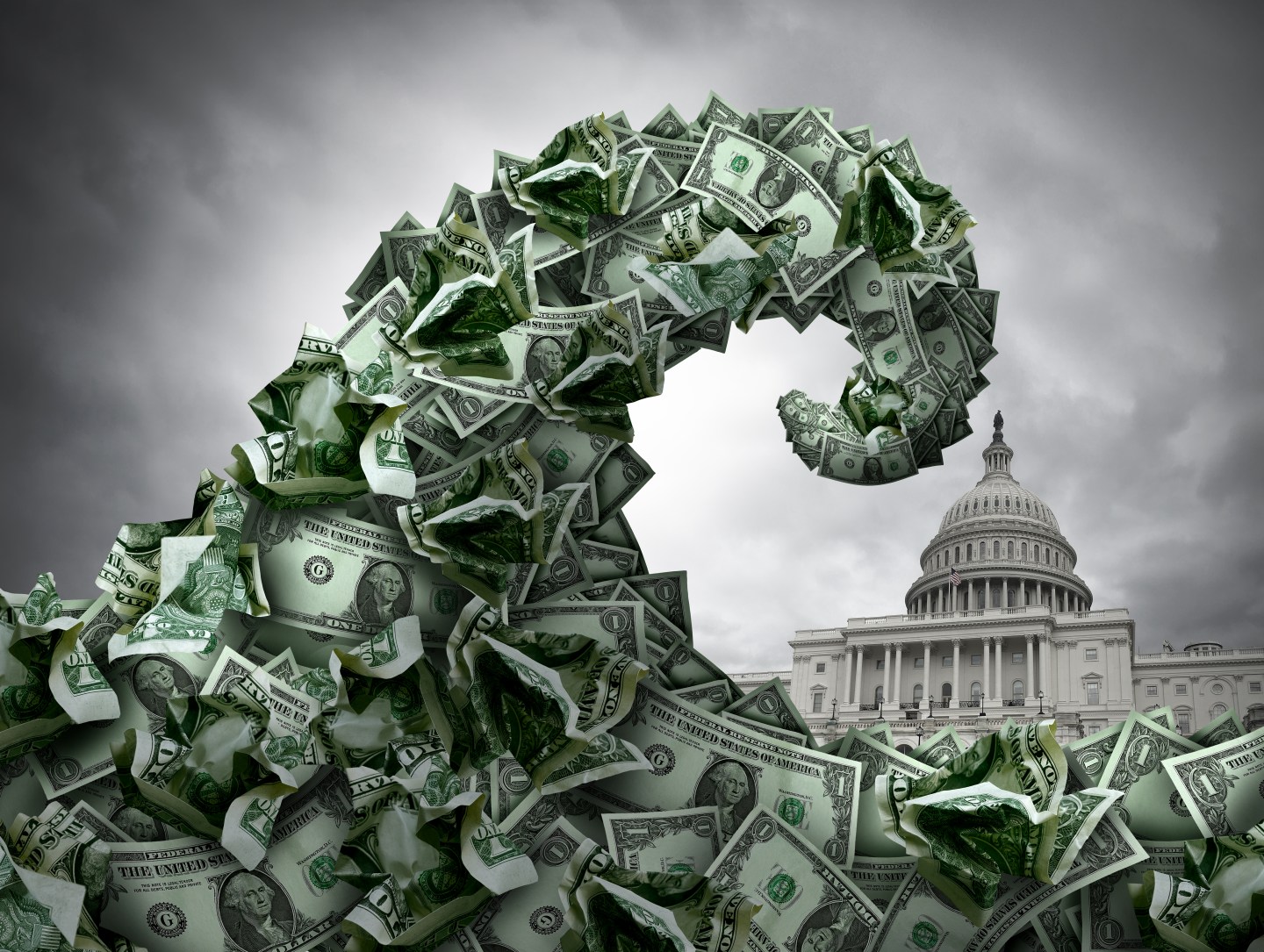
Debt interest payments threaten to overwhelm the U.S. government.

America has had gigantic budget deficits and debt that have been dangerous and ballooning for years, yet it’s only recently that they’re stirring alarm among voters in a big way. In the spring of 2025, a poll conducted by the non-partisan Peterson Foundation found that 76% of all voters, including 73% of Democrats and 89% of Republicans, agree that addressing the rampant borrowing that’s endangering our economic standing and threatens their own financial futures should be a top priority for the president and Congress.

Recommended Video

Since that survey’s release, the picture’s deteriorated at a far faster pace than the Congressional Budget Office and private forecasters anticipated, due in part to the coming tax rate reductions and spending increases embodied in President Trump’s One Big Beautiful Bill. The single major line item that’s now growing fastest, and that’s added the most to the budget shortfall since start of the pandemic, is a dark horse: interest expense. This burgeoning cost that contributes nothing towards supporting national defense, funding the nation’s promises on delivering healthcare for seniors, and funding border control, is the one budget feature most likely to increasingly outrage the folks. Recall that in the 1992 presidential race, independent candidate and political unknown Ross Perot made the exploding interest on the national debt a centerpiece of his maverick campaign, and thanks in largely to hammering home the looming danger ahead, captured nearly 20% of the popular vote.

Since 2019, interest on the debt has exploded

In the 2019 fiscal year, net interest expense was still no big deal. It totaled just $375 billion, and accounting for a modest 1.7% of GDP. By FY 2025 (ended in September), the figure had jumped to $952 billion, a rise of 153%, or 17% a year. In that same six year period, its trajectory far outstripped the still alarming surges in Medicare (25%), Medicaid (32%), not to mention national defense (7%). In FY 2025, interest ranked as the third largest spending area after Social Security, and nearly caught Medicare, which at $997 billion was less than 5% ahead of debt service. Interest gobbled 3.2% of national income, almost twice its share pre-COVID.

From FY ’19 to FY ’25, interest soared from under one dollar in ten to more than one dollar in six-and-a-half of all U.S. spending.

The ramp only accelerated from October through December, the first quarter of FY 2026. Interest expense hit $179 billion, versus $160 billion in the first three months of FY 2025. For that period at the close of last year, it towered as the nation’s 2nd largest expenditure, narrowly beating both Medicare and national defense. In its most recent Long-Term Budget Projections, the CBO estimates that interest will keep gobbling more and more of national income, going from today’s 3.2% by 4.0% by 2034. At that level, interest costs would reach $1.6 trillion—almost 70% more than today—and replace Medicare by a hair as the budget’s second highest cost. At that point, interest would be absorbing the equivalent of one in four dollars collected in all individual income taxes.

It’s the basic, “primary” deficit that’s causing the jump in interest costs

The interest takeoff arises from a fundamental problem. The underlying source is the “primary” deficit, the structural gap between revenues and outlays that that creates big shortfalls before counting interest expense. As the primary deficit grows, the U.S. must borrow the expanding difference, and that’s been the story. Adding to the pain: As the principal amount owed has kept expanding, so too has the cost of financing each new billion dollars added to the tab. Since 2019, the average rate on U.S. debt has risen substantially, from a super-bargain 2.49% 7 years ago, to 3.35% in FY 2025. And it’s only at its current range in the mid-3’s because the U.S. is relying heavily on short-term borrowings to hold down the overall expense, meaning that if the Treasury wants to reduce risk by refinancing that debt with 10 year or even longer duration bonds, the rates it pays to rise well beyond the current numbers, hiking total interest expense even more.

As the gulf between what the U.S. spent and collected kept waxing, interest became a bigger and bigger contributor to the deficits that now raise such dread. The shortfall between revenues and expenses vaulted from $998 billion in 2019 to $1.8 trillion in FY 2025. That’s a leap of $800 billion, or 80%. In that span, interest added $577 billion to the federal budget, accounting for roughly 70% of the notorious deficit. The CBO projects that under current law, the gap will zoom to $1 trillion in FY 2025, a staggering 6% of GDP, to 117% in 2034. The agency forecasts that interest will join Medicare as the top drivers of that 17 point advance.

It’s important to note that the additional tariffs imposed by the Trump administration, though a significant fund-raiser, haven’t come close to slowing that growing “V” between receipts and spending. Interest’s a big part of the story. In FY 2025, the U.S. raised around $200 billion from import duties and associated revenues, some $125 billion more than the previous fiscal year. In the same interval, interest expense grew from $881 billion to $952 billion. That extra $71 billion offsets almost 60% of the gains from tariffs.

All told, debt service is claiming an ever-greater share of the dollars America’s promised to spend on benefits for future generations. Those payments hogging more and more of our tax dollars are the price we’re paying for years of over-spending and under-taxing. If anything decisively gets American voters to focus on the damage from debt and deficits, it’s the ravages of Big Interest.

Join us at the Fortune Workplace Innovation Summit May 19–20, 2026, in Atlanta. The next era of workplace innovation is here—and the old playbook is being rewritten. At this exclusive, high-energy event, the world’s most innovative leaders will convene to explore how AI, humanity, and strategy converge to redefine, again, the future of work. Register now.
About the Author
Shawn Tully
By Shawn TullySenior Editor-at-Large

Shawn Tully is a senior editor-at-large at Fortune, covering the biggest trends in business, aviation, politics, and leadership.

See full bioRight Arrow Button Icon

Latest in Economy

Finance
Lorem ipsum dolor sit amet, consectetur adipiscing elit, sed do eiusmod tempor incididunt ut labore et dolore magna aliqua. Ut enim ad minim veniam
By Fortune Editors
October 20, 2025
Finance
Lorem ipsum dolor sit amet, consectetur adipiscing elit, sed do eiusmod tempor incididunt ut labore et dolore magna aliqua. Ut enim ad minim veniam
By Fortune Editors
October 20, 2025
Finance
Lorem ipsum dolor sit amet, consectetur adipiscing elit, sed do eiusmod tempor incididunt ut labore et dolore magna aliqua. Ut enim ad minim veniam
By Fortune Editors
October 20, 2025
Finance
Lorem ipsum dolor sit amet, consectetur adipiscing elit, sed do eiusmod tempor incididunt ut labore et dolore magna aliqua. Ut enim ad minim veniam
By Fortune Editors
October 20, 2025
Finance
Lorem ipsum dolor sit amet, consectetur adipiscing elit, sed do eiusmod tempor incididunt ut labore et dolore magna aliqua. Ut enim ad minim veniam
By Fortune Editors
October 20, 2025
Finance
Lorem ipsum dolor sit amet, consectetur adipiscing elit, sed do eiusmod tempor incididunt ut labore et dolore magna aliqua. Ut enim ad minim veniam
By Fortune Editors
October 20, 2025

Most Popular

Finance
Lorem ipsum dolor sit amet, consectetur adipiscing elit, sed do eiusmod tempor incididunt ut labore et dolore magna aliqua. Ut enim ad minim veniam
By Fortune Editors
October 20, 2025
Finance
Lorem ipsum dolor sit amet, consectetur adipiscing elit, sed do eiusmod tempor incididunt ut labore et dolore magna aliqua. Ut enim ad minim veniam
By Fortune Editors
October 20, 2025
Finance
Lorem ipsum dolor sit amet, consectetur adipiscing elit, sed do eiusmod tempor incididunt ut labore et dolore magna aliqua. Ut enim ad minim veniam
By Fortune Editors
October 20, 2025
Finance
Lorem ipsum dolor sit amet, consectetur adipiscing elit, sed do eiusmod tempor incididunt ut labore et dolore magna aliqua. Ut enim ad minim veniam
By Fortune Editors
October 20, 2025
Finance
Lorem ipsum dolor sit amet, consectetur adipiscing elit, sed do eiusmod tempor incididunt ut labore et dolore magna aliqua. Ut enim ad minim veniam
By Fortune Editors
October 20, 2025
Finance
Lorem ipsum dolor sit amet, consectetur adipiscing elit, sed do eiusmod tempor incididunt ut labore et dolore magna aliqua. Ut enim ad minim veniam
By Fortune Editors
October 20, 2025
Rankings
  • 100 Best Companies
  • Fortune 500
  • Global 500
  • Fortune 500 Europe
  • Most Powerful Women
  • Future 50
  • World’s Most Admired Companies
  • See All Rankings
Sections
  • Finance
  • Leadership
  • Success
  • Tech
  • Asia
  • Europe
  • Environment
  • Fortune Crypto
  • Health
  • Retail
  • Lifestyle
  • Politics
  • Newsletters
  • Magazine
  • Features
  • Commentary
  • Mpw
  • CEO Initiative
  • Conferences
  • Personal Finance
  • Education
Customer Support
  • Frequently Asked Questions
  • Customer Service Portal
  • Privacy Policy
  • Terms Of Use
  • Single Issues For Purchase
  • International Print
Commercial Services
  • Advertising
  • Fortune Brand Studio
  • Fortune Analytics
  • Fortune Conferences
  • Business Development
About Us
  • About Us
  • Editorial Calendar
  • Press Center
  • Work At Fortune
  • Diversity And Inclusion
  • Terms And Conditions
  • Site Map
  • Facebook icon
  • Twitter icon
  • LinkedIn icon
  • Instagram icon
  • Pinterest icon

Latest in Economy

powell
CommentaryMiddle class
Forget the K-Shape: We have a barbell economy—and the middle class is buckling under the weight
By Katica RoyJanuary 14, 2026
21 hours ago
Greenland
PoliticsGreenland
Trump demands NATO help with U.S. acquiring Greenland: ‘Anything less than that is unacceptable’
By Emma Burrows and The Associated PressJanuary 14, 2026
23 hours ago
newsom
PoliticsTaxes
‘You are really playing with fire with this one’: California billionaires tax ignites, pitting labor unions and voters against tech execs
By MIchael R. Blood, Michael Liedtke and The Associated PressJanuary 14, 2026
23 hours ago
trump
PoliticsWhite House
‘Jamie Dimon probably wants higher rates. Maybe he makes more money that way’: Trump continues Fed attacks in Detroit visit
By The Associated Press and Nick LichtenbergJanuary 14, 2026
23 hours ago
trump
EconomyTariffs and trade
Trump insists ‘the Trump economic boom has officially begun’ because of ‘historic use of tariffs’
By Will Weissert, Corey Williams, Nick Lichtenberg and The Associated PressJanuary 14, 2026
23 hours ago
engineer
Commentaryengineering
China graduates 1.3 million engineers per year, versus just 130,000 in the U.S. We need AI to bridge the gap
By Paul Eremenko and Ashish SrivastavaJanuary 14, 2026
23 hours ago

Most Popular

placeholder alt text
Personal Finance
Peter Thiel makes his biggest donation in years to help defeat California’s billionaire wealth tax
By Nick LichtenbergJanuary 14, 2026
20 hours ago
placeholder alt text
AI
'Godfather of AI' says the technology will create massive unemployment and send profits soaring — 'that is the capitalist system'
By Jason MaJanuary 12, 2026
3 days ago
placeholder alt text
Success
Despite his $2.6 billion net worth, MrBeast says he’s having to borrow cash and doesn’t even have enough money in his bank account to buy McDonald’s
By Emma BurleighJanuary 13, 2026
2 days ago
placeholder alt text
AI
Being mean to ChatGPT can boost its accuracy, but scientists warn you may regret it
By Marco Quiroz-GutierrezJanuary 13, 2026
2 days ago
placeholder alt text
Future of Work
'Microshifting,' an extreme form of hybrid working that breaks work into short, non-continuous blocks, is on the rise
By Nick LichtenbergJanuary 13, 2026
2 days ago
placeholder alt text
Economy
Jamie Dimon warns $38 trillion national debt is going to 'bite': 'You can't just keep borrowing money endlessly'
By Eleanor PringleJanuary 14, 2026
1 day ago

© 2025 Fortune Media IP Limited. All Rights Reserved. Use of this site constitutes acceptance of our Terms of Use and Privacy Policy | CA Notice at Collection and Privacy Notice | Do Not Sell/Share My Personal Information
FORTUNE is a trademark of Fortune Media IP Limited, registered in the U.S. and other countries. FORTUNE may receive compensation for some links to products and services on this website. Offers may be subject to change without notice.