
The United States economy is producing more goods and services with surprising efficiency, handing policymakers a welcome economic buffer but leaving analysts scrambling to explain exactly what is fueling the engine.
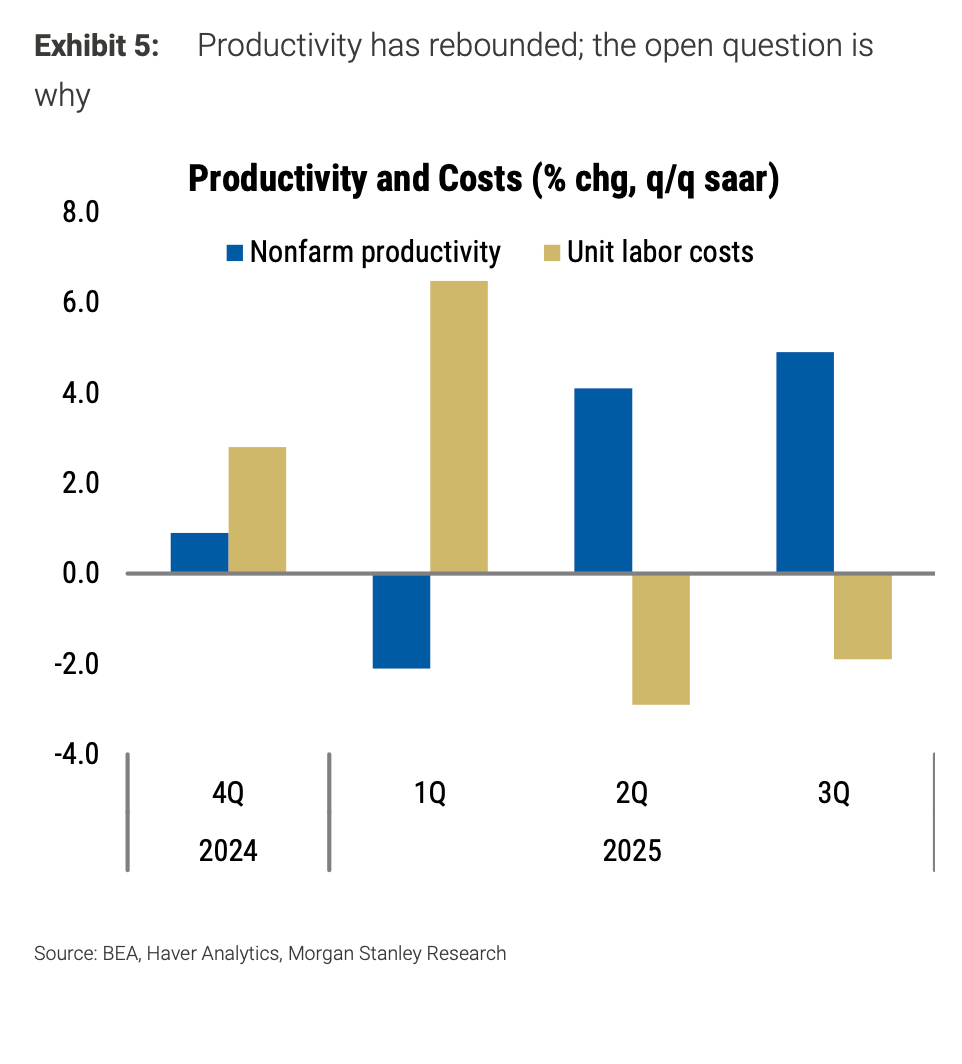
According to a research note released Friday by Morgan Stanley, third-quarter GDP data revealed a “surge” in nonfarm productivity growth to an annualized rate of 4.9%. This marks the second consecutive quarter of substantial gains, soaring well above the four-quarter average of just 1.9%.
While a spike in productivity—essentially the measure of how much output a worker creates per hour—is generally viewed as the “magic bullet” for economic growth without inflation, chief economist Michael Gapen insisted that the root cause of this specific acceleration remains elusive.
“We believe much of the rise is cyclical,” Morgan Stanley economists noted in the report, adding that “it remains an open question as to what is driving the productivity acceleration.”
The math of doing more with less
Others on Wall Street have flagged the productivity improvement as well. Bank of America Research’s Head of US Equity & Quantitative Strategy, Savita Subramanian, told Fortune in August 2025 that productivity was finally starting to point up, by some estimates, with companies largely learning to do more with less during the pandemic.
In fact, the labor market has been mired in at least a “low-hire-low-fire” mode for much of the last year, while Apricitas Economics even dubbed it “the no-hire economy.” For the last five months, Joseph Politano wrote on his Substack on Jan. 11, the economy added functionally zero jobs, with its 44,000 monthly average the lowest since 2020 and below any single year of the 2010s.
When companies maintain or increase their output while hiring fewer workers, the mathematical result is a jump in productivity. And the demand side of this equation is being propped up by wealthier households, providing the “output” necessary to keep productivity numbers high, even as lower-income demand wavers Gapen argued.
Consumer spending surprised to the upside in the third quarter, rising 3.5%, driven largely by spending on services, but he suggested a “K-shaped consumer” is in the driver’s seat. In the auto sector, for example, households earning over $150,000 now account for 43% of new car purchases, up from 30% five years ago. Conversely, households earning under $75,000 have seen their share of new car sales drop to 25% from 35% over the same period.
The advent of AI has been cited elsewhere as a potential factor in productivity gains. While Gapen didn’t address AI, his report’s emphasis on cyclical reasons suggests a different reason. Earlier this month, Oxford Economics found that firms “don’t appear to be replacing workers with AI on a significant scale,” but were instead making layoffs to correct for past overhiring, especially during the period called “the Great Resignation.”
The productivity boom has immediate consequences for monetary policy. Stronger economic momentum reduces the urgency for the Federal Reserve to cut interest rates to save the labor market.
Previously, Gapen’s team expected rate cuts as early as January and April 2026 due to feared labor market weakness. However, citing the combination of 4.4% unemployment and stronger growth data, Morgan Stanley has shifted its forecast to a delay in cuts until June and September, waiting for clear signs that tariff-related inflation pressures have passed.
“We think the Fed can live with slower employment growth so long as the unemployment rate is stable,” the economists wrote.
For this story, Fortune journalists used generative AI as a research tool. An editor verified the accuracy of the information before publishing.